24 April 2026
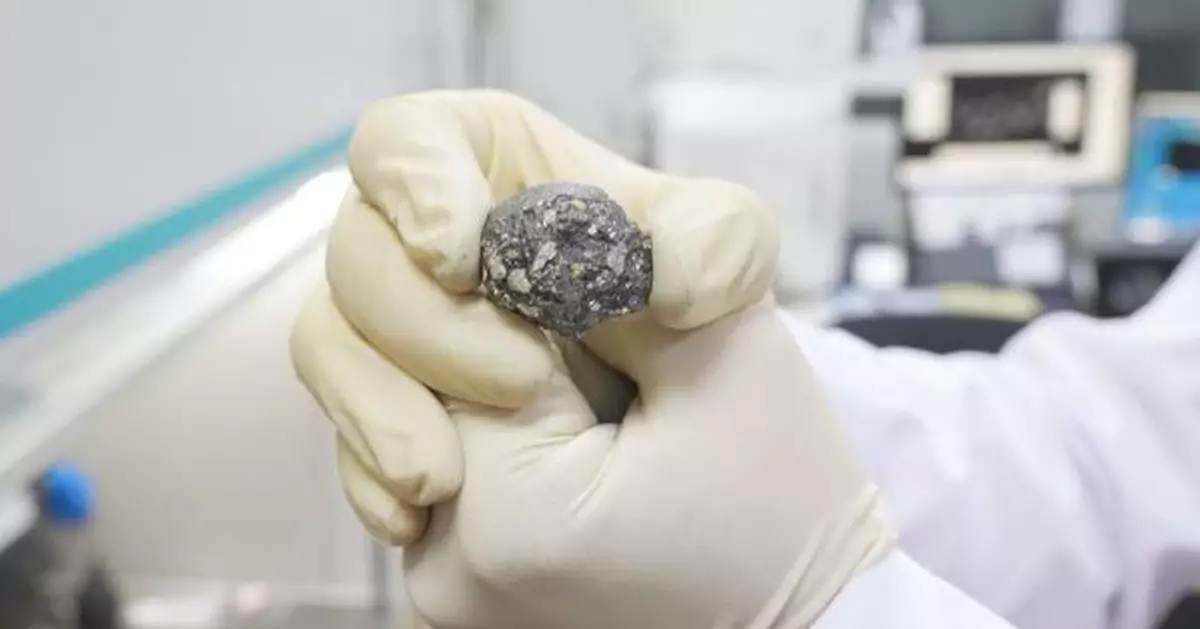
In a monumental announcement that has electrified the global scientific community, the China Geological Survey and the Chinese Academy of Geological Sciences confirmed on Friday, April 24, 2026, the discovery of a brand-new “alien” mineral found within a lunar meteorite. This substance, officially named Cerium-Magnesium Changesite (also referred to as Magnesiochangesite-(Ce)), represents the 11th new lunar mineral ever identified by humanity. The discovery was made during an intensive micro-analysis of a 44-gram spherical meteorite that fell in China, marking a historic milestone in the study of extraterrestrial materials delivered naturally to Earth from the Moon.
The meteorite itself, characterized by a dark molten fusion crust acquired during its high-velocity entry into Earth’s atmosphere, was recovered from the Taklamakan Desert. Upon slicing the specimen, researchers found tiny, transparent, and brittle crystals that exhibited properties never before documented in Earth-native minerals. These grains are exceptionally small, typically measuring between 3 and 25 micrometers—roughly one-twenty-fifth the diameter of a human hair. Despite their microscopic scale, the material’s unique chemical composition, particularly its ratio of rare earth elements, magnesium, and iron, offers a direct window into the Moon’s ancient volcanic history.
The most striking feature of the new mineral is its fluorescent effect. Under specific lighting conditions, the colorless crystals emit a distinct glow, a property that has immediate implications for the future of advanced materials science. Researchers believe this natural luminescence could provide the blueprint for a new generation of high-efficiency LEDs and energy-saving lighting technologies. By studying how the Moon’s extreme environment—characterized by intense pressure and temperature fluctuations—formed such a structure, synthetic chemists may be able to replicate these “alien” properties for industrial use on Earth.
“The discovery provides key mineralogical evidence for understanding the origin and evolution of the moon, and expands the boundaries of human knowledge of the material world,” stated Wang Yanjuan, a doctoral researcher at the Chinese Academy of Geological Sciences and the lead scientist who first identified the mineral. She emphasized that the mineral’s existence suggests geological conditions once existed on the Moon that are entirely foreign to our own planet’s history. “Its rare earth element ratio and the characteristic changes in its crystal structure can provide important references for synthetic materials,” she added, highlighting the bridge between deep-space exploration and terrestrial innovation.
The identification of Cerium-Magnesium Changesite also serves as a critical data point for the evolution of the lunar mantle. Scientists believe the mineral formed during a period of intense volcanic activity, where magma cooled under conditions vastly different from those found in Earth’s crust. This find reinforces China’s position as a leader in lunar science, tying the nation with the United States in the total number of new lunar minerals discovered. The China Manned Space Agency noted that while sample-return missions like Chang’e-6 provide pristine soil, meteorites like this one allow for the study of material from potentially deeper or more distant regions of the Moon that have not yet been visited by probes.
Furthering the scientific dialogue, Che Xiaochao, an associate researcher at the Institute of Geology, explained the broader implications of the find. “The discovery of a new mineral in extraterrestrial space indicates that conditions once existed beyond Earth that have never occurred on our planet. If the same mineral is later found on Earth, it would suggest our planet once experienced similar conditions, allowing us to use it to infer and compare broader geological and celestial activities,” Che noted. This comparative mineralogy is vital for reconstructing the early history of the Solar System and understanding how rocky planets like Earth and the Moon diverged in their chemical development.
Beyond its academic value, the discovery is expected to spark a renewed interest in lunar mining and resource utilization. The presence of rare earth elements within the crystal structure confirms that the Moon is a treasure trove of materials that are increasingly scarce on Earth but essential for modern electronics and green energy solutions. Qu Kai, a member of the Commission of New Minerals and Mineral Names, remarked, “Cerium-Magnesium Changesite is found to have a fluorescent effect, which has promising potential applications in producing LEDs. Its composition can provide important references for synthetic materials.”
As the global space race shifts from mere exploration to the sustainable use of space resources, the discovery of Cerium-Magnesium Changesite stands as a testament to the untapped potential of the lunar surface. The China Geological Survey has announced that it will make a portion of the data available to international researchers to foster collaborative study on the mineral’s unique properties. For now, this 44-gram messenger from the Moon has proven that even the smallest fragment of space debris can hold the key to the next great leap in human technology.