
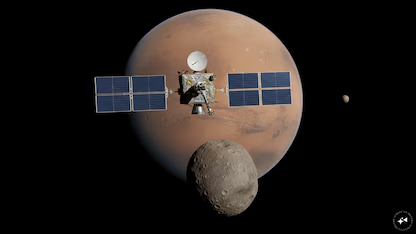
The Japan Aerospace Exploration Agency (JAXA) has embarked on an ambitious planetary exploration endeavor: the Martian Moons eXploration (MMX) mission. Targeting Mars’s largest and innermost satellite, Phobos, MMX aims to execute the first-ever round-trip sample return mission to the Martian system. Built in collaboration with international partners including NASA, France’s CNES, and Germany’s DLR, the mission addresses one of astronomy’s fundamental mysteries: how terrestrial planets formed and how key ingredients for life were distributed across the early Solar System.
The genesis of life on Earth depended heavily on the delivery of volatile compounds, such as water and organic materials. Scientists hypothesize that during the early violent era of the Solar System, comets and asteroids carrying these vital molecules bombarded inner rocky planets like Earth and Mars. However, the exact mechanisms governing how water and prebiotic molecules were transported across the snow line—the region in the early solar system cold enough for volatile compounds to condense into solid ice—remain unresolved. Mars, located closer to the snow line than Earth, acts as a crucial historical record. By examining the composition of Mars’s moons, scientists hope to trace the movement of these life-enabling elements and understand the primitive conditions under which planetary habitability arises.
At the center of the MMX mission is a long-standing scientific controversy regarding the origins of Phobos and Deimos. One theory posits that the moons are captured asteroids drawn into Mars’s gravity well from the outer solar system. If true, their composition will reflect primitive, carbon-rich materials unaltered by planetary processes, shedding light on the early volatile reservoirs of our solar neighborhood. Alternatively, the giant impact hypothesis suggests a massive body collided with young Mars, throwing a ring of debris into orbit that eventually coalesced into the two moons. Under this scenario, Phobos is composed of ancient Martian crustal material mixed with the impactor. Resolving this origin story will provide a window into the evolutionary dynamics of early terrestrial planets.
Crucially, Phobos acts as an ideal cosmic repository for Martian history. Over billions of years, powerful meteoroid impacts on Mars’s surface launched debris and atmospheric gases into space, much of which settled directly onto Phobos. As a result, the regolith of Phobos holds a pristine layer of Martian ejecta, including remnants from an ancient period when Mars harbored liquid surface water, a thicker atmosphere, and potentially favorable conditions for life. Collecting soil from Phobos allows scientists to analyze ancient Martian crustal and atmospheric fragments without requiring the immense fuel and gravitational requirements needed to launch a sample directly off the surface of Mars itself.
To gather these invaluable samples, MMX incorporates groundbreaking space engineering and robotic technologies. A key element of the mission is Idefix, a small rover codeveloped by CNES and DLR. Deployed prior to the main lander, Idefix will perform close-up reconnaissance, testing the mechanical properties of Phobos’s extremely weak gravitational environment and identifying safer touchdown zones for the mothership. The primary lander will then execute two separate touchdowns to collect at least 10 grams of surface material from different depths using advanced coring mechanisms. Operating and maneuvering in ultra-low gravity presents extreme technical challenges, making these landing and sampling techniques major milestones for autonomous interplanetary navigation.
Once the collection operations are completed, the spacecraft will ignite its propulsion systems to escape the Martian gravitational field, transferring the collected material into a sealed Sample Return Capsule. The capsule is scheduled to journey back to Earth and make a targeted landing in the Australian desert. Back in terrestrial laboratories, researchers will subject the samples to sophisticated micro-analysis, searching for organic molecules, isotopic markers, and hydrated minerals. By unlocking the secrets trapped within Phobos’s soil, JAXA’s MMX mission stands to reframe our understanding of how worlds become habitable and how the building blocks of life spread across the cosmos.