May 15, 2026
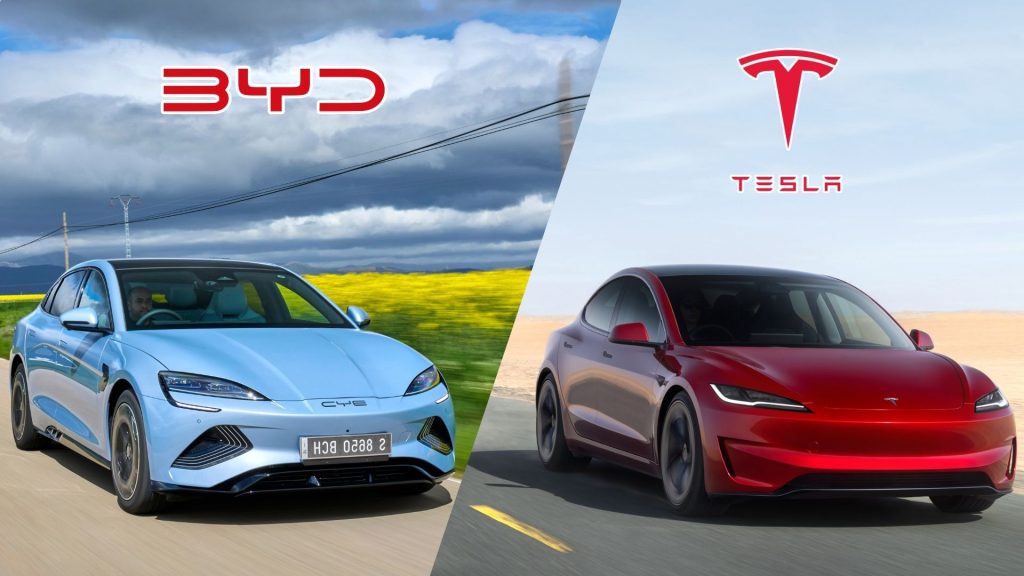
Recently, the global automotive landscape witnessed a definitive shift in the balance of power, as BYD, the Chinese automaking giant, officially cemented its victory over the faltering American titan, Tesla. While Tesla had briefly managed to reclaim the crown for global pure electric vehicle sales in the first quarter of 2026, the narrative that truly defined the industry was BYD’s overwhelming strategic dominance, characterized not merely by sales volume but by an aggressive global expansion and technological superiority that left Elon Musk’s empire scrambling for answers.
The story of BYD’s defeat of Tesla is a multifaceted saga of brutal price wars, seismic policy shifts in China, logistical mastery in exports, and a product blitz that rendered Tesla’s limited lineup dangerously obsolete. By mid-May 2026, the data was undeniable: BYD had successfully transformed from a local disruptor into the world’s most feared automotive powerhouse, having effectively ended Tesla’s reign as the undisputed king of the electric era.
To understand the magnitude of BYD’s triumph on this day, one must first acknowledge the battlefield: the Chinese domestic market, the largest and most competitive EV arena on the planet. As of April 2026, BYD did not just compete in China; it utterly dominated, capturing a staggering 21.4% market share of all new energy vehicles (NEVs) sold. In stark contrast, Tesla suffered a catastrophic collapse in its most critical manufacturing hub. According to the China Passenger Car Association (CPCA), Tesla’s retail sales in China plummeted to a mere 25,956 units in April, a dramatic freefall representing a 9% year-on-year decline and a gut-wrenching 53.74% drop compared to March.
This disastrous performance was so severe that Tesla was completely ejected from the top ten NEV sellers list in China for the month of April, a territory it once commanded with ease. While BYD moved 182,025 vehicles domestically, Tesla was outsold not only by legacy giants like Geely and Changan but also by newer, nimbler rivals such as Xiaomi and Leapmotor. Tesla’s desperation was palpable, leading to the launch of aggressive “Easy Loan” incentives in a frantic bid to clear inventory and prop up collapsing demand as CEO Elon Musk touched down in Beijing to navigate the crisis.
However, the most devastating blow to Tesla’s global narrative came not from BYD’s home dominance, but from its shock-and-awe campaign on the high seas. While Tesla struggles with a two-model lineup and production inefficiencies, BYD has unleashed a logistics juggernaut. In April 2026 alone, BYD exported a record-shattering 135,098 vehicles—every single one either a pure battery electric vehicle (BEV) or a plug-in hybrid.
To put this staggering figure into perspective, BYD exported more cars in a single month than Tesla likely sold globally during that same period. Estimates based on Tesla’s first-quarter deliveries of 358,023 units suggest a monthly average of roughly 119,000 vehicles; BYD’s export number alone eclipsed this, proving that the Chinese giant is playing a different game entirely—one of massive scale and aggressive internationalization that Tesla simply cannot match without a cheaper, mass-market vehicle. This export explosion has allowed BYD to effectively insulate itself from the cooling domestic demand in China, turning international waters into a moat against Tesla’s global ambitions.
This global surge has resulted in Tesla losing its “first-mover advantage” in key strategic markets across three continents, effectively being dethroned as the EV king in region after region. In a symbolic passing of the torch, BYD has claimed the top EV sales spot in the United Kingdom for the first four months of 2026, selling 12,754 BEVs and relegating Tesla to a distant second place.
The disruption is even more pronounced in emerging markets; in Brazil, a nation where Volkswagen once held a multi-decade monopoly, BYD shocked the industry by moving 14,911 vehicles in April, narrowly edging out the German giant to become the best-selling brand in the country—a feat achieved without a single Tesla in sight. Down under in Australia, BYD has completely reversed the sales charts. While Tesla held the top spot in 2024 and 2025, BYD has surged to number one in 2026, with models like the Sealion 7 decimating the once-ubiquitous Tesla Model Y (1,780 registrations versus just 822 for the Y in April).
The technological and valuation metrics further illuminate why BYD is winning the war. Investors and consumers are rapidly distinguishing between Tesla’s political volatility and BYD’s engineering-first approach. BYD’s ultra-fast charging system, capable of delivering 250 miles of range in just five minutes, has rendered Tesla’s Supercharger network (which takes 15 minutes for 200 miles) technologically obsolete. Furthermore, BYD’s diversified portfolio—which includes the booming plug-in hybrid electric vehicle (PHEV) segment that Tesla refuses to enter—provides a massive buffer.
In total NEV sales (including hybrids), BYD obliterated Tesla in 2025 with 4.27 million vehicles compared to Tesla’s 1.64 million, a gap that has only widened in 2026. While Tesla remains a “pure play” EV maker facing an aging Model 3 and Model Y lineup, BYD offers everything from the Seagull city car to luxury Yangwang supercars, capturing consumer demand at every price point.
Of course, the immediate first-quarter results of 2026 showed Tesla briefly retaking the “global BEV sales crown” with 358,023 deliveries versus BYD’s 310,389 pure EVs. However, this narrow statistical victory for Tesla was an illusion of accounting, a “dead cat bounce” fueled by the expiration of subsidy policies. Industry analysts at SNE Research noted that BYD’s 310,389 BEV sales actually represented a 27.8% decline for the group when including hybrids, but this was a direct and expected result of the Chinese government slashing EV subsidies and implementing a 5% sales tax on vehicles that were previously tax-free. This policy hangover temporarily kneecapped every automaker in China, causing a market-wide dip, but it did not alter the underlying trajectory of BYD’s global conquest. Meanwhile, Tesla’s “win” came with an asterisk: the company produced 408,386 vehicles but only sold 358,023, leaving it with a record glut of over 50,000 unsold cars piling up in inventory.
As the news broke on May 15, 2026, the verdict from Shanghai to Sao Paulo was unanimous: BYD has not only defeated Tesla but has redefined the parameters of victory. Tesla’s reliance on a shrinking subsidy market in the US and its failure to adapt to the price wars of China have left it exposed. BYD’s victory is structural, not seasonal. By leveraging vertical integration, aggressive pricing, hybrid technology, and an export logistics network that defies Western trade barriers, BYD has proven that Tesla is no longer the future of the automobile; it is a legacy player fighting a rear-guard action against a faster, cheaper, and more innovative rival. The crown that Tesla briefly reclaimed in Q1 2026 has already tarnished, and as the second quarter unfolds, BYD’s momentum suggests that the American firm may never lead the EV race again.