May 15, 2026
For nearly fourteen years, NASA’s Curiosity rover has traversed the rust-colored plains of Mars, overcoming extreme radiation, freezing temperatures, and the abrasive grit of the Gale Crater. However, in late April 2026, the veteran explorer met a challenge unlike any in its storied history: a 28.6-pound (13-kilogram) rock that refused to let go. The standoff between the car-sized robot and a slab of Martian stone dubbed “Atacama” lasted for six days, bringing scientific operations to a halt as engineers 140 million miles away worked to liberate the rover’s primary sampling tool.
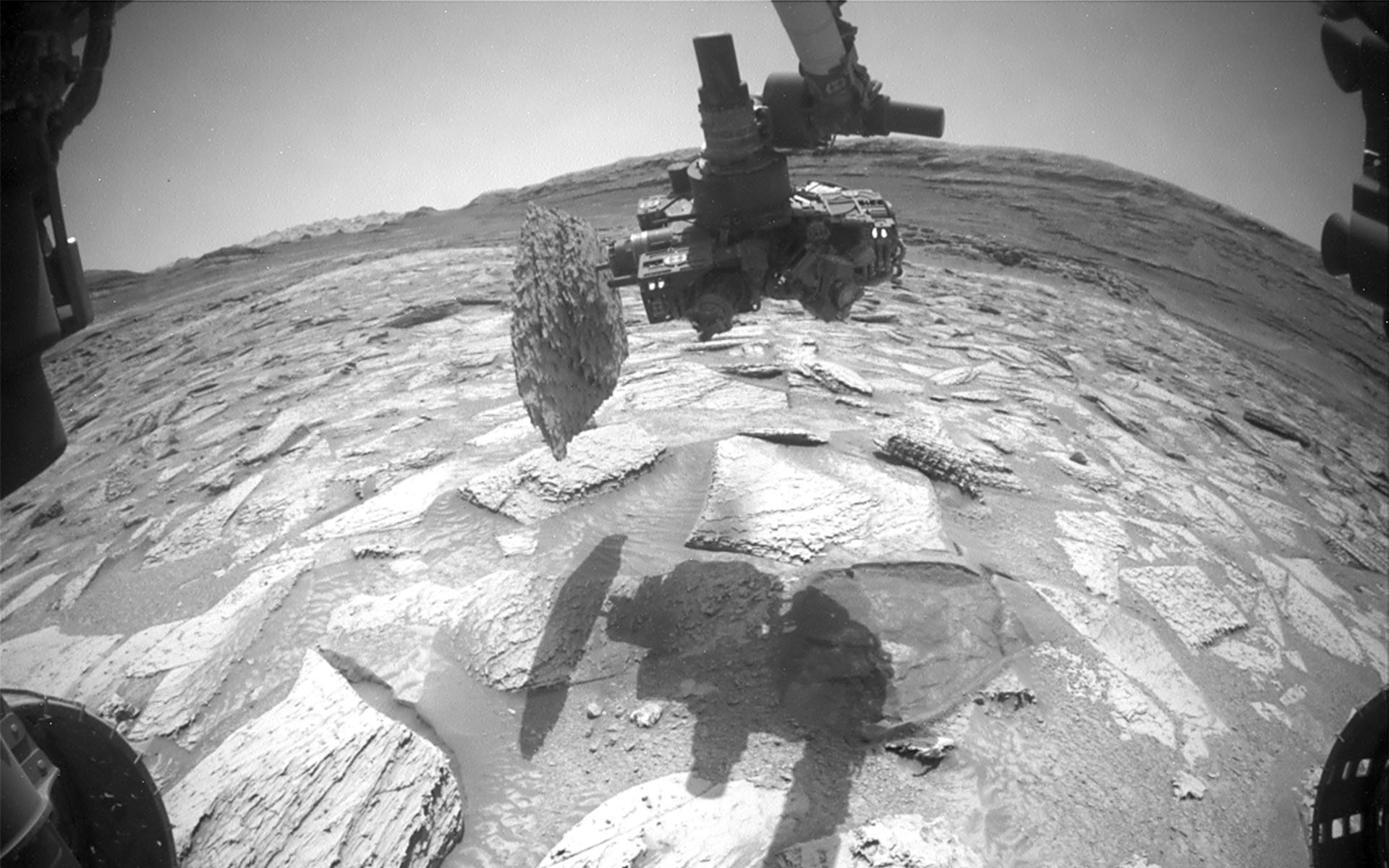
The ordeal began on April 25, 2026, during what should have been a routine sampling mission. Curiosity deployed its rotary-percussive drill into a flat, 1.5-foot-wide rock to collect powderized material for chemical analysis. While the rover has fractured stones or peeled away layers in the past, this event was unprecedented. As the robotic arm retracted, the entire Atacama rock lifted out of the ground, firmly wedged against the fixed sleeve that surrounds the rotating drill bit. For the first time in over 13 years of Martian exploration, the rover had accidentally “kidnapped” a piece of the planet.
The situation was immediately identified as a potential mission-threatening risk. The Alpha Particle X-ray Spectrometer (APXS), a critical instrument used to identify chemical elements in rocks and soil, is mounted on the same robotic arm. “We saw that something is not working or not normal. Then you look at the pictures and it’s like, ‘Woah!’” said Ralf Gellert of the University of Guelph, who helps operate the APXS. The weight of the rock and its awkward positioning threatened to strain the arm’s motors or damage the sensitive sensors nearby if not handled with extreme precision.
Navigating a mechanical crisis on Mars is a lesson in patience. Due to the vast distance between Earth and the Red Planet, radio signals take several minutes to travel one way. This communication delay meant that every command sent by the Jet Propulsion Laboratory (JPL) team required hours of waiting to confirm success or failure. Orbax, a science communicator at the University of Guelph, noted the tension of the situation: “We’re talking about distances so far away that you can have seven to 10-minute-long lapses in communication. So, an entire strategy had to be come up with.”
The rescue operation unfolded in several phases:
-
April 26–28: The mission team initially attempted to vibrate the drill in its current position, hoping gravity and percussion would dislodge the stone. The rock remained unmoved.
-
April 29: Engineers sent instructions to reposition the robotic arm to a different angle before activating the drill’s vibration again. While navigation cameras captured images of sand pouring out from the edges of the Atacama rock, the main mass stayed stubbornly attached to the drill sleeve.
-
May 1: With the rover entering its sixth day of being “held hostage,” the team decided to “throw everything at the wall.” They choreographed a complex sequence of tilting the drill further, rotating the arm, and spinning the drill bit simultaneously while applying maximum vibration.
To the relief of everyone at JPL and the University of Guelph, the high-intensity maneuver worked. The Atacama rock finally detached during the first round of the new commands, crashing onto the Martian surface and fracturing upon impact. Images downlinked shortly after showed the drill bit finally clear and the shattered remains of the rock resting below the arm.
Reflecting on the challenge, William Farrand, a geoscientist at the Space Science Institute, observed the poetic nature of the obstacle in a NASA blog post: “Like its namesake, the Atacama drill target on Mars presented a challenge to the Curiosity rover and to the rover team.” The Atacama Desert in Chile is one of the harshest environments on Earth, and its Martian counterpart proved just as unforgiving.
Despite the six-day delay, the rover’s resilience has once again been proven. “I think people are nervous when you have an issue like this. Is this the end of the Curiosity rover?” Orbax remarked. “Well, in this case, it wasn’t. We were able to push through and continue to gather data from it for hopefully years to come.” With the drill freed and the APXS instrument confirmed to be undamaged, Curiosity has resumed its climb up Mount Sharp, continuing its mission to seek signs of ancient habitability and organic molecules.
This “stuck rock” saga serves as a reminder that even after a decade of success, Mars still has the power to surprise. As the rover continues its journey, the team remains vigilant, knowing that on the Red Planet, even a single stone can change the course of a mission. As the rover’s team famously quipped on social media years prior: “When you run into a challenge, sometimes it’s best to step back and shake it off.”