
14 May 2026
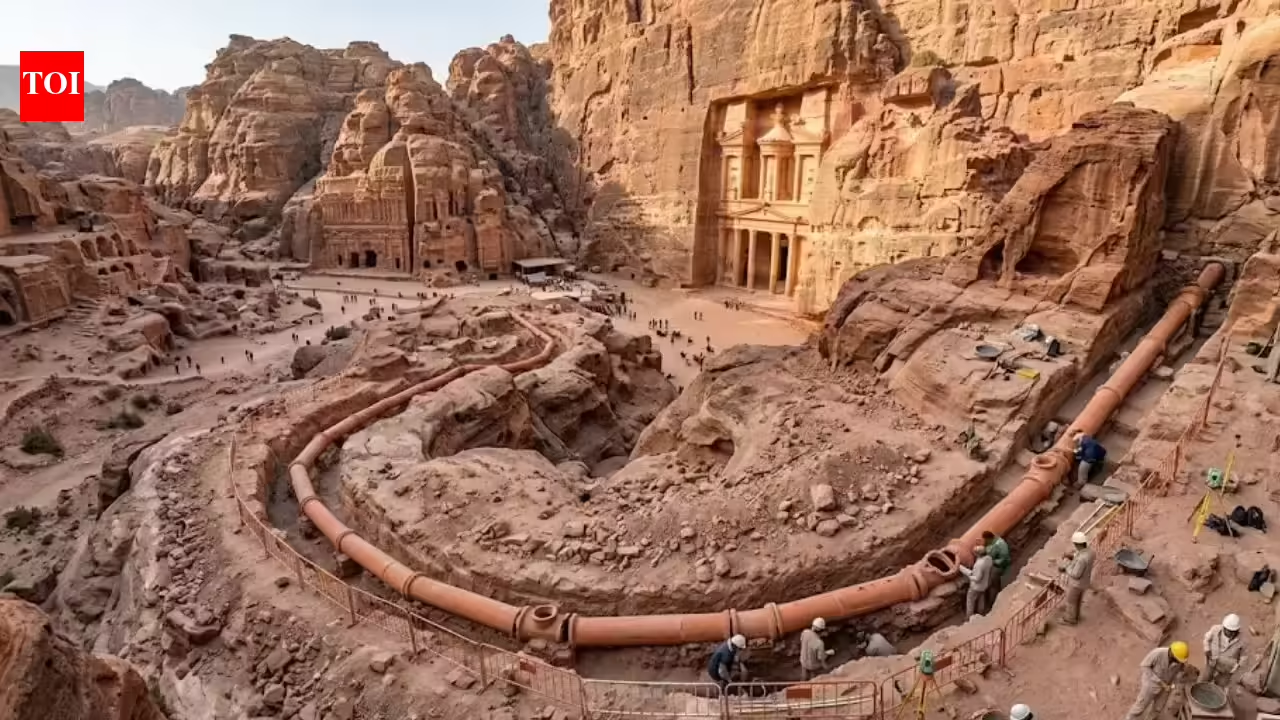
In a revelation that rewrites the hydrological history of the ancient Nabataean civilization, a team of international archaeologists and hydraulic engineers has uncovered a hidden 116-meter-long pressurized water pipeline carved deep into the sandstone cliffs of Petra. The discovery, made public today following a six-month excavation, demonstrates that the Nabataeans—famed for their rock-cut architecture—possessed high-pressure hydraulic mastery previously thought impossible for pre-Roman societies.
The pipe, buried under rubble and deliberately concealed behind a false wall in the northern sector of the ancient city, was found to be constructed from tightly interlocking limestone segments sealed with a waterproof lime-plaster mortar reinforced with fine sand and ceramic dust. Unlike open channels or gravity-fed aqueducts common to the region, this system was designed to sustain pressures exceeding 4.5 atmospheres, allowing water to be forced upward against gravity to elevated residential areas and ceremonial platforms.
According to the preliminary report released by the Jordanian Department of Antiquities, the pipeline was part of a complex surge-relief system linked to an underground cistern that collected flash floods from the surrounding canyons. Dr. Elena Marchetti, lead archaeologist from the University of Bologna, stated in a press briefing: “We have completely misunderstood the Nabataeans. They were not just master water harvesters—they were engineers who understood Bernoulli’s principle of fluid dynamics centuries before it was formally described. This pipe includes abrupt reductions in diameter and air-release vents that prevent cavitation under pressure. It is the earliest known example of a true force main in human history.”
The team discovered that sections of the pipeline featured manual shut-off valves made of basalt, operated by bronze levers, allowing maintenance crews to isolate damaged segments without draining the entire system. Residue analysis inside the pipe revealed traces of deliberately added alum and tannins, indicating the Nabataeans used chemical treatments to suppress biological growth and mineral scaling—a practice not documented again until the Roman Empire’s zenith.
The 116-meter pipeline runs from the so-called “Monastery” cistern complex down to a previously unexcavated reservoir near the city center, but with a twist: at its midpoint, the pipe rises almost 12 meters vertically, forcing water upward using only the weight of descending water from a higher feeder cistern. Dr. Aisha Al-Farouqi, a hydraulic engineer at the German-Jordanian University, explained: “When we ran computer simulations, we were astonished. The gradient and pipe diameter create a perfect siphon effect combined with trapped air cushions that act as natural pressure regulators. If we tried to patent this design today, it would still be considered innovative for off-grid mountain water supply. The Nabataeans had no cast iron, no rubber seals, no digital modeling—yet they achieved leak rates lower than some modern municipal systems.”
Excavators found that the joints were tapered and coated with a natural asphalt compound sourced from the Dead Sea region, which remained partially elastic even after two millennia. In three places along the pipeline, stone access shafts allowed workers to descend and replace worn sealing rings, a maintenance network that reveals long-term urban planning and a specialized hydraulic guild.
The discovery came as a complete accident. Initial ground-penetrating radar surveys in late 2025 were meant to map secondary tombs, but anomalous density signatures led the team to break through a collapsed section of wall. Inside the narrow, man-sized tunnel, researchers found graffiti in Nabataean Aramaic that roughly translates as “Do not break this vein—the city drinks from it.” Below this warning, chiseled symbols depict a wave-like motif with numbers that Dr. Marchetti’s team interprets as water flow rates and maintenance dates.
This is the first direct evidence that the Nabataeans actively monitored and quantified hydraulic performance using a standardized notation. “We have water cults, we have inscriptions about cisterns, but never a technical manual or a labeled pressure diagram,” noted epigrapher Dr. Samer Qasim from the University of Jordan. “This graffiti changes that. It shows literacy in engineering, not just ritual. They knew exactly what they were doing.”
The implications for Petra’s known water system are seismic. Earlier theories suggested the city’s famous “Soldier’s Tomb” and “Silk Tomb” received rain runoff via simple channels. The new evidence proves that pressurized water could reach heights of over 40 meters above the valley floor, making possible fountains, gravity-defying waterfalls, and even small-scale hydropower for milling grain. Dr. Marchetti added: “We must now re-examine every monumental tomb. Many have mysterious U-shaped grooves cut into door jambs—those were not decorative. They likely held bronze pipes for ritual water displays, powered by pipelines exactly like this one. The Nabataean elite were not just building tombs; they were building kinetic water theaters.” The team has already identified three potential matching pressure pipes using drone LIDAR, suggesting the 116-meter pipeline may be just one component of a hidden pressurized network stretching over two kilometers beneath Petra’s main streets.
Jordanian authorities have declared the site a protected “Hydraulic Heritage Zone” and suspended further excavation to design a conservation plan. However, a small museum-quality section of the pipe, complete with an intact shut-off valve, will be opened to the public by October 2026. For now, the discovery forces a radical reassessment of ancient engineering. As Dr. Al-Farouqi concluded: “Every textbook on Roman aqueducts or Persian qanats will need a new chapter. The Nabataeans were not followers—they were pioneers of high-pressure hydraulics. And they hid their best work. Why? That is the next mystery.” The answer may lie still deeper under the Rose-Red City, where the whisper of pressurized water, silent for 1,600 years, has finally been heard again.