
February 27, 2026
In a remarkable display of its rapidly expanding space capabilities, China has executed a series of successful satellite launches throughout February 2026, significantly bolstering its broadband internet constellations, deploying world-first artificial intelligence (AI) technology for Earth observation, and strengthening its global meteorological monitoring network. This flurry of activity underscores the nation’s ambitious goals to become a dominant force in space technology and its commitment to building a comprehensive space-based infrastructure for both commercial and scientific applications.
The launch campaign was highlighted by several groundbreaking missions. On February 12, 2026, a Jielong-3 (Smart Dragon-3) carrier rocket lifted off from waters off the coast of Yangjiang in South China’s Guangdong Province. This sea-based mission successfully deployed a cluster of seven satellites into low Earth orbit. Among these was the “CUHK-1” satellite, developed by the Chinese University of Hong Kong (CUHK), which has been hailed as the world’s first satellite to deploy a large-scale AI model, specifically a version of the DeepSeek large language model, directly in orbit . This technological leap allows the satellite to process and analyze high-resolution multispectral data in near-real-time, a significant advancement from traditional Earth observation methods that rely on sending vast amounts of raw data back to Earth for processing. “The successful launch of this satellite is not only another breakthrough for CUHK in aerospace technology but also marks a new milestone in intelligent remote sensing and spatial information applications,” stated Dennis Lo Yuk-ming, Vice-Chancellor and President of CUHK . “The technology overcomes the traditional Earth-observation process… providing a new technical paradigm for intelligent remote-sensing applications and improving response efficiency,” added Ma Peifeng, chief designer of the satellite project, explaining how the team optimized the AI model to identify targets and extract features directly in space .
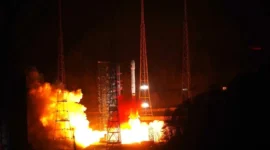
Complementing this AI-driven innovation, China continues to aggressively build out its national broadband infrastructure. On February 23, 2026, at 19:49 Beijing Time, a Long March-3B rocket launched from the Xichang Satellite Launch Center, successfully placing the Zhongxing-26 satellite into its preset orbit . This high-throughput communications satellite is designed to provide high-speed broadband access for fixed terminals as well as those on vehicles, vessels, and aircraft, further bridging the digital divide and enhancing connectivity across the nation’s vast territory. This mission was the 463rd flight of the Long March rocket series, a testament to the program’s maturity and reliability . Earlier in the month, the Hainan commercial spacecraft launch site in Wenchang also saw intense activity. A Long March-12 carrier rocket launched the 19th group of low-orbit internet satellites, marking the 12th mission since the commercial site became operational and signaling its entry into a phase of high-density, routine operations . This site is becoming a hub of activity, having attracted over 700 space-related enterprises, drawn by both the launch capacity and supportive trade policies. “What attracted us here is not only the launch capability, but the entire industrial ecosystem,” noted a senior executive from a satellite company based in the Wenchang International Aerospace City. “Finding partners and testing solutions here is extremely efficient” . The economic impact is also being felt locally, with a local homestay operator observing, “We used to live by the weather, now we live by the rockets,” highlighting the region’s transformation from a traditional fishing community into a modern “Space Town” .
In the realm of Earth observation and remote sensing, China added another versatile asset. On a date prior to February 18, 2026, the Yaogan-46 remote sensing satellite was launched from the Wenchang Spacecraft Launch Site aboard a modified Long March-7 rocket . According to official statements, this satellite will serve a wide array of civilian applications, including disaster prevention and relief, land resource surveys, hydrological studies, and meteorological observations. Its launch adds a critical tool for monitoring environmental changes and managing natural resources from space. This mission was noted as the 605th flight of the Long March rocket series, reflecting the high pace of Chinese space launches .
Finally, China is also reinforcing its commitment to international scientific cooperation through its meteorological satellite program. While the Fengyun-3H satellite was launched in late 2025, its first images were released in October of that year, and by February 2026, it was fully operational, providing crucial data from its polar orbit . This satellite, like its predecessor the Fengyun-3E which launched into a coveted “early morning” polar orbit in 2021, plays a vital role in the global network of weather satellites. The Fengyun-3E’s unique orbit provides critical data that fills a gap in the international constellation, feeding into global numerical weather prediction models to improve medium and long-range forecasts worldwide . The value of this contribution has been acknowledged by global meteorological leaders. Phil Evans, director general of Eumetsat, previously noted that the satellite’s presence fills an “important orbital gap,” while Petteri Taalas, then secretary general of the World Meteorological Organization, stated, “Now, with the advent of FY-3E, CMA (China Meteorological Administration) will become the third pillar in the global meteorological polar orbiting constellation” . Florence Rabier, director general of the European Center for Medium-Range Weather Forecasts, added, “We therefore anticipate a significant contribution from observations collected by FY-3E to global weather forecast skill”.