May 27, 2026
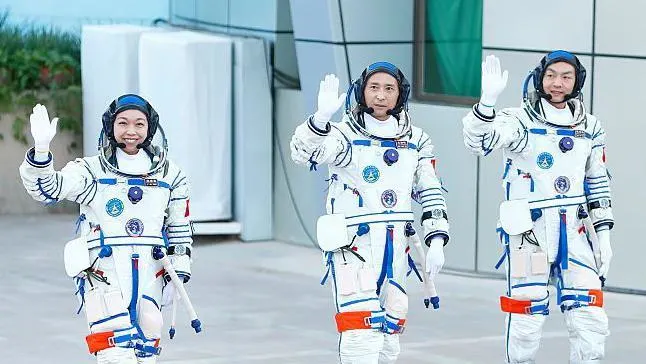
China officially unveiled the three-person crew of the Shenzhou-23 mission, confirming details of a historic flight that has already placed the nation’s newest astronauts into orbit. The crew, which launched successfully on the evening of May 24 from the Jiuquan Satellite Launch Center atop a Long March-2F rocket, represents a significant evolution in China’s manned space strategy. Leading the team is Commander Zhu Yangzhu, a 39-year-old space engineer and veteran of the Shenzhou-16 mission.
He is joined by Zhang Zhiyuan, also 39, a former air force pilot making his first spaceflight. However, the figure capturing global attention is Li Jiaying (Lai Ka-ying in Cantonese), a 43-year-old former Hong Kong police officer who has made history as Hong Kong’s first astronaut and China’s fourth female astronaut to reach space. Following a rapid automated flight of approximately 3.5 hours, the Shenzhou-23 spacecraft successfully docked with the Tiangong space station’s radial port in the early hours of May 25, where the crew was received by the incumbent Shenzhou-21 astronauts for a scheduled in-orbit handover.
The mission is defined by two groundbreaking achievements: the inclusion of a payload specialist from a special administrative region and an unprecedented endurance challenge. While Li Jiaying’s journey is a source of immense pride, the primary scientific objective of Shenzhou-23 is to have one crew member remain aboard Tiangong for a full year—nearly double the standard six-month rotation. This experiment is critical for China’s lunar ambitions, specifically the goal of landing astronauts on the Moon by 2030, as well as future missions to Mars.
Speaking about the historic inclusion of the Hong Kong astronaut, the region’s Chief Executive, John Lee, expressed profound national pride, noting that the city has transitioned from a supporter to an executor of national aerospace endeavors. Li Jiaying herself, reflecting on her unique path from law enforcement to space exploration, stated, “This is a rare chance. Why not try?” adding, “How high our Chinese spacecraft flies, that’s how high we can hold our heads high” .
The technical and medical challenges of a year-long stay are immense, requiring significant upgrades to both spacecraft hardware and human endurance protocols. In a direct response to a previous incident where the Shenzhou-20 capsule’s viewport was struck by space debris, Chinese engineers have upgraded the Shenzhou-23’s portholes with enhanced protection, adding layers of防烧蚀 (heat ablation resistant) material to ensure astronaut safety over the longer duration. Experts at the Astronaut Center of China have overhauled the crew’s training regimen to prepare for the psychological and physical toll of extended microgravity. B
ian Qiang, an expert at the center, explained the rigorous preparations: “To meet these challenges, we have reinforced the astronauts’ physical fitness and reserves of various physiological functions, while intensifying training in psychological resilience and crew compatibility” . The astronaut selected for the one-year mission will be determined based on how the crew adapts during the initial stages of the flight, as the mission aims to implement China’s first space-based human-body research program to study bone density loss, muscle atrophy, and radiation exposure.
Beyond human endurance, Shenzhou-23 is a mobile laboratory carrying more than 100 new scientific projects, many focused on preparing for long-term deep-space habitation. Researchers are particularly excited about the continuation of the nation’s space agriculture program. For the first time, scientists will attempt to grow two consecutive generations of rice in orbit, moving from “seed-to-seed” to “seed-to-seed-to-seed” to study how long-term microgravity affects genetic stability and causes “space syndrome” in crops. Cang Huaixing, a researcher at the Technology and Engineering Center for Space Utilization under the Chinese Academy of Sciences, detailed the scope of the experiments: “For the first time, two consecutive generations of rice will be grown in orbit, aiming to clarify how long-term space microgravity affects the genetic stability of rice. These samples will be used to study life-origin catalysts, microbial adaptive evolution, and higher plant genetic variations, systematically revealing the deep-layer effects of space radiation” .
Additional cutting-edge research includes studies on zebrafish and mouse embryos to establish a space embryonic research system, as well as dynamic experiments on perovskite solar cells to test their viability for future lunar bases and low-orbit satellites. As the crew settles into their orbital routine, the success of this mission is viewed not just as a national achievement, but as a necessary stepping stone for the survival and technological self-sufficiency of humanity beyond Earth.