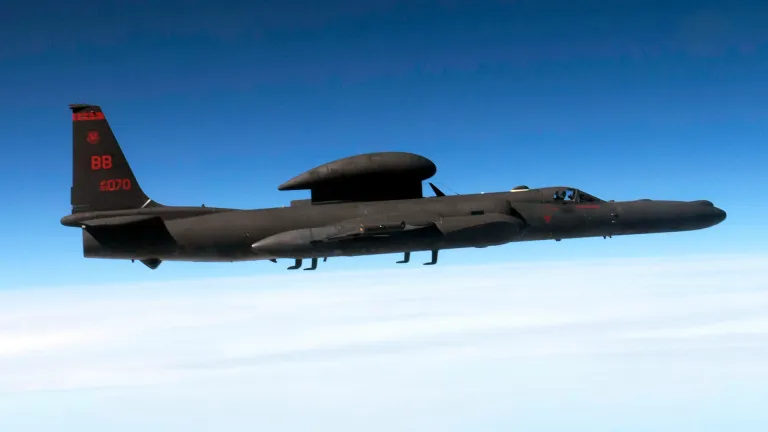
The legend of the Lockheed U-2 ‘Dragon Lady’ is not merely the story of an aircraft, but a sprawling, six-decade-long chronicle of Cold War brinkmanship, technological audacity, and the quiet, tireless vigilance that defines modern aerial reconnaissance. Conceived in the deepest shadows of the 1950s, this single-engine jet was never intended to be a fighter or a bomber. Its sole mission was to fly higher than anyone else, to the very edge of space, and to simply watch .
Designed by the legendary Clarence “Kelly” Johnson and his secretive Skunk Works team, the U-2 was a radical departure from conventional military aviation. Johnson envisioned a lightweight glider-like airframe that could carry a heavy payload of cameras and sensors to an unprecedented 70,000 feet—beyond the reach of Soviet fighters, flak, and the first generation of surface-to-air missiles . Remarkably, the aircraft was initially projected to have an operational life of just two years . Yet, decades later, it remains an indispensable asset, outlasting its planned replacement, the supersonic SR-71 Blackbird, by proving that in the world of intelligence, persistence and reliability often trump sheer speed.
The urgency behind the U-2’s creation was born from paranoia. In the mid-1950s, the United States was terrified of a “bomber gap” with the Soviet Union. After the Soviets detonated a hydrogen bomb and unveiled the M-4 bomber, American intelligence was flying blind . President Dwight D. Eisenhower desperately needed to know the true nature of the Soviet threat, and conventional aircraft were unable to penetrate the Iron Curtain without being intercepted.
Johnson’s gamble paid off spectacularly; the first U-2 test flight took place on 1 August 1955 at the mysterious Area 51, just nine months after the contract was signed . By July 4, 1956, a U-2 was flying deep over Soviet territory. The intelligence it brought back was transformative, revealing that there was no bomber gap—the Soviet nuclear program was far less advanced than feared, which prevented a potential overreaction and massive defense spending by the U.S. .
This aura of invincibility, however, was shattered in a single, dramatic moment. On May 1, 1960, a U-2 piloted by Francis Gary Powers was struck by a Soviet SA-2 “Guideline” surface-to-air missile over Sverdlovsk . The pilot, unable to activate the aircraft’s self-destruct charge, was captured alive.
The incident caused a massive diplomatic crisis for the Eisenhower administration, who initially claimed it was a weather research plane, only to be exposed when the Soviets produced Powers and the largely intact wreckage . The legend of the U-2 was rewritten; it was not invincible, but it was resilient. Just two years later, during the Cuban Missile Crisis, the U-2 once again took center stage. On October 14, 1962, a U-2 flown by Major Richard Heyser captured photographic proof of Soviet nuclear missile sites under construction in Cuba . Days later, another U-2, piloted by Major Rudolf Anderson Jr., was shot down over the island, killing him instantly and bringing the world closer to nuclear war than ever before . Anderson remains the only person killed by enemy fire during the crisis.
U-2 pilots inhabit a rare fraternity. The selection process is notoriously grueling, requiring a two-week interview process that filters for a very specific psychological and physical profile . The nickname “Dragon Lady” —officially adopted from a contemporary comic strip character—captures the aircraft’s dual personality perfectly.
As one retired pilot, Lt. Col. Thomas “TA” Anderson (Pilot #743), explained, the name reflects the unpredictability of the flight experience: “Some days when you go fly, you’re fighting the dragon and other times you’re dancing with the lady. You just don’t know what you’re going to get” . Flying at the edge of space, where the air is thin and the margin for error is zero, requires wearing a full-pressure spacesuit. The aircraft is notoriously difficult to land, requiring a chase car to radio the pilot down to the runway because the long, glider-like wings and the pilot’s limited downward visibility make depth perception almost impossible .
Contrary to popular belief, the U-2 flying today is not a museum piece. While the design is from 1955, the current airframes were built in the 1980s as U-2R/S models and have been continuously upgraded with modern avionics, glass cockpits, and state-of-the-art sensors . The U-2S, the current variant, remains a frontline intelligence asset for the U.S. Air Force.
While satellites provide persistent coverage, they follow predictable orbits. The Dragon Lady can be tasked immediately, loitering over a hotspot for hours, flying high above weather and commercial traffic to intercept communications or capture high-resolution imagery . Over the past two decades, the U-2 has proven its worth in the wars in Afghanistan and Iraq, tracking insurgents, hunting IEDs, and providing crucial battlefield awareness to ground troops .
Recently, as the U.S. military pivots to face near-peer adversaries like China and Russia, the Dragon Lady has proven she still has teeth. In a striking demonstration of longevity and capability, in August 2025, the U-2 set a new altitude and endurance record on the 70th anniversary of its first flight . This event, confirmed by Air Force officials, showcased that the septuagenarian spy plane can still push the boundaries of flight. It has been used in recent years for diverse missions ranging from monitoring cartel activity along the Mexican border to tracking Chinese surveillance balloons .
Yet, the sun is finally setting on the legend. The Air Force has planned to retire the U-2 fleet by 2026, replacing its high-altitude role with a combination of the RQ-4 Global Hawk drone and next-generation space-based systems . The U-2 was, in the words of former CIA Director George Tenet, “one of the greatest intelligence achievements of any intelligence service of any nation” . Having served longer than the B-52 in terms of active program life, the Dragon Lady’s legacy is secure. She is the rare weapon that helped prevent a war rather than start one, providing the clear-eyed data necessary for leaders to make rational decisions during the most dangerous decades of the 20th century. The Dragon Lady is finally going home to roost, but the shadow she casts over the history of aviation and espionage will remain for generations.