India’s military doctrine is undergoing a monumental paradigm shift, expanding its strategic horizon beyond traditional land, sea, and air frontiers into the high altitude of outer space. Historically anchored in civilian applications under the Indian Space Research Organisation (ISRO), India’s space enterprise is now decisively merging with military strategy. The imperative driving this transformation is simple yet profound: tracking threats deep within enemy territory long before they approach the Indian border, thereby expanding reaction time and drastically shortening the tactical battlefield decision loop.
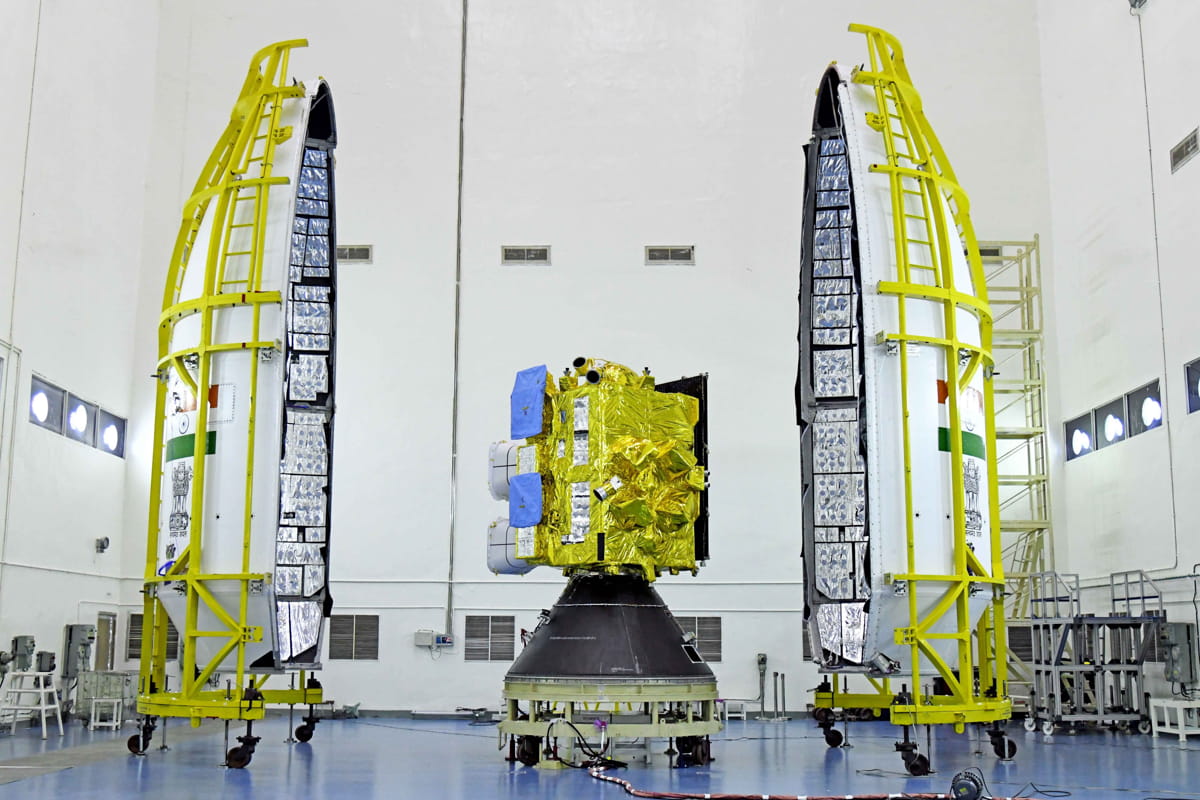
At the center of this futuristic defense shield is the Space-Based Surveillance Phase-III (SBS-III) programme. Approved by the Prime Minister-chaired Cabinet Committee on Security (CCS) at an estimated cost of ₹26,968 crore, SBS-III marks the largest and most ambitious space surveillance initiative in India’s history. Under this scheme, the armed forces are laying the groundwork to deploy a robust, proliferated constellation of 52 military-grade satellites across Low Earth Orbit (LEO) and Geostationary Earth Orbit (GEO). Scheduled for full deployment between 2025 and 2029, this network aims to provide an unbroken, real-time eye in the sky over the high-altitude Himalayan borders, the vast Indian Ocean, and deep into adversary nations.
The urgency behind building this space architecture stems directly from recent operational lessons, including insights gathered during Operation Sindoor, which exposed key blind spots in continuous border surveillance. During peak operational periods, Indian defense planners had to rely on a piecemeal combination of legacy domestic assets and foreign commercial satellite data to track troop movements and military build-ups. The takeaway for the military leadership was clear: India must master the Observe, Orient, Decide, and Act (OODA) loop. By shifting surveillance hundreds of kilometers beyond border posts into adversary staging grounds, defense forces gain crucial hours—and even days—of warning time to mobilize counter-deployments.
Beyond scale, SBS-III signifies a structural evolution in how India builds and manages strategic technology. Breaking away from the era where ISRO acted as the sole builder and operator of defense satellites, the new framework establishes a distributed public-private ecosystem. Out of the 52 planned satellites, ISRO will construct 21 platforms, while 31 satellites will be built and launched by private domestic defense and space startups. This decentralized model not only accelerates manufacturing timelines but also builds operational resilience, ensuring that India’s domestic commercial industry is deeply integrated into national security infrastructure.
Technologically, the new space fleet represents a generational leap in sensor capabilities. The satellites will be equipped with hybrid payloads combining Synthetic Aperture Radar (SAR) with ultra-high-resolution optical sensors. SAR technology allows the satellites to penetrate thick cloud cover, dense fog, and heavy Himalayan snowfall, delivering uninterrupted, round-the-clock imagery regardless of daylight or adverse weather conditions. Furthermore, these platforms will feature onboard Artificial Intelligence (AI) capable of autonomous data analysis. Instead of transmitting raw, bulky imagery back to ground stations for manual analysis, onboard AI processors will detect anomalous activity—such as missile transport, aircraft movements, or naval ship deployments—and immediately relay verified threat alerts to the Defence Space Agency (DSA).
The strategic scope of the constellation extends far beyond terrestrial land borders into the vast maritime domain. Parliamentary and defense panels have explicitly linked the SBS-III framework to India’s broader Indian Ocean Region (IOR) strategy. With the expanding footprint of the China-Pakistan naval nexus and the rapid induction of foreign-built warships and submarines by adversary navies, maintaining continuous Maritime Domain Awareness (MDA) has become paramount. The satellite network will maintain real-time tracking over critical sea lanes of communication (SLOCs), exclusive economic zones (EEZs), and strategic choke points across the Indo-Pacific, preventing surprise naval deployments.
Modern space warfare dictates that surveillance assets themselves must be hardened against enemy disruption. Adopting global best practices demonstrated by major space powers, India is moving away from relying on a few large, expensive satellites toward a distributed, proliferated Low Earth Orbit constellation. By spreading capabilities across dozens of smaller, interconnected platforms, the network remains resilient against kinetic Anti-Satellite (ASAT) missiles or ground-based directed energy weapons. If an adversary disables one satellite, the remaining nodes instantly reroute data flows to maintain operational continuity.
To ensure these assets remain operational over extended timelines, the Indian military is also planning On-Orbit Maintenance and Refuelling (OOMR) missions. By deploying robotic servicing spacecraft capable of extending satellite lifespans and replenishing onboard thrusters, India aims to maximize the operational durability of its orbital defense grid. Simultaneously, India is augmenting its orbit defense with counter-space capabilities, including electronic warfare jammer suites, cyber defense protocols, and kinetic deterrents to protect domestic assets from orbital interception.
Crucially, the space-based constellation does not operate in isolation. It forms the top layer of a multi-domain defense grid, seamlessly interfacing with ground and airborne surveillance platforms. Target tracking data harvested from orbit will be fed directly into ground-based Passive Coherent Location (PCL) radar networks, Arudhra 4D multi-function radars, and airborne platforms such as Intelligence, Surveillance, Target Acquisition, and Reconnaissance (ISTAR) aircraft. From there, real-time targeting vectors are integrated directly into frontline combat assets, including upgraded Su-30MKI Virupaksha jet fleets and long-range precision strike missile batteries.
By synthesizing space-based artificial intelligence, high-frequency radar imagery, and private industry agility, India is establishing an active, pre-emptive defense perimeter in orbit. As critical components of modern conflict shift to outer space, this multi-layered orbital shield ensures that India can detect, analyze, and neutralize national security threats long before they ever reach the physical border.