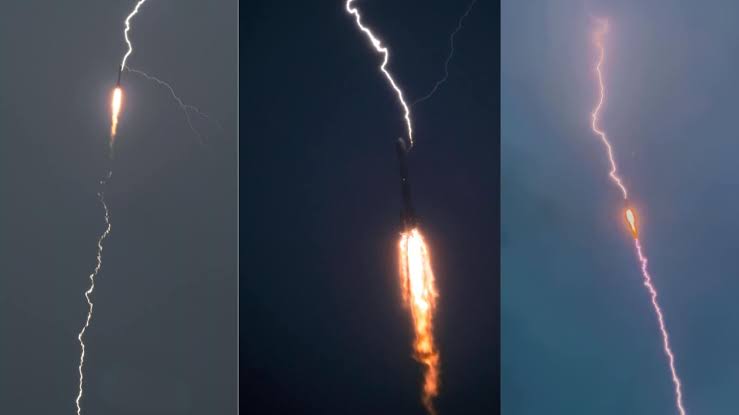
On July 25, 2026, a significant event unfolded at the Xichang Satellite Launch Center in China, where a Long March 3B rocket successfully launched despite enduring a direct lightning strike during its ascent. The mission, which was carrying a critical satellite payload, faced what is often a catastrophic scenario for spaceflight, but the rocket’s robust design and the resilience of its avionics allowed the launch to proceed without interruption. This incident has since become a focal point for discussions regarding launch safety protocols and the increasing reliability of modern space vehicles under extreme weather conditions.
The lightning strike occurred shortly after liftoff, as the rocket ascended through a volatile atmosphere that contained thunderstorm activity. The electrical discharge was visible to ground-based cameras and observers, causing a momentary flash of concern before the vehicle continued its trajectory. However, the rocket’s electrical systems and guidance computers performed flawlessly, absorbing the surge without suffering any degradation in performance. This event underscores the rigorous testing that launch vehicles undergo to handle electrical surges, as a single point of failure in the avionics could have led to a loss of control. The successful outcome was a testament to the engineering redundancy built into the Long March 3B, which is known for its heavy-lift capabilities and has been a workhorse for China’s space program for decades.
Following the launch, Chinese space authorities confirmed that the satellite was successfully inserted into its designated orbit and that all post-launch systems were functioning nominally. The payload is believed to be a communications or navigation satellite, though specific details remained classified at the time of the report. What makes this event particularly noteworthy is the timing, as the monsoon season in the Xichang region frequently presents high humidity and thunderstorm risks, prompting stringent weather criteria for launch windows. The fact that the mission was allowed to proceed suggests that meteorological predictions had not foreseen the specific strike, or that the risk was deemed acceptable given the vehicle’s resilience. This incident will likely prompt a review of weather monitoring procedures and the criteria used to define acceptable launch conditions.
The survival of the Long March 3B during such an event is a major achievement for China’s aerospace engineers, as lightning strikes on rockets are rare but have historically resulted in mission failures or anomalies in other space programs worldwide. The ability to withstand such a shock without requiring an abort sequence or experiencing a payload malfunction speaks to the advancements in composite materials and shielding technologies used in the rocket’s construction. Furthermore, it highlights the importance of ground-based lightning suppression systems, which are typically employed at launch sites to mitigate risk, though they are often ineffective once the rocket is in the air. The vehicle’s own flight computer system was able to isolate the surge, preventing it from affecting the propulsion or telemetry systems.
In the broader context of the global space industry, this event serves as a powerful data point for improving launch safety and reliability across all spacefaring nations. Engineers will likely analyze the telemetry data from this flight to better understand how the electrical current traveled through the rocket’s structure and how the onboard systems responded. This could lead to even more resilient designs for future rockets. The mission also highlights the growing trend of routine, high-stakes launches, where the reliability of the hardware is so high that even adverse weather events are increasingly less likely to derail a mission. China’s space program, which has been rapidly expanding its capabilities, saw this launch as a clear demonstration of its technical maturity.
Ultimately, the Long March 3B’s successful mission on July 25, 2026, reinforces the resilience of modern rocket technology and the expertise of mission controllers in dealing with unpredictable natural phenomena. While the event will certainly be remembered as a nerve-wracking moment for those involved, it has concluded as a remarkable success story, with the satellite now operational and the rocket having proven its mettle. The incident has been widely covered in aerospace circles, serving as a reminder that while space is the ultimate frontier, the journey there must often contend with the forces of Earth itself.