
July 11, 2026
In a monumental shift for global aerospace engineering, aviation titan Airbus and leading German engine manufacturer MTU Aero Engines have officially announced the creation of a groundbreaking joint venture to develop and commercialize the world’s first fully electric, hydrogen fuel cell aircraft engine. This historic alliance, formally unveiled in July 2026, marks the next critical milestone in the transition toward climate-neutral commercial aviation, aiming to fundamentally reshape air travel in the same way electric vehicles have revolutionized the automotive sector.
Built upon a foundational framework established at the Paris Air Show in June 2025, this newly independent European powerhouse is designed as a highly agile organization structured to accelerate the technology development, design, laboratory testing, and stringent regulatory certification required to bring zero-emission powertrains to commercial aircraft. The non-binding agreement outlines a highly strategic collaboration that is expected to begin operational activities by 2027, following standard regulatory clearances and standard European social consultation processes, bringing an unprecedented level of scale to the green aviation economy.
The newly established venture represents an unprecedented structural departure from traditional aerospace practices, breaking a decades-old industry boundary by directly embedding an aircraft manufacturer like Airbus into primary engine manufacturing. Historically, airframe constructors have relied exclusively on specialized third-party propulsion conglomerates like Rolls-Royce, GE Aerospace, or Pratt & Whitney to design and supply powerplants. However, the sheer technical complexity of cryogenic liquid hydrogen storage, thermal management, and advanced electrical powertrain integration has driven Airbus to take a direct stake in the engine-making process itself.
According to industry insiders familiar with the ongoing structural negotiations, the venture is leaning toward being headquartered in Germany, with Airbus projected to hold a commanding 75% majority stake valued at upwards of €1.2 billion, while MTU Aero Engines will retain the remaining 25% ownership. By establishing this deep financial and operational alignment, the two companies aim to establish absolute European technological sovereignty over next-generation commercial propulsion systems, positioning themselves ahead of emerging zero-emission aerospace competitors in both the United States and China.
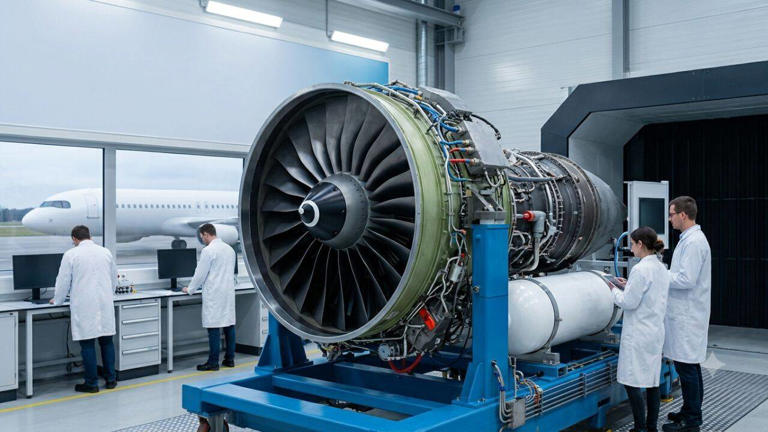
The core technology powering this revolutionary engine architecture centers entirely on a fully electric, hydrogen fuel cell system that eliminates standard combustion processes altogether. Rather than burning hydrogen directly within a modified gas turbine—a method that still generates heat and trace nitrogen oxides—this system relies on a clean electrochemical reaction. Within the fuel cell stack, liquid hydrogen drawn from onboard cryogenic tanks reacts directly with atmospheric oxygen to generate high-voltage electricity, which then powers a set of high-efficiency electric motors to drive the aircraft’s fans.
The only byproduct of this chemical process is pure, harmless water vapor, completely eliminating in-flight emissions of carbon dioxide, carbon dioxide equivalents, soot, particulate matter, and harmful nitrogen oxides (NOx). This dramatic pivot to a pure electric fuel cell layout follows a decisive operational course-correction enacted by Airbus in March 2025, during which the airframer decided to reallocate its immense engineering resources away from standard hybrid combustion research to focus purely on the most disruptive, high-decarbonization potential of fuel-cell-based electric flight.
To successfully transform laboratory research into an industrial, certifiable commercial product, both partners are pooling a highly complementary set of industrial capabilities. Airbus brings its unparalleled expertise in massive commercial aircraft programs, large-scale systems integration, complex fuel cell powertrain testing, and specialized knowledge regarding the handling and insulation of liquid hydrogen at extreme cryogenic temperatures. Conversely, MTU Aero Engines supplies decades of internationally recognized expertise in core engine design, component validation, maintenance, repair, and overhaul (MRO) procedures, alongside its proprietary “Flying Fuel Cell” (FFC) development architecture.
Prior to formalizing this joint venture, MTU had already secured vital technical milestones, including finalizing its Flying Fuel Cell design, initiating prototype stack manufacturing, and successfully completing the initial testing phase of its specialized eMoSys electric motor. Furthermore, MTU’s ongoing leadership in the European Union’s Clean Aviation “HEROPS” program—which targets the creation of a 1.2-megawatt ground-based demonstrator powertrain—will provide a vital technological springboard for the joint venture’s upcoming development cycles.
While the establishing of the joint venture provides an aggressive timeline, the partners are explicitly designing the new company to manage the entire lifecycle of the fuel cell powertrain, extending from initial software modeling to eventual global commercialization. Leaders from both corporate entities have emphasized that the single greatest hurdle ahead does not lie merely in proving that a hydrogen engine can turn a propeller, but in bridging the massive gap between advanced laboratory research and the ultra-strict airworthiness standards demanded by global regulators like the EASA and FAA.
The immediate operational roadmap dictates that the joint venture will serve as a centralized catalyst for public-private cooperation across Europe, leveraging state-backed research grants to construct dedicated, cutting-edge hydrogen testing cells. By creating a distinct, hyper-focused corporate entity detached from the daily logistical demands of standard commercial jetliner manufacturing, Airbus and MTU believe they can dramatically shorten the development lifespan of high-output fuel cells, establishing the complex supply chains required to mass-produce these systems reliably.
Beyond the isolated mechanics of engine engineering, Airbus and MTU have explicitly noted that the eventual success of hydrogen-powered flight will hinge on the simultaneous emergence of a wider hydrogen aviation economy. Building a zero-emission commercial aircraft is completely futile without a massive global infrastructure overhaul capable of producing, transporting, and pumping tons of green liquid hydrogen directly at commercial airport gates. Acknowledging these vast structural challenges, Airbus previously adjusted its initial timeline for its “ZEROe” zero-emission aircraft program, extending the targeted commercial launch window from the mid-2030s into the early 2040s to allow the broader energy ecosystem to mature.
Consequently, the joint venture will concurrently work alongside European legislative bodies, airport authorities, and green energy providers to help draft the necessary regulatory frameworks, safety protocols, and refueling infrastructures needed to support hydrogen-powered flights at a globally viable scale. Ultimately, this landmark joint venture establishes a definitive line in the sand for the aerospace sector, signaling that the future of clean, short-to-medium-haul commercial flight will be built upon an electric, hydrogen-insulated foundation.