
July 8, 2026
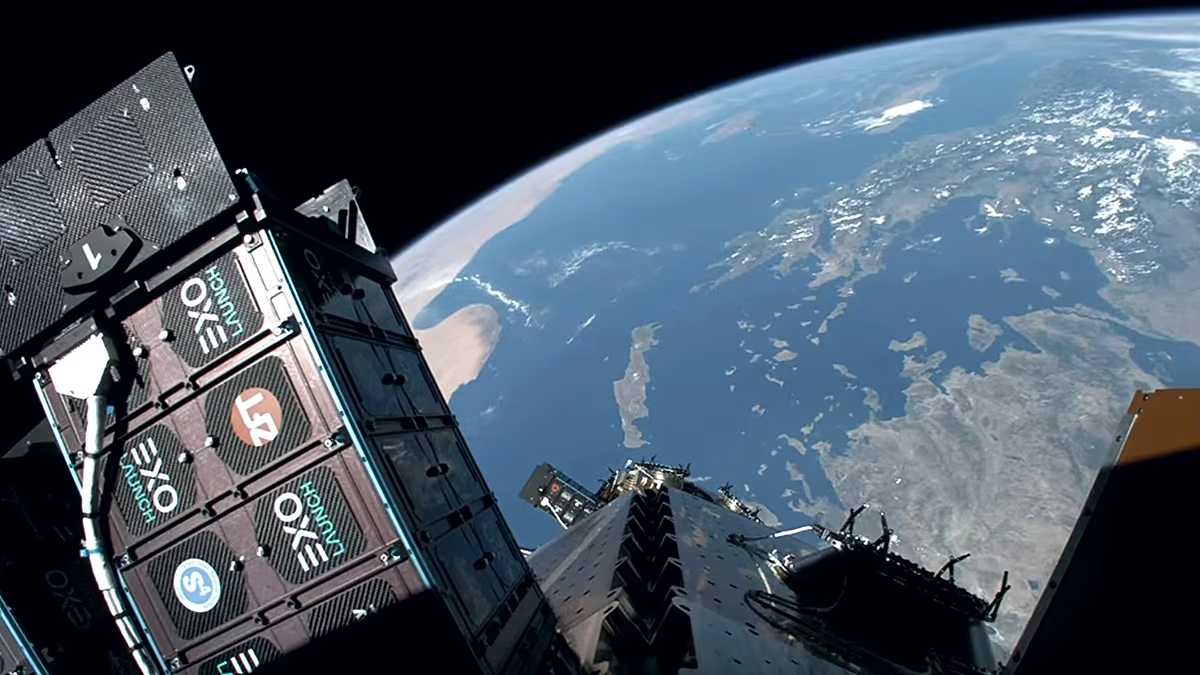
Greece took a significant and decisive step forward in its national space program with the successful launch and orbital insertion of the Hyperion GR-1, the country’s first optical microsatellite developed under its National Microsatellite Programme . The satellite was launched from the Cape Canaveral Space Force Station in Florida on a SpaceX rocket, and its entry into orbit marks the beginning of a new era for Greece, equipping the nation with independent Earth observation capabilities for the first time .
This launch is not an isolated event but the first phase in the deployment of a Greek constellation of seven optical microsatellites, which are being constructed domestically by the Greek company Open Cosmos Aegean, based in Pallini, Attica . This ambitious project is funded by the Recovery and Resilience Facility “Greece 2.0” and is being implemented by the General Secretariat for Telecommunications and Posts with the crucial support of the Hellenic Space Centre (ELKED) and the European Space Agency (ESA) .
The Hyperion GR-1 is equipped with advanced technology that positions it as a powerful tool for the Greek state. It is capable of capturing high-resolution multispectral images with a resolution of up to 90 centimetres, allowing for the precise monitoring and systematic recording of changes in both the natural and built environment . More importantly, it goes beyond simple image capture by incorporating cutting-edge data-processing capabilities using Artificial Intelligence (AI) directly onboard the satellite .
This edge computing, combined with inter-satellite links, enables the rapid processing and near real-time transmission of critical information to ground stations, drastically reducing the time needed to receive and act on vital data . The vast amount of data collected by the Hyperion GR-1 and its future counterparts will be centralized and disseminated through the Government Geospatial Observation Hub, a unified digital platform designed to make satellite information readily accessible to all branches of public administration, thereby enhancing operational effectiveness .
The potential applications of this new national asset are extensive and directly impact the lives of Greek citizens and the security of the nation. The satellite’s primary focus will be on civil protection, where its data will be instrumental in the early detection and monitoring of wildfires, floods, and other natural disasters, as well as enabling faster and more accurate post-disaster damage assessment . Furthermore, it will play a crucial role in environmental monitoring, contributing to the protection of forests and water resources, and supporting precision agriculture and aquaculture to increase efficiency and sustainability .
In addition to its civilian applications, Hyperion GR-1 is a strategic asset for maritime surveillance, allowing for the monitoring of shipping lanes, detecting incidents of marine pollution, and enhancing the surveillance of Greece’s Exclusive Economic Zone—a capability of growing geostrategic importance . The data will also be applied to urban planning, monitoring large public works projects, identifying illegal construction, and safeguarding critical national infrastructure .
Beyond its operational benefits, the Hyperion GR-1 mission represents a major leap forward for the Greek space industry and economy. The satellite was built with the active participation of Greek companies and engineers, significantly bolstering domestic know-how and fostering a competitive ecosystem in the rapidly growing field of microsatellite technology . This strengthens the capacity for developing and exporting Greek-made space technologies and services .
With this launch, Greece now has a total of 18 microsatellites in orbit, a testament to its growing presence in space . This achievement is part of a broader, long-term national strategy, as outlined by the recently presented HELLAS-SPACE 2.0 programme, a follow-up initiative with a substantial budget of €350 million, which aims to further expand the country’s space capabilities and industrial footprint . As Minister of Digital Governance and Artificial Intelligence, Dimitris Papastergiou, stated, the launch of Hyperion GR-1 marks “a new era” for the nation, providing a powerful tool to make the state more effective and the country more resilient for the benefit of all citizens .