
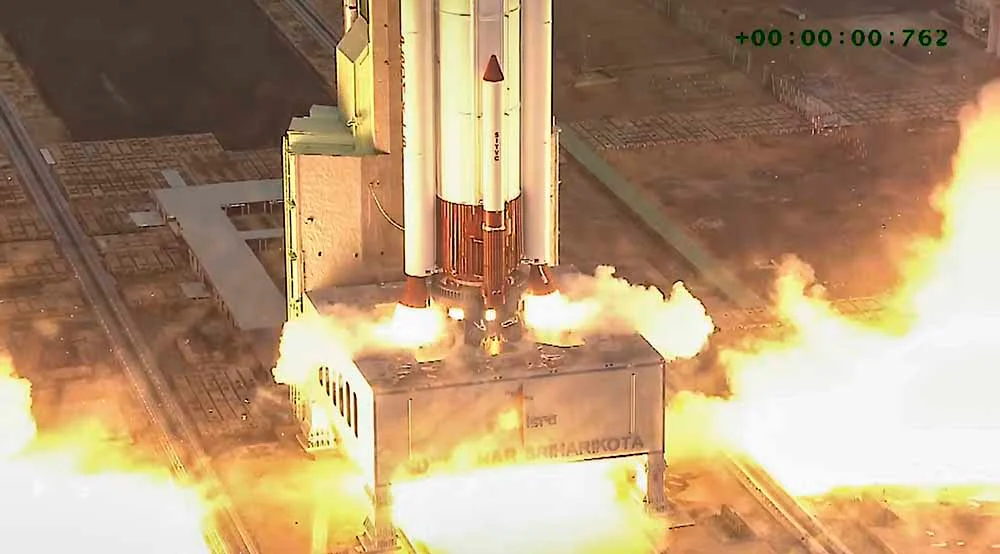
A new study by researchers from the University of Cambridge and Italy’s Politecnico di Torino has challenged the long-standing global perception of India’s space program as a paragon of frugal engineering . The peer-reviewed paper, published in the journal Economics Letters, analyzed a comprehensive dataset of more than 6,740 rocket launches between 1960 and 2025 to estimate the cost of delivering payloads to Low Earth Orbit across major spacefaring nations . Its headline finding is stark: India’s estimated launch cost of $13,302 per kilogram in 2025 was the highest among all countries studied, making it more than four times costlier than the United States, which topped the efficiency charts at $3,225 per kilogram . This figure places India at the top of a cost table that includes Europe ($9,897/kg), Russia ($6,682/kg), China ($5,809/kg), and Japan ($5,287/kg), against a global average of $3,868/kg .
The researchers, Alessio Terzi and Francesco Nicoli, acknowledge that their conclusion appears counterintuitive and runs contrary to the well-established narrative of India’s frugal space program . They argue the key to this paradox lies in the scale of India’s launch vehicles. Indian rockets generally carry smaller payloads compared to their international counterparts, meaning that the significant fixed costs of a launch—such as infrastructure, fuel, and ground support—are distributed over fewer kilograms, thereby inflating the cost-per-kilogram metric . The study goes beyond a simple price comparison, exploring the dynamics of “experience curves” where costs fall as launch frequency and accumulated experience increase. It found statistically significant cost reductions through experience only for the United States and Europe since 2010, while India, China, Russia, and Japan did not show a similar trend . The U.S. advantage, particularly through SpaceX’s reusable Falcon 9 rockets and a high launch cadence, has allowed it to achieve economies of scale that are unmatched globally .
The Cambridge study has been met with a forceful rebuttal from India’s space establishment. ISRO Chairman Dr. V. Narayanan firmly rejected the paper’s conclusions, stating it was based on “wrong data” . However, a detailed public explanation of which specific datasets or calculations were flawed was not provided . The study’s authors had based their estimates on public sources, including government reports and academic research, standardized to comparable 2024 dollar values . Further challenging the methodology, former ISRO Chairman Dr. S. Somanath argued that cost-per-kilogram is a misleading metric that fails to capture the full economics of a space mission . He asserted that when considering the launch of a large spacecraft, such as a 4.5-tonne satellite, India’s total mission costs are broadly comparable to those of American providers . Dr. Somanath also contended that SpaceX’s lower costs are largely due to its immense scale and high internal utilization, arguing that they “don’t pass on the benefits to anyone but use it for their own launches” .
A highly-placed source from the Department of Space offered additional nuance, pointing out that the Cambridge study failed to account for India’s unique pricing structure and incentives . The source noted that ISRO’s commercial arm, NSIL, provides a significant 30% subsidy on launch costs to its customers . Furthermore, launching from India saves money on logistics and transport, and the study did not consider the additional costs incurred by foreign launchers when multiple satellites must be maneuvered to different orbits . This debate is further complicated by the opaque nature of India’s actual launch economics, as ISRO does not publicly disclose comprehensive mission cost structures, with one of the most frequently cited official references being a parliamentary response from 2018 . The study’s findings arrive at a sensitive time for ISRO, which has faced recent challenges including a difficult year with no successful launches and the attrition of 125 scientists . The debate underscores a critical question for India’s space ambitions: as the global launch industry pivots towards reusability and scale, achieving cost competitiveness will be essential for maintaining its strategic and commercial edge .