
June 18, 2026
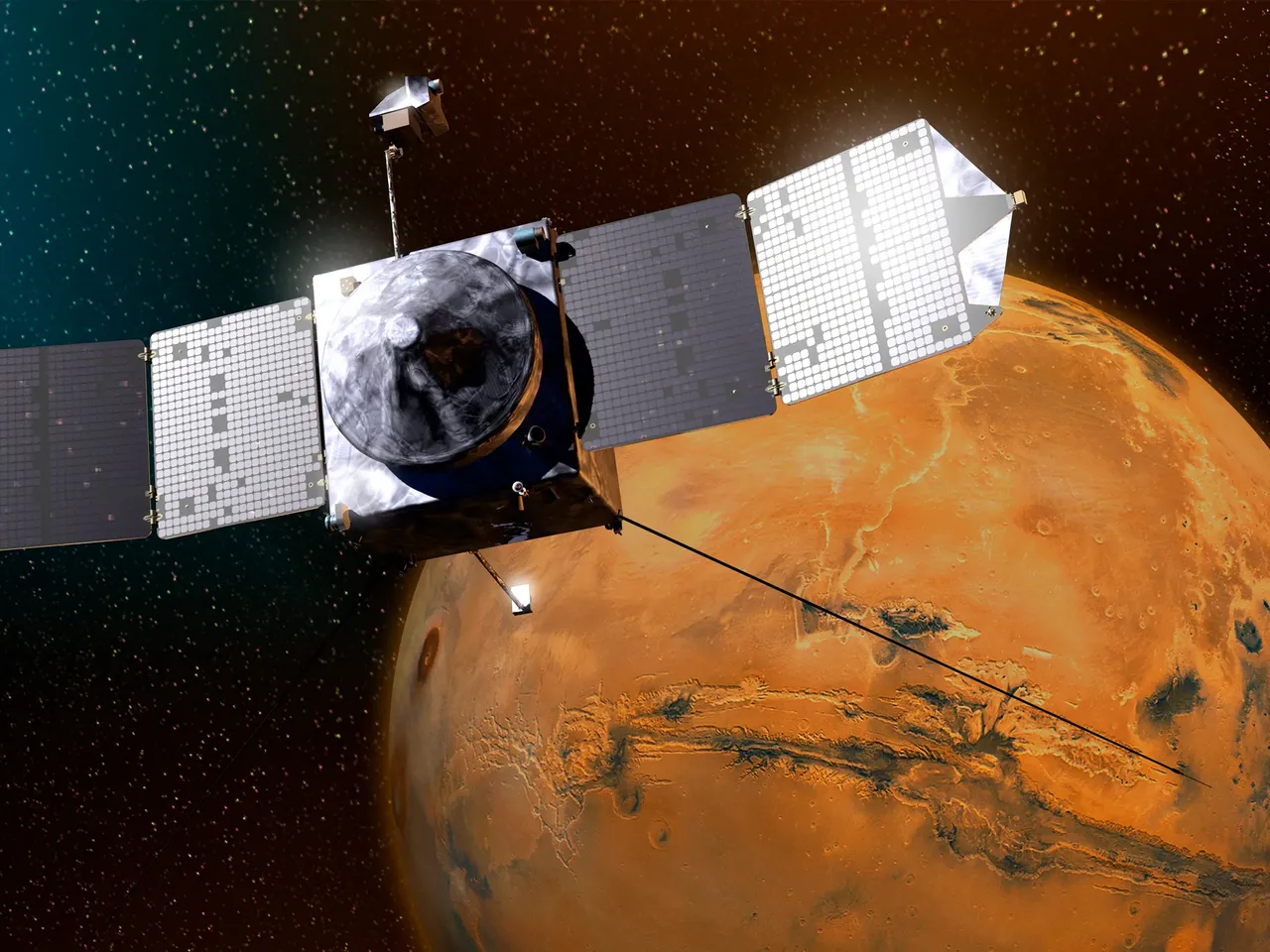
The scientific community bid a poignant farewell to one of NASA’s most successful and beloved Mars missions. After months of desperate but ultimately futile attempts to reestablish contact, the space agency officially began the decommissioning process for the MAVEN (Mars Atmosphere and Volatile Evolution) orbiter, bringing an 11-year journey of discovery to a bittersweet end . The mission’s final chapter began in December 2025, when the spacecraft fell silent during a routine pass behind Mars . While initial contact was lost, mission controllers held out hope, but the silence proved permanent.
An anomaly review board convened by NASA in February 2026 later pieced together a grim picture from fragments of recovered telemetry: MAVEN had emerged from behind the planet in an unexpected state. The spacecraft was in safe mode, rotating at an abnormally high rate of approximately 2.7 revolutions per minute, a state it was not designed for . Investigators concluded that this uncontrolled tumbling eventually drained the orbiter’s batteries, leading to a complete loss of power and a permanent end to its communications system . The final cause of the anomaly remains under investigation, but the conclusion was inescapable. “The conclusion is that the spacecraft is not recoverable,” stated Mike Moreau, MAVEN’s project manager at NASA’s Goddard Space Flight Center, encapsulating the team’s profound sense of loss .
Despite the sorrow, the overriding sentiment from the scientific community was one of immense pride and celebration for a mission that far exceeded all expectations. Originally launched in November 2013 with a primary mission of just one year, MAVEN became a cornerstone of Martian exploration for over a decade . Its goal was historic: to be the first mission dedicated to understanding how Mars lost the thick atmosphere that once allowed liquid water to flow on its surface, transforming it from a potentially habitable world into the cold, arid desert we see today . The wealth of data MAVEN returned is unparalleled, contributing to over 800 scientific publications and providing the clearest picture yet of atmospheric escape at any planet in our solar system . It was the first to directly observe “sputtering,” a process where energetic particles knock atmospheric atoms into space, and helped quantify that roughly 65% of the planet’s original argon gas has been lost over time .
The mission also made the groundbreaking discovery that solar storms dramatically accelerate this atmospheric loss, providing a key mechanism for how Mars dried out . Beyond erosion, MAVEN revealed an entirely new type of aurora on Mars, created by protons rather than electrons, which are not confined to the poles as they are on Earth . It also captured the effects of planet-encircling dust storms on the upper atmosphere, showing how they can lift water molecules high enough to be lost to space . “The MAVEN mission has truly advanced our understanding of the Martian atmosphere and evolution. This dataset has had a tremendous impact on the field,” said Shannon Curry, MAVEN’s principal investigator from the University of Colorado Boulder. “The team is certainly broken up about this, but at the same time, we are incredibly proud of the science we’ve accomplished over the last decade” .
MAVEN’s legacy, however, was not confined to pure science. It played a crucial, albeit often overlooked, role as a high-capacity communications relay for NASA’s rovers on the Martian surface, including Curiosity and Perseverance . Although it supported just over 8% of relay sessions, the orbiter returned nearly 18% of all science data transmitted from the Martian surface, cementing its value as a critical asset in the Mars Relay Network .
Its loss creates a noticeable gap, but one that the remaining orbiters—Mars Odyssey, Mars Reconnaissance Orbiter, and the European Space Agency’s Mars Express and Trace Gas Orbiter—have been able to adjust for. “The Mars Relay Network is resilient enough at this point in time to accommodate, for the most part, the loss of MAVEN with the added delay,” said Tiffany Morgan, the director of NASA’s Mars Exploration Program . While its loss is a blow to the network, it is not an incapacitating one. Yet, the mission’s end is tinged with a sense of missed opportunity, as MAVEN will no longer be able to complement the observations of the newly launched ESCAPADE mission, which was set to further investigate Mars’ magnetosphere .
Even in its silent retirement, the spacecraft will remain a part of the Martian landscape for decades to come. The MAVEN orbiter is expected to continue its celestial orbit around the Red Planet for another 50 to 100 years before atmospheric drag eventually pulls it into the atmosphere, where it will burn up like a shooting star . For the team that dedicated so much of their lives to the mission, the farewell is deeply personal. “The team really has experienced the loss of a loved one with the end of the mission,” Moreau lamented . But even in this moment of loss, the spirit of triumph and defiance shines through. Asked what she would write on MAVEN’s tombstone, Curry did not hesitate to deliver the mission’s epitaph, one that perfectly captures the sentiment of a generation of scientists. “Best. Mars. Mission. Ever.” she declared, a fitting tribute to a spacecraft that revolutionized our understanding of the Red Planet and whose data will continue to be a wellspring of knowledge for years to come .