June 10, 2026
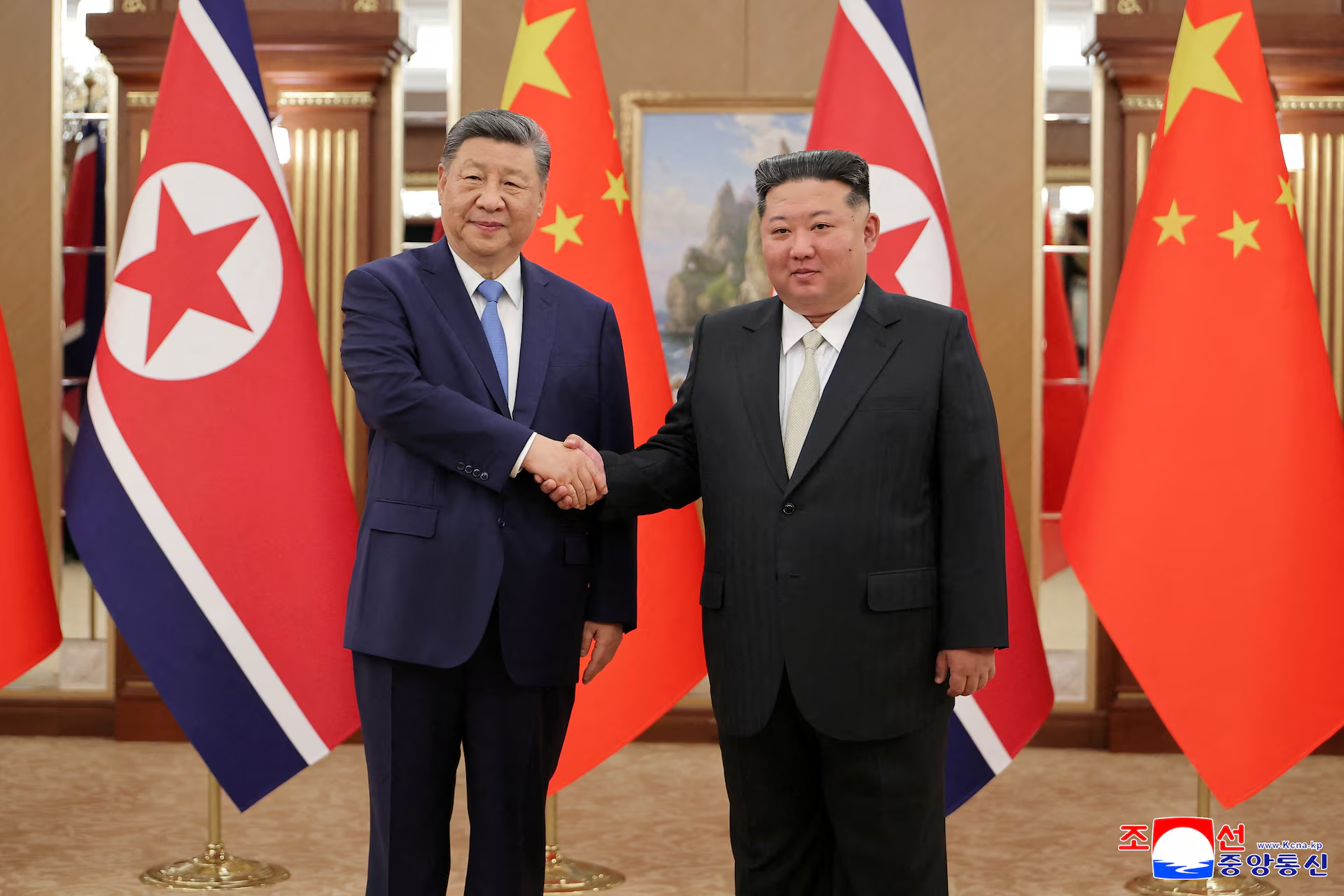
The high-stakes geopolitical landscape of Northeast Asia experienced a profound shift as Chinese President Xi Jinping concluded a pivotal two-day state visit to Pyongyang, North Korea, spanning June 8–9, 2026. This highly choreographed diplomatic event marked Xi’s first overseas trip of 2026 and his first visit to North Korea in seven years, timed meticulously to coincide with the 65th anniversary of the 1961 Sino-North Korean Treaty of Friendship, Cooperation, and Mutual Assistance.
Met at Pyongyang International Airport with immense pageantry by North Korean leader Kim Jong Un, the summit served as a powerful visual declaration of solidarity. However, beneath the gushing public displays of a relationship “forged in blood,” the meeting carried deep strategic calculations, serving as China’s proactive gambit to manage its shifting buffer zone and reassert dominance over a traditional ally that has recently drifted closer to Moscow.
The timing of the summit is the most critical element of the analysis, positioning Xi Jinping as a central geopolitical power broker in a rapidly shifting multipolar world. The Pyongyang trip follows back-to-back high-level summits hosted by Xi in Beijing just weeks prior, featuring U.S. President Donald Trump on May 14–15 and Russian President Vladimir Putin on May 20, 2026. By immediately pivoting to North Korea, Xi sought to brief Kim on these encounters while establishing China’s distinct role in balancing ties among competing global powers.
For Beijing, the primary source of anxiety stemming into 2026 has been the deepening military and technology alliance between North Korea and Russia, highlighted by the clandestine deployment of roughly 11,000 North Korean troops to Russia’s Kursk frontline. Intelligence data emerging by April 2026 indicated that North Korean forces had suffered over 7,000 casualties in the conflict. In exchange for this material and manpower support, Moscow shattered long-standing United Nations Security Council constraints by agreeing to transfer high-stakes military hardware to Pyongyang, including nuclear submarine technology and advanced Sukhoi Su-35 fighter jets.
Alarmed that Russia’s unconstrained patronage is reducing China’s traditional leverage over Kim’s regime, Xi utilized this state visit to subtly weaken the Moscow-Pyongyang axis without fracturing his own broader alignment with Russia. The summit’s public declarations focused heavily on strengthening strategic communication through elevated official visits and expanding state-to-state cooperation across politics, economy, and culture. According to reports from China’s state-run Xinhua news agency, Beijing proposed concrete, practical measures to revitalize North Korea’s economic lifelines, focusing on trade, agriculture, infrastructural construction, and the restoration of cross-border transport links that had remained depressed since the pandemic. By re-anchoring North Korea’s economy to Beijing, China aims to ensure that Pyongyang remains dependent on Chinese stability rather than becoming entirely emboldened by Russian military transactions.
What was left unsaid at the summit, however, emerged as the most telling indicator of a fundamental shift in regional dynamics. In a striking departure from historical diplomatic posturing, official readouts from the bilateral meetings completely omitted any mention of North Korean denuclearization. Analysts noted that Xi Jinping effectively offered a tacit legitimacy to Pyongyang’s nuclear weapons program by acknowledging North Korea’s sovereign “security and development interests.” During a lavish welcoming banquet at the Mokran House, Xi explicitly wished that the North Korean people would fulfill the domestic goals set forth at their recent ruling party congress—a platform where Kim Jong Un had explicitly pledged to bolster the state’s nuclear force.
This passive acceptance was underscored just days before Xi’s arrival when Kim’s powerful sister, Kim Yo Jong, declared the country’s status as a nuclear weapons state an irreversible reality and a line of no retreat. Kim further emphasized this posture during the week by inspecting a newly inaugurated weapons-grade nuclear materials production factory and testing AI-guided tactical cruise missiles. Realizing that traditional coercion toolkits have diminishing returns on a nuclear-armed neighbor, Beijing has seemingly abandoned the immediate goal of denuclearization, choosing instead to stabilize the regime under its own diplomatic umbrella.
In return for China’s diplomatic shielding and economic proposals, Kim Jong Un offered unwavering geopolitical alignment on critical core interests. Kim explicitly affirmed his full support for the “One China principle,” validating Beijing’s sovereignty claims over Taiwan irrespective of changes in the broader international landscape. This alignment feeds directly into Xi’s broader diplomatic architecture, known as the “Four Global Initiatives,” which explicitly challenges the U.S.-led international order in favor of a multipolar system. Both leaders used their platform to firmly oppose “hegemonism” and Western “power politics,” projecting a unified front against the trilateral security alignment of the United States, South Korea, and Japan.
Despite the intense displays of unity, subtle differences in how the summit was framed by each country’s state media revealed contrasting structural priorities. While China’s Xinhua focused on practical state-to-state frameworks and economic integration, North Korea’s state media (KCNA) intentionally framed the summit as a pact between equal partners, emphasizing regime dignity and rewritten ties on an equal footing. This indicates that while Kim is eager to rebalance his foreign policy between China and Russia to avoid over-reliance on a single patron, he intends to navigate this new era as the leader of a recognized nuclear state rather than a subordinate client.
Ultimately, the June 2026 summit did not yield a breakthrough toward regional disarmament, nor did it position China as a direct catalyst for renewed U.S.-North Korea dialogue, despite speculation surrounding a potential second-term Trump-Kim meeting. Instead, the visit achieved its core, low-cost objective: it provided a powerful visual rebuttal to Western narratives that Pyongyang had permanently migrated into Moscow’s orbit. By securing North Korea’s economic dependence and offering a diplomatic buffer that Russia cannot replicate, Xi Jinping successfully checked Vladimir Putin’s expanding influence in Northeast Asia, reinforced China’s critical buffer zone against the West, and solidified a highly complex, contemporary framework for the Sino-North Korean alliance.