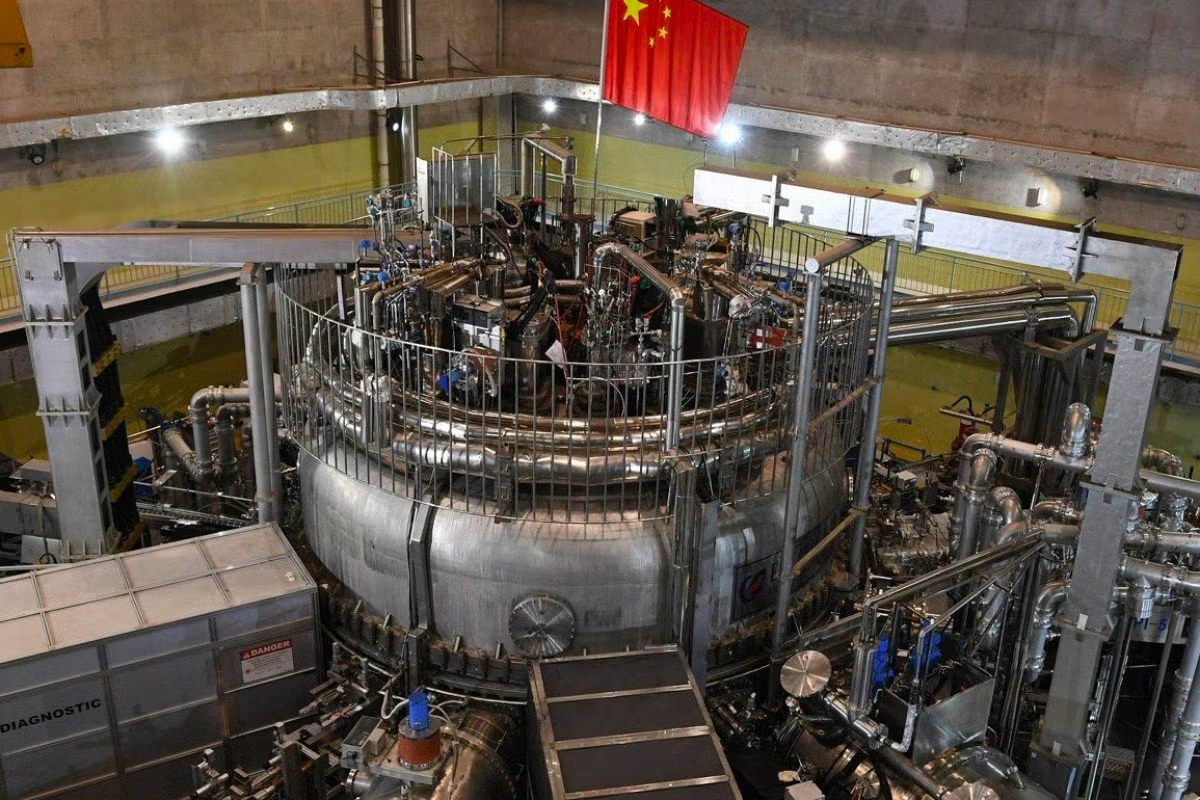
In a monumental leap forward for fusion energy research, China has successfully completed the construction of a 582-tonne superconducting magnet, the largest of its kind ever built for a fusion device. This engineering marvel is a critical component for the country’s “artificial sun” project, officially known as the Comprehensive Research Facility for Fusion Technology (CRAFT), and represents a significant stride towards harnessing the power of the stars for limitless clean energy on Earth. The sheer scale of this achievement, culminating in 100% domestic production of core technologies, marks a pivotal moment in the global quest for controlled nuclear fusion, demonstrating China’s growing capability to independently build complex systems required for a working fusion reactor.
To understand why such a colossal magnet is essential, one must first grasp the fundamental challenge of creating a star on Earth. An “artificial sun” is a tokamak, a device that uses powerful magnetic fields to confine and control plasma heated to over 100 million degrees Celsius. At these extreme temperatures, matter exists as a superheated, electrically charged gas where atomic nuclei can overcome their natural repulsion and fuse, releasing enormous energy. However, no physical material can withstand direct contact with such a inferno. This is where the 582-tonne Toroidal Field (TF) superconducting magnet comes into play.
It is designed to generate a powerful, invisible “magnetic cage” that confines the blazing plasma, suspending it within the vacuum chamber and preventing it from touching the reactor walls. “Its job is to use a powerful magnetic field to confine the plasma… It works like an invisible, extremely sturdy magnetic cage,” explained Wu Yu, a researcher at the Institute of Plasma Physics, Chinese Academy of Sciences (ASIPP). This D-shaped magnet, measuring 21 meters in length, 12 meters in width, and 3.3 meters in height, is 1.3 times the volume of similar magnets used in the international ITER project and stores three times more energy. Ultimately, sixteen such coils will be assembled in a ring to create a unified magnetic field, generating a 6.5-tesla field at the plasma’s core. The successful development of this magnet, which required six years of intensive work and yielded 47 authorized patents, is a testament to its intricate engineering.
The TF magnet is not acting alone. In a synchronized breakthrough, scientists also passed full-parameter testing on a high-temperature superconducting central solenoid (CS) coil. If the TF magnet is the “cage,” the CS coil is the “spark plug” or the “power heart” of the reactor. This coil, which successfully carried a stable current of 60 kiloamperes with an energy storage of 6.03 megajoules, plays a vital role in inducing and driving the plasma current, a crucial step for initiating and sustaining the fusion reaction. “It’s the spark plug of a car engine,” stated Qin Jinggang, an ASIPP researcher, highlighting its importance in the ignition process. Its performance indicators, including a maximum magnetic field ramp rate of 5.1 Tesla per second and an ultra-low joint resistance of 0.87 nano-ohms, have reached world-leading levels, showcasing the advanced technological prowess behind this project.
The necessity for these magnets extends beyond simple confinement; it is about creating the precise conditions for a self-sustaining fusion reaction. The plasma must be stable and dense enough for atomic nuclei to collide and fuse. Any instability, such as edge-localized modes or tungsten impurity accumulation from the reactor walls, can disrupt the core plasma and quench the reaction. Researchers are actively exploring new methods to enhance plasma confinement, such as using small, 3D magnetic perturbations to suppress edge instabilities and improve core performance.
This delicate balancing act underscores why the giant magnet’s ability to create a stable, controlled environment is so critical. The newly completed magnets operate under incredibly demanding conditions; they must function reliably at minus 268.95 degrees Celsius—colder than outer space—while enduring massive electromagnetic forces and high radiation for an expected operational life of 60 years. Achieving this required breakthroughs in materials science and manufacturing, including the development of specialized niobium-tin superconductors and ultra-low-resistance joints that are effectively zero-loss at 100-kiloampere currents. “A temperature deviation of just a few degrees can cause performance to collapse,” Wu Yu noted, illustrating the extreme precision required for this task.
The successful completion of these two superconducting magnet systems is more than just a technical milestone; it signifies a major step towards energy independence and the realization of a “China-made” solution for fusion technology. The project has achieved a full localization of core technologies, breaking foreign monopolies and securing the supply chain against “chokepoints”. This self-reliance is a crucial strategic advantage. The development comes at a time when China’s other fusion projects are also setting records; the EAST reactor, for instance, has achieved a world record by sustaining a 100-million-degree plasma for 1,066 seconds. With these magnet breakthroughs, China has now cleared key engineering hurdles, paving the way for a clear timeline toward commercial fusion energy.
Under its “three-step” fusion roadmap, the compact Burning Plasma Experimental Superconducting Tokamak (BEST) is planned for completion by the end of 2027, with the goal of achieving fusion power generation around 2030. “The commercialization of fusion energy is still a long road ahead, but every core technology breakthrough brings humanity one step closer to the ultimate clean energy source,” Qin Jinggang concluded. This 582-tonne giant magnet is not merely a piece of hardware; it is a powerful symbol that the dream of a limitless, clean energy future is being forged, one monumental component at a time.