
June 16, 2026
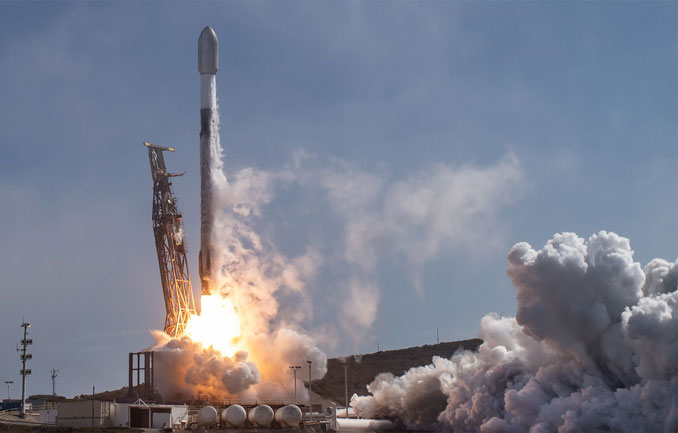
Just four days after completing the largest initial public offering in Wall Street history, SpaceX successfully launched its first mission as a publicly traded company, sending 24 Starlink broadband satellites into orbit from Vandenberg Space Force Base in California. The mission, which took off at approximately 8:34 a.m. PDT from Space Launch Complex 4E (SLC-4E), marked a seamless transition from private innovator to public powerhouse for Elon Musk’s aerospace juggernaut .
While the launch itself was described by mission controllers as a routine Starlink deployment, the symbolic weight of the event was undeniable, as it signaled to global investors that SpaceX’s core operational capabilities remain unaffected by its new status on the Nasdaq. The rocket used for this historic flight was the Falcon 9 first-stage booster B1093, which flew for an impressive 14th time, demonstrating the extraordinary reliability and cost-efficiency of SpaceX’s reusable rocketry system . Approximately eight minutes after lifting off, the veteran booster made a pinpoint landing on the autonomous droneship “Of Course I Still Love You,” stationed in the Pacific Ocean, marking the 624th successful booster landing for the company and the 203rd for that specific vessel .
The launch comes on the heels of a blockbuster market debut that has fundamentally altered the landscape of the aerospace industry. On June 12, 2026, SpaceX officially began trading on the Nasdaq Global Select Market under the ticker symbol “SPCX,” following an IPO that raised approximately $75 billion. The company priced 555.56 million shares of Class A common stock at $135 each, an unprecedented figure that easily surpassed the previous record held by Saudi Aramco . Investor demand was voracious; the offering was reportedly oversubscribed within hours, and on the first day of trading, the stock opened at $150 and closed at $160.95 — a nearly 19 percent surge that pushed SpaceX’s market capitalization to over $2.1 trillion.
This valuation instantly made SpaceX the sixth most valuable publicly traded company in the world**, placing it ahead of Tesla, Broadcom, and Saudi Aramco by market value . Trading volumes were extraordinary, with more than 360 million shares changing hands on the debut day, a volume ten times higher than the second-largest IPO of 2026 . For context, the company reported having 10.3 million Starlink subscribers across 164 countries as of the first quarter of 2026, generating $4.4 billion in operating profit from that division alone, even as the company continues to invest heavily in Starship development at a net loss .
Monday’s launch from Vandenberg’s SLC-4E, designated Starlink Group 17-54, was specifically intended to populate the low-Earth orbit constellation with 24 Starlink V2 Mini Optimized satellites . These satellites are part of SpaceX’s aggressive strategy to densify its network, offering high-speed, low-latency internet to remote and underserved regions globally. The Falcon 9 flew a south-southwesterly trajectory upon leaving the pad, arcing over the Pacific Ocean to insert the payload into a specific orbital plane.
While the mission proceeded without technical incident, analysts were watching closely, noting that as a public entity, SpaceX now faces pressures it did not previously endure, including quarterly earnings reports, heightened shareholder scrutiny, and expectations to accelerate development of the fully reusable Starship spacecraft for NASA’s Artemis lunar missions and, eventually, Mars colonization . However, the successful launch and recovery helped reassure Wall Street that the company’s workhorse rocket remains reliable.
The strategic decision to take SpaceX public after 24 years in business marks a pivotal moment for the commercial space industry. Founded in 2002, the company had famously remained private for decades, with Musk historically arguing that public markets’ focus on short-term profits could conflict with the long-term, capital-intensive goal of reaching Mars . That calculus changed as Starlink matured into a cash-generating machine, providing the steady revenue needed to satisfy public investors while still funding ambitious research and development.
The 30-day “greenshoe” option granted to underwriters allows for the purchase of an additional 83.33 million shares if demand remains high, potentially raising the total offering to $86 billion . Furthermore, SpaceX is expected to qualify for fast-track inclusion in the Nasdaq 100 index, which would trigger automatic buying from index-tracking funds and further stabilize the stock price . For Musk, the listing makes him the rare founder of two publicly traded companies each worth over a trillion dollars — Tesla and now SpaceX . As the 24 Starlink satellites coasted to their operational orbit approximately 65 minutes after launch, they carried with them not just internet connectivity, but the weight of a new era in space finance, proving that the final frontier is now firmly tied to the bottom line of the stock market .