May 16, 2026
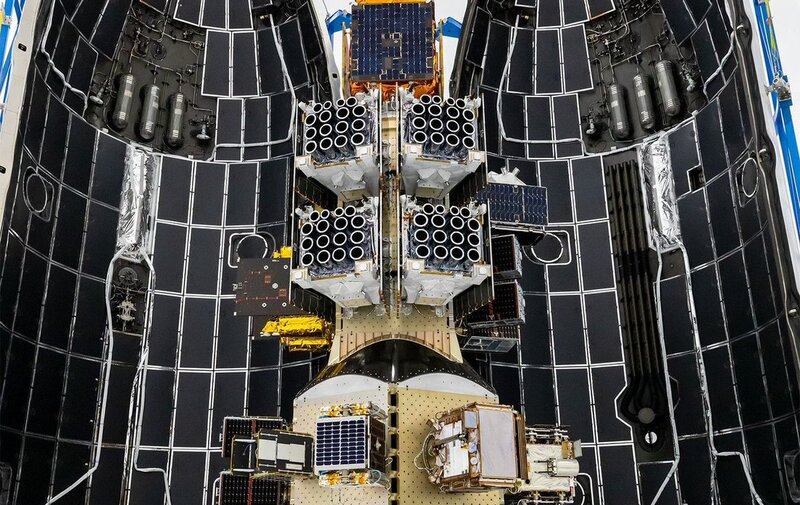
While the world’s media briefly noted the launch of a satellite aboard a SpaceX Falcon 9 rocket from Vandenberg, California, on May 3, experts are now hailing the payload as a “silent game changer” for Earth observation. The satellite, named Drishti, was built by the Bengaluru-based start-up GalaxEye, and it represents a fundamental leap in how nations can monitor the planet. For decades, the field of space-based surveillance faced an unavoidable trade-off: optical satellites provided beautiful, high-resolution images but were blinded by clouds and darkness, while radar (SAR) satellites could see through any weather but produced grainy, difficult-to-interpret data. Drishti shatters this paradigm by operating as the world’s first commercial OptoSAR satellite, meaning it fuses both Electro-Optical (EO) and Synthetic Aperture Radar (SAR) sensors onto a single, unified platform weighing approximately 190 kilograms, making it the largest privately built satellite in India.
The core of this breakthrough lies in a technology that researchers have pursued for years but only GalaxEye has successfully operationalized. By synchronizing the sensors so they image the exact same target at the exact same time from the same angle, Drishti eliminates the “temporal gaps” and “parallax errors” that plagued previous attempts to merge data from two different satellites. Dr. S. Somanath, former chairman of ISRO, noted the significance of this maturity, stating, “India’s space start-up sector is maturing with innovation, with GalaxEye ready to launch a unique day-and-night viewing radar and optical imaging satellite. ISRO’s support in bolstering Indian space start-ups is now showing results. India’s talented youth are showing their prowess”.
The practical result is seamless: a user receives a visually clear, photograph-like image that simultaneously carries the structural and penetration data of radar. For a country like India, where the tropics ensure that 70 percent of the landmass is often covered by clouds, this is not merely an upgrade; it is the difference between being blind and seeing clearly during a crisis. Suyash Singh, Founder and CEO of GalaxEye, explained the genesis of the idea, noting, “We have found that India is a country which is tropical in nature. We have more clouds than the West. The West has never thought about this concept because they never had this problem”.
In the context of national security, the launch of Drishti is already being described as a strategic inflection point. Senior military sources have pointed out that during Operation Sindoor—India’s recent cross-border strikes—the Indian military had to rely on commercial American satellite imagery to conduct bomb damage assessments. Drishti closes that gap permanently. It offers a sovereign, persistent, all-weather “eye in the sky” that peers down on adversarial terrain regardless of the time of day or meteorological conditions.
Lt. Gen. A.K. Bhatt (Retd.), Director General of the Indian Space Association (ISpA), emphasized this shift, stating, “The successful launch of GalaxEye’s first satellite under Mission Drishti marks a pivotal shift in India’s approach to Earth observation. It serves as a definitive proof-of-concept for India’s private space sector reforms and signals a transition from small-scale testing to sovereign, all-weather surveillance capabilities critical for national security and disaster response”. This capability provides a continuous watch over troop movements and infrastructure in contested zones, ensuring that bad weather no longer offers operational cover to adversaries.
Beyond the battlefield, the dual-use nature of Mission Drishti is poised to revolutionize civilian applications ranging from agriculture to infrastructure. Prime Minister Narendra Modi hailed the achievement as a landmark, stating it was “a testament to our youth’s passion for innovation and nation-building” . Union Home Minister Amit Shah echoed this sentiment, noting that the launch “will change how our Earth is observed and emboss the prowess of our youth on the globe, realising Modi Ji’s vision of a space-power India” .
The technology allows for precise monitoring of flood plains even through cyclonic cloud cover, assessment of crop health during the monsoon, and the tracking of maritime vessels in the dense fog of the northern bays. The former ISRO chairman highlighted the entrepreneurial drive behind the mission, explaining, “This can become the gold standard for the world. This is something that we are doing completely in India, never tried before in the world”. The satellite is currently undergoing commissioning, but the intent is already clear: to build a constellation of up to ten such satellites by 2030, creating a dense, real-time mesh of data around the planet.
Finally, Mission Drishti is a resounding validation of India’s space sector reforms. For decades, space was the exclusive domain of the government-run ISRO. However, the establishment of IN-SPACe (Indian National Space Promotion and Authorization Center) has actively nurtured private talent. GalaxEye, incubated at IIT Madras, is the product of over five years of indigenous R&D, proving that Indian start-ups can not only build hardware for the brutal environment of space but can also file global patents on core technologies.
Dr Pawan Goenka, Chairman of IN-SPACe, stated, “The sustained effort over the last five to six years on confidence-building, capacity-building, and the commercialisation of India’s private space technology ecosystem is now showing tangible results. Mission Drishti by GalaxEye is a fine example of this”. Furthermore, a landmark partnership with NewSpace India Limited (NSIL) , ISRO’s commercial arm, ensures that the data generated by this private satellite will be distributed globally, turning India from a consumer of foreign space data into a curator and seller of a unique, high-value intelligence product. Drishti has not just reached orbit; it has redefined the vantage point from which India—and the world—sees everything below.