
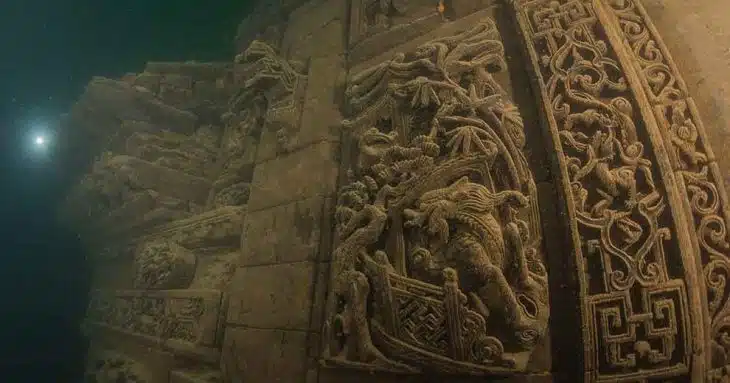
Deep beneath the surface of Qiandao Lake in China’s Zhejiang province lies an extraordinary relic of the past: the ancient city of Shicheng, also known as the “Lion City” . Often dubbed the “Atlantis of the East,” this is no mythical lost world but a remarkably preserved 600-year-old metropolis that was intentionally flooded in 1959 . The city’s submersion was a decision made to facilitate industrialization, specifically to create the Xin’an River hydroelectric dam, which required the relocation of nearly 300,000 people who had called the region home for centuries .
After being forgotten for decades, the city was dramatically rediscovered in 2001 when the Chinese government organized an expedition to explore what remained of the sunken metropolis . What they found was nothing short of astonishing: a city frozen in time, its stone architecture perfectly intact thanks to the protective embrace of the water, which shields it from wind, rain, and sun erosion .
The city, whose history dates back to the Ming and Qing dynasties and possibly even earlier to the Tang Dynasty in 621 AD, lies at a depth of between 26 and 40 meters (85-131 feet) . The incredible state of preservation has captivated archaeologists and divers alike. The city’s streets are wide, and its most defining feature is its 265 stone archways, adorned with intricate carvings of lions, dragons, and phoenixes, with some of the stonework dating back to the year 1777 . The city’s unique design also features five entrance gates, a departure from the traditional four found in other ancient Chinese cities .
The wooden beams and stairs of some structures were also found to be intact, a testament to the exceptional preservation conditions . Following its rediscovery and the publication of photographs in 2011 by Chinese National Geography, the site has become a major attraction for advanced divers seeking to explore the “time capsule” of Imperial China . However, because the ruins have yet to be fully mapped, dives are considered “Exploratory” and are limited to those with significant deep-water diving experience . While the city rests silently underwater, its allure continues to draw global fascination, solidifying its place as one of the most significant and well-preserved underwater archaeological sites in the world .