
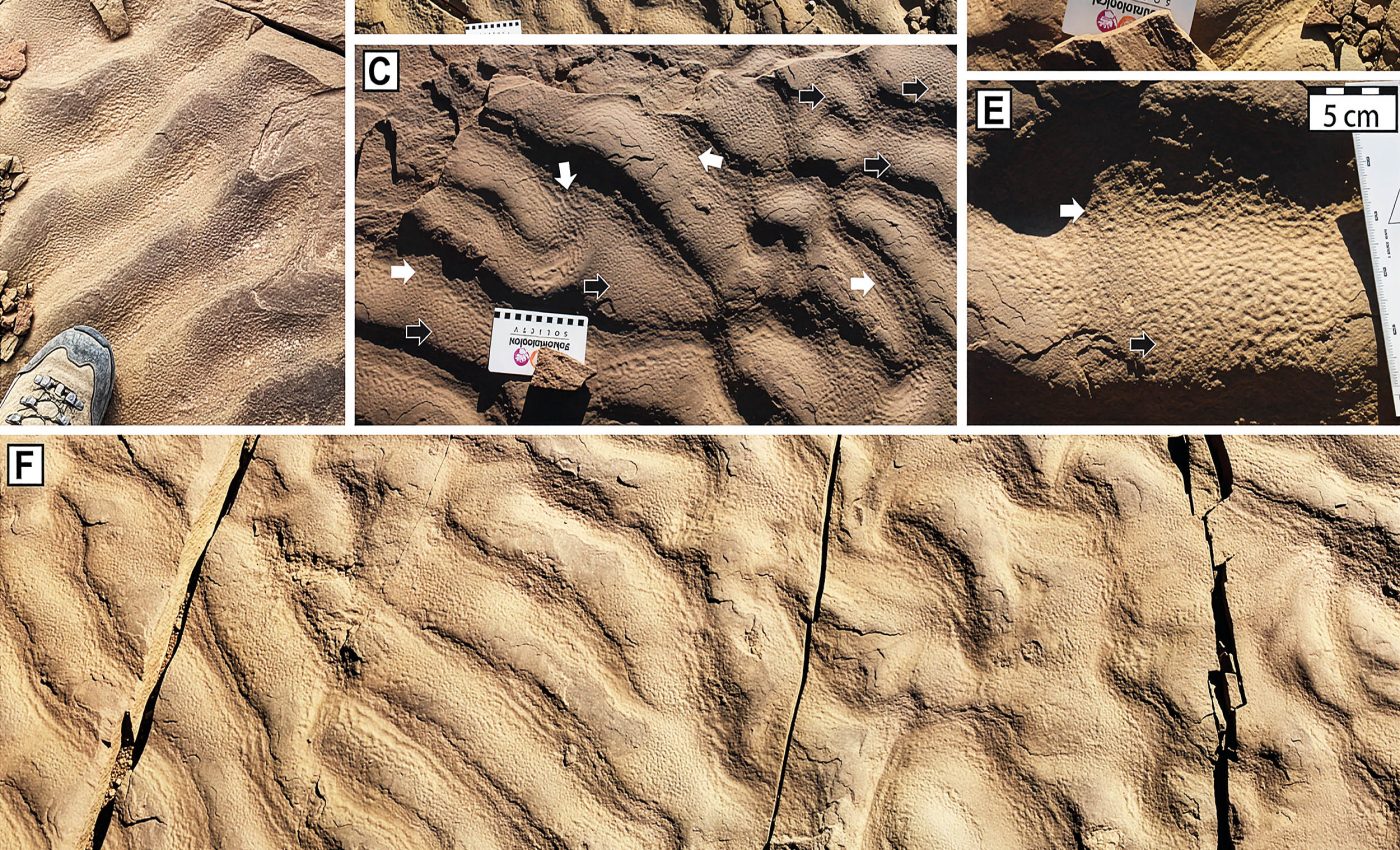
In a discovery that has fundamentally shifted our understanding of biology and the resilience of the “building blocks” of existence, an international team of geobiologists announced today that they have found fossilized evidence of ancient microbial life in a location previously thought to be a biological wasteland. The findings, centered in the Dadès Valley of Morocco’s High Atlas Mountains, reveal that complex microbial ecosystems thrived in the crushing, sunless depths of the ancient ocean—specifically within deep-water sediments known as turbidites—dating back approximately 180 million years to the Early Jurassic period.
The scientific community is stunned because these “wrinkle structures”—tiny, preserved ridges in the rock—were historically considered “postcards from the shallows.” For decades, it was a settled rule of paleontology that such textures were the work of photosynthetic microbial mats, which require sunlight and therefore only exist in shallow, coastal waters. However, the Moroccan site proves that these life forms were operating in the photic-null zone, at depths exceeding 180 meters, where sunlight cannot penetrate.
Redefining the Limits of Life
The discovery was led by Dr. Rowan Martindale, a renowned paleoecologist, who first noticed the anomalies while hiking through the rugged Moroccan terrain. The rocks in this region were once part of a deep-sea floor, yet they were covered in the delicate, wavy patterns typically associated with beach-adjacent algae. After years of rigorous chemical analysis and peer review, the team confirmed that these were not created by sun-loving plants, but by chemosynthetic microbes—organisms that harvest energy from chemical reactions rather than light.
“Let’s go through every single piece of evidence that we can find to be sure that these are wrinkle structures in turbidites,” said Dr. Martindale during the press briefing. “These structures shouldn’t be in this deep-water setting. It forces us to rethink the long-standing assumption that wrinkle structures are created only by photosynthetic microbial mats.”
The implications of this find are massive for Astrobiology. If life on Earth was thriving in high-pressure, pitch-black environments 180 million years ago, it significantly increases the statistical probability of finding similar ancient life in the subsurface oceans of Europa or the frozen crust of Mars.
Key Highlights of the Discovery
-
Unexpected Habitat: Life was found in deep-sea turbidites, sediments formed by underwater landslides, proving that life could survive—and be preserved—in high-energy, dark environments.
-
The Age of the Find: The fossils date back 180 million years, a period when dinosaurs dominated the land, but a “hidden world” of microbes was conquering the deep ocean.
-
Chemical Fingerprinting: Scientists detected elevated carbon concentrations beneath the wrinkles, a “smoking gun” for biological activity.
-
Preservation Miracle: The rapid burial of these microbes by underwater landslides protected them from oxygen and decay, essentially “flash-freezing” them in stone for millions of years.
A New Map for the Stars
The discovery coincides with recent data from the Perseverance Rover on Mars, which has been investigating “leopard spots” in Martian rocks—patterns that, on Earth, are almost always caused by microbial life. By finding an Earth-based equivalent in such an “impossible” location as the deep Moroccan seabed, NASA scientists are now more confident than ever in their search for extraterrestrial biosignatures.
“This is a game-changer for how we hunt for life on other planets,” noted Dr. Harshit Soni, a geologist specializing in ancient sedimentary deposits. “We used to look for ‘the light.’ Now, we know we need to look deeper into the dark, into the chemical signatures left behind in the most hostile corners of a planet’s crust.”
The Moroccan discovery proves that biological “wrinkles” are far more hardy than we gave them credit for. It suggests that even after mass extinctions or catastrophic climate shifts, life finds a way to retreat into the deep, carving out a niche where the sun never shines.
The Road Ahead
As of this morning, research teams are already planning new expeditions to the Vindhya region in India and the Son River Valley, where similar sedimentary structures have recently been reported. The goal is to determine if this “deep-dark” life was a global phenomenon or a localized miracle.
“The entire area seems to have been prone to meteoritic activities and unique geological shifts in the past,” explained Dr. SC Rai, principal of a leading research college involved in the exploration. “We are in talks with international institutes for further exploration. This area is very rich in fossils, and we suspect we have only scratched the surface of what’s buried here.”