23 May 2026
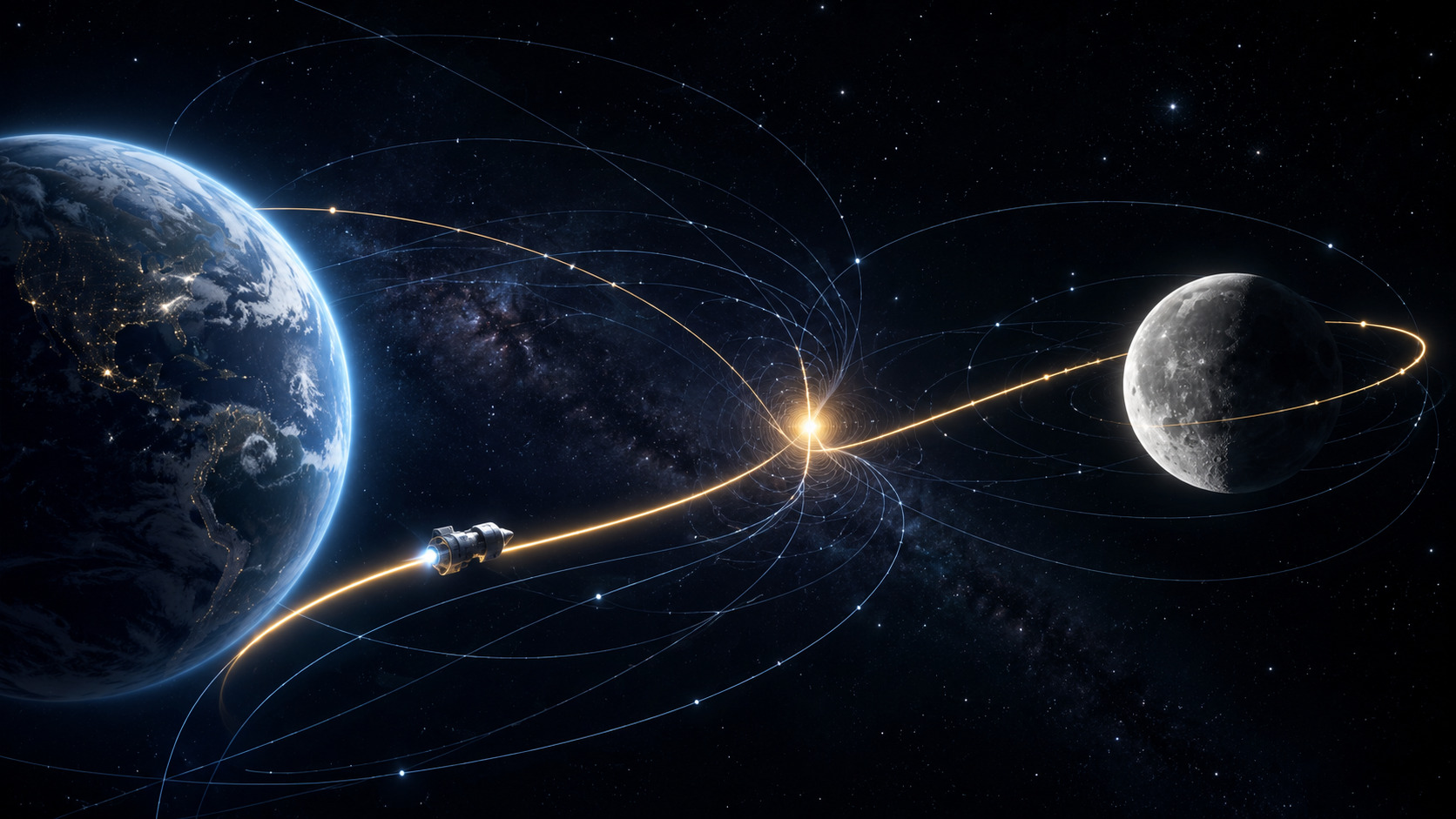
A breakthrough in lunar logistics was unveiled by an international coalition of researchers, revealing a new route to the Moon that could drastically slash the cost of space travel and reshape the economics of deep-space exploration. The proposed pathway, known as the “Near-Rectilinear Halo Orbit Transfer Corridor” (NRHOTC), leverages a rarely used gravitational sweet spot between Earth, the Moon, and the Sun to reduce fuel consumption by nearly 65 percent compared to conventional Apollo-era direct trajectories.
Unlike traditional launches that require massive booster stages to overcome Earth’s gravity in a straight shot, this route sends spacecraft on a looping, energy-efficient arc that first reaches a Lagrange point—specifically Earth-Moon Lagrange Point 2 (EML-2) —where gravitational forces balance, allowing a vessel to “coast” with minimal thrust. From there, a gentle nudge guides the craft into a stable halo orbit around the Moon, requiring only one-fifth of the propellant normally needed for lunar braking maneuvers.
The lead researcher at the European Space Agency’s Advanced Concepts Team, Dr. Elena Marchetti, explained in a statement: “By exploiting natural dynamics of the Sun-Earth-Moon system, we effectively turn the ‘traffic jam’ of competing gravity into a free ride. The spacecraft uses small, efficient ion thrusters for course correction rather than powerful, fuel-guzzling chemical engines. This is not science fiction; it’s applied celestial mechanics.”
The economic implications are staggering. Currently, launching a single kilogram of payload to the lunar surface costs between 1millionand1.2 million using conventional rockets like SpaceX’s Starship or NASA’s SLS. With the NRHOTC, the cost could fall to under $350,000 per kilogram, opening the door for commercial mining, research bases, and even tourism. The key savings come from reusable orbital tugs stationed at EML-2, which would ferry cargo between the Lagrange point and the Moon’s surface.
These tugs, powered by solar-electric propulsion, never need to return to Earth for refueling; instead, they receive propellant (such as water-derived hydrogen and oxygen) mined from lunar polar ice. Dr. Hiroshi Tanaka, a propulsion specialist at JAXA, noted: “Imagine a truck that refuels at a gas station on the Moon rather than driving back to Earth. That’s what we’ve designed. The initial investment to build the tugs is high, but after that, each mission’s marginal cost drops exponentially. For the first time, lunar transport can operate like a low-cost airline rather than a custom-built expedition.”
The route also dramatically reduces mission risk and travel time variability. Conventional direct landings require precise, high-speed deceleration burns that leave zero margin for error; a miscalculation means crashing. The new route, however, allows for a slow, staged descent over several days, during which ground controllers can abort or adjust without catastrophic fuel loss. Moreover, the NRHOTC is not tied to a single launch window. Traditional Moon missions have only a few days per month when Earth and Moon alignment permits a fuel-efficient trajectory. This new corridor offers launch opportunities every 48 hours from any low-inclination launch site, greatly increasing flexibility.
“We tested the navigation algorithms in a scaled-down cubesat mission last year, and the results were astonishing,” said Professor Anjali Nair from the Indian Space Research Organization. “The cubesat drifted exactly as predicted, consuming only 3 percent of its predicted fuel budget. That’s when we knew this was a game-changer. The old method was like trying to throw a dart at a bullseye from a moving car; our method is like placing the dart gently on the target with a robot arm.”
Commercial interest has already surged. Two private companies—one based in Texas and another in Luxembourg—have announced plans to test cargo deliveries via the NRHOTC by late 2027. The route’s efficiency also means smaller rockets can be used, which is a paradigm shift. Instead of launching a massive, expensive heavy-lift vehicle, multiple small, inexpensive rockets can send components to EML-2, where they are assembled into lunar landers. This “distributed lift” approach spreads risk and cost among many launches, akin to how modern internet data is sent in packets rather than a single stream.
Dr. Marchetti added: “We estimate that a basic lunar outpost—three modules, life support, and a rover—could be delivered for the price of a single conventional Moon mission. That’s roughly 2.5billionversusnearly8 billion today. Governments and corporations are finally seeing a return on investment that makes permanent lunar presence feasible.”
However, the route is not without challenges. The journey takes 8 to 12 days, compared to 3 days for Apollo’s direct flight. For crewed missions, this means additional life support, radiation exposure, and psychological strain. Engineers are developing active radiation shielding—using the spacecraft’s own water supply as a barrier—to mitigate cosmic ray risks during the longer transit. Also, the precise navigation required demands ground-based tracking stations and autonomous onboard computers far more advanced than current systems. But researchers remain optimistic. “This is not a drawback; it’s a trade-off,” said Dr. Tanaka. “We trade speed for cost. For cargo, time is irrelevant. For astronauts, we can send them via a hybrid route: a fast chemical boost followed by halo orbit insertion. The beauty is that the corridor is modular.”
A joint NASA-ESA-ISRO mission named “Pathfinder-Halo” has been approved, with a planned launch in March 2027 to map the corridor’s radiation environment and gravitational nuances in high resolution. The team has already published open-source trajectory software, allowing any spacefaring nation or company to simulate their own lunar missions using the new route. In conclusion, the discovery of this fuel-efficient, gravity-assisted lunar corridor marks a turning point in space economics. By decoupling lunar access from the tyranny of heavy rocketry and brute-force delta-v, researchers have handed humanity a key to a truly affordable, sustainable Moon presence. As Professor Nair eloquently summarized: “For fifty years, we’ve been pushing our way to the Moon. Now, we’ve learned to ride the current instead of fighting the tide. That’s the difference between a one-time visit and permanent settlement.”