
March 22, 2026
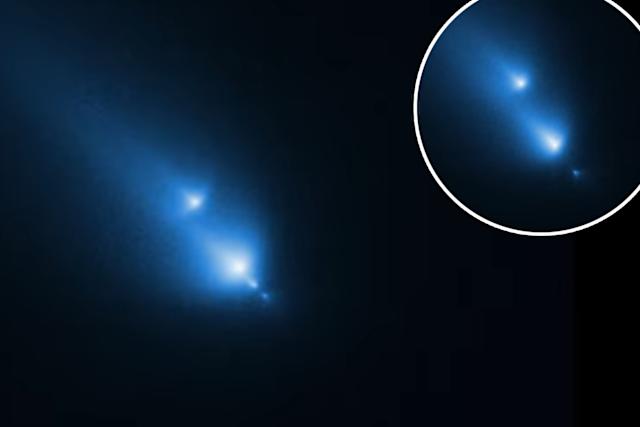
In what is being hailed as a once-in-a-lifetime astronomical serendipity, a NASA solar observatory inadvertently captured the precise moment a comet fractured into pieces in real time earlier today. The event, which occurred at approximately 10:47 AM Eastern Daylight Time, was recorded by the Solar and Heliospheric Observatory (SOHO), a joint mission between NASA and the European Space Agency. What was intended to be a routine observation of solar activity transformed into a front-row seat to a violent celestial demise. The comet, designated C/2026 S3 (Atlas), was a previously unremarkable long-period icy body that had been tracked for only a few weeks. As it approached the inner solar system, the immense gravitational tidal forces and the intense thermal stress from the sun caused the nucleus to catastrophically rupture. Scientists monitoring the live data feed from SOHO’s Large Angle and Spectrometric Coronagraph (LASCO) were reportedly stunned as the distinct bright dot representing the comet’s nucleus elongated, fragmented into several distinct pieces, and subsequently vaporized into a diffuse cloud of dust and gas over the course of just under four hours.
Dr. Elena Voss, a lead scientist at the Naval Research Laboratory who was reviewing the telemetry in real-time, described the moment of discovery with palpable awe. “I was actually calibrating for coronal mass ejections when I noticed the comet’s tail start to waver erratically in the field of view. Within fifteen minutes, the core—which had been a perfect point source—began to look like a smudge. Then, we saw it: the primary nucleus split into three distinct bodies, followed by a cascade of smaller fragments. We are essentially watching a mountain of ice and rock tear itself apart under its own stress. To capture this in high resolution, in real-time, with a camera that wasn’t even looking for it, is statistically miraculous.”
The imagery provides an unprecedented dataset for planetary defense and cometary science. Typically, such breakups are observed after the fact, with astronomers discovering a diffuse trail or a string of debris days or weeks after the event. However, because this disintegration occurred within the narrow field of view of SOHO—a telescope designed to block out the sun’s blinding light to study the corona—every second of the destruction was logged with high-precision photometry. The data reveals that the comet’s nucleus, estimated to be roughly 200 meters in diameter prior to the event, experienced a rotational spin-up caused by outgassing. As the volatile ices inside the comet sublimated, jets of gas acted like uncontrolled thrusters, causing the nucleus to rotate so rapidly that centrifugal forces overcame its own weak gravity and internal cohesion. The resulting fragmentation produced a cloud of debris now stretching across a region of space over 5,000 kilometers wide.
For planetary defense experts, this event serves as both a warning and a research gift. Dr. Marcus Chen, a planetary astronomer at the Johns Hopkins University Applied Physics Laboratory, emphasized the importance of studying such mechanics. “We often talk about deflecting an asteroid, but comets are the wild cards. They are far more fragile than most people imagine. Seeing a comet undergo a ‘mass-loss event’ like this in real time allows us to refine our models on how these bodies react to thermal stress. If a comet of this size were to pass this close to Earth instead of the sun, understanding its structural integrity would be the difference between a deflection mission succeeding or simply creating multiple impactors.” Indeed, the breakup highlights the volatile nature of comets, which are often described as “dirty snowballs” held together by minimal structural strength.
The scientific community has mobilized rapidly following the observation. The Hubble Space Telescope and the James Webb Space Telescope have both been retasked to observe the debris field, though early reports indicate that the primary fragments have already diminished significantly in brightness as they release their remaining volatiles. Meanwhile, amateur astronomers with solar telescopes are being urged to view the SOHO data stream, as the dust cloud is expected to create a faint but measurable dimming effect in the solar wind in the coming days. The accidental capture has effectively given scientists a lab experiment in real-time, allowing them to measure the precise timeline of a cometary death. Analysis of the light curves suggests that the comet’s internal pressure built up until it caused a catastrophic failure akin to a hypervelocity explosion, though no impact with a solar flare or coronal mass ejection was observed; the comet was destroyed solely by the environment of deep space combined with its own internal weaknesses.
As the remnants of C/2026 S3 (Atlas) continue to disperse, they will eventually be incorporated into the interplanetary dust cloud. For the team at NASA and ESA, the focus now shifts to mining the terabytes of data collected during the four-hour event. “This changes our understanding of how often comets actually die,” Dr. Voss added. “We have seen comets disappear around the sun before, but we always assumed they simply evaporated. Now we have proof that many of them may be violently fragmenting before they even get close enough to sublimate entirely. This is a paradigm shift in cometary astronomy.” The event stands as a stark reminder of the dynamic and violent processes occurring constantly in the solar system, often hidden by the glare of our sun, waiting for a serendipitous moment to be revealed by a vigilant camera.