March 24, 2026
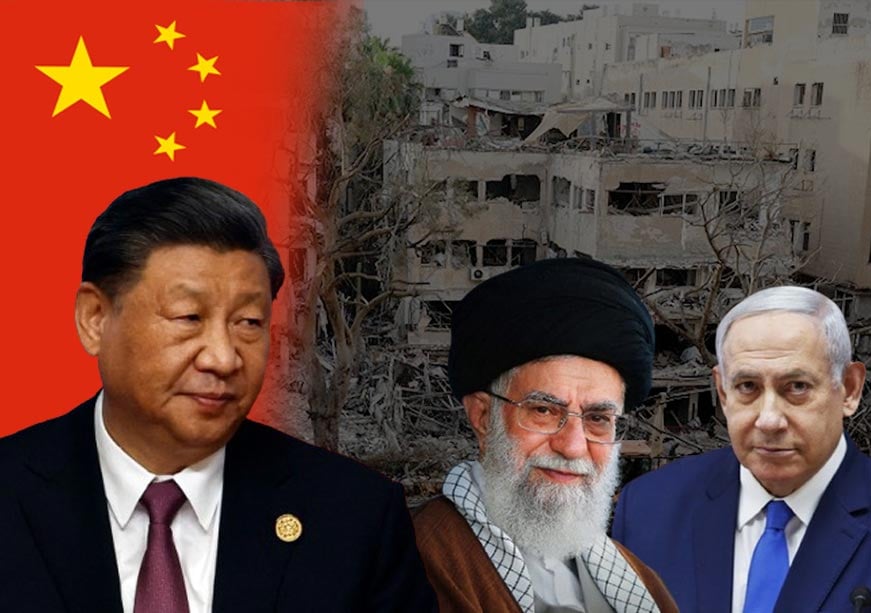
As the conflict between US-Israeli forces and Iran enters its fourth week, China’s diplomatic machinery has been operating at full throttle, attempting to navigate what it calls a “war that should not have happened” . Since the outbreak of hostilities on February 28, 2026, Beijing has adopted a calibrated stance that balances its long-standing principles of non-interference with its urgent strategic interests, primarily energy security and regional stability. The Chinese government has moved from issuing condemnatory statements to conducting intensive shuttle diplomacy, all while ensuring the safety of its citizens and securing its economic lifelines through the Strait of Hormuz. China’s position is defined by a clear call for an immediate cessation of military operations, a rejection of the unilateral use of force, and a push for a political solution that respects the sovereignty of all nations involved, including Iran and the Gulf Arab states.
In the immediate aftermath of the strikes that reportedly killed Iran’s former Supreme Leader, China’s Foreign Ministry was quick to voice its grave concern. Official statements from Beijing have consistently framed the conflict as a dangerous escalation with global repercussions. Chinese Foreign Minister Wang Yi, during a press conference on the sidelines of the National People’s Congress on March 8, famously declared that “this war should not have happened, and it benefits no one” . He invoked classical Chinese philosophy to underscore the point, citing Han Feizi’s dictum that “war is a weapon of destruction; its use must be carefully considered” . This rhetorical framing is crucial; it allows China to position itself as a responsible major power advocating for peace and stability, contrasting itself with what it implies is the reckless behavior of the United States and its allies. The official state-run Xinhua news agency went further, characterizing the initial attacks as “brazen aggression against a sovereign nation” and an example of “power politics and hegemony” that violates the fundamental norms of international relations .
China’s diplomatic efforts have been characterized by intensive high-level engagement aimed at preventing a wider conflagration. In early March, Foreign Minister Wang Yi held a series of phone calls with his counterparts from key regional and international players, including Russia, Iran, Oman, France, Israel, Saudi Arabia, and the UAE . These calls were not merely symbolic; they were part of a concerted effort to build a consensus for de-escalation. Chinese Foreign Ministry spokesperson Mao Ning emphasized that China was “intensively reaching out to various parties” to urge an immediate halt to military operations and a return to dialogue . The core message delivered during these calls was a rejection of the “arbitrary use of force” and a reminder that the protraction and escalation of the conflict serve no one’s interests . This diplomatic blitz was accompanied by a more tangible form of engagement: the deployment of Special Envoy Zhai Jun to the Middle East for “shuttle diplomacy” .
The mission of Special Envoy Zhai Jun, who arrived in the region shortly after the conflict began, highlights China’s ambition to play a direct role in mediation, moving beyond mere rhetorical condemnation. According to Foreign Ministry spokesperson Guo Jiakun, the envoy’s objective is to “bring about an immediate stop to the military conflict and to bring parties concerned back to the negotiation table” . While the specifics of his itinerary were not fully disclosed to maintain diplomatic discretion, his presence in the region signals Beijing’s intent to leverage its relationships with all sides, including Iran and the Gulf Cooperation Council (GCC) states. This is a delicate balancing act. On one hand, China maintains a comprehensive strategic partnership with Iran and is its largest oil customer. On the other, it has deep economic ties with Saudi Arabia and the UAE, with bilateral trade volumes reaching approximately $300 billion in 2024 . Beijing’s mediation efforts are thus driven by a pragmatic need to preserve its influence across the board, avoiding being drawn into a zero-sum game between Tehran and Washington.
A critical test of China’s impartiality came during the United Nations Security Council proceedings. On March 11, Chinese Ambassador to the UN Fu Cong delivered a stark explanation of China’s vote on a draft resolution concerning the situation. While China expressed deep concern and supported the efforts of Gulf states, Fu Cong stated that China had “no choice but to abstain” from the vote because the draft resolution did not “fully reflect the root cause and the overall picture of the conflict in a balanced manner” . This diplomatic maneuver is highly significant. By abstaining, China avoided endorsing a text that likely placed primary blame on Iran, while also refraining from a veto that would have alienated the US and its Gulf partners. In his address, Fu Cong made Beijing’s position unequivocal, stating that the “fundamental way to prevent further deterioration of the situation is for the United States and Israel to cease their military operations” . He emphasized that the outbreak of this war “lacks justification and legitimacy,” and warned that the entire region risks being pushed into a “dangerous abyss” .
Despite its condemnation of the initial strikes, China has also shown a pragmatic understanding of the security concerns of the Gulf Arab states, who are often the target of retaliatory actions. Fu Cong explicitly stated that China “does not go along with Iran’s attacks against the Gulf Arab states,” and condemns “all indiscriminate attacks against innocent civilians and non-military targets” . This position is a crucial aspect of Beijing’s balancing act. It reassures Saudi Arabia and the UAE that China’s relationship with Iran does not come at the expense of their security. This aligns with China’s broader interest in protecting its massive investments and trade relationships in the wealthy Gulf monarchies. Foreign Minister Wang Yi reinforced this by emphasizing that “the sovereignty, security, and territorial integrity of Iran and Gulf states must be respected” . This even-handed approach is designed to preserve the diplomatic gains China has made in the region, particularly the 2023 Beijing-brokered rapprochement between Saudi Arabia and Iran. When asked about the impact of the war on that agreement, Foreign Ministry spokesperson Guo Jiakun noted that the reconciliation between the two regional powers was a “shared strategic asset of all countries in the region, and needs to be doubly cherished” .
Underpinning all of Beijing’s diplomatic and political calculations is the issue of energy security. As the world’s largest importer of crude oil, China has an existential interest in the stability of the Strait of Hormuz, through which approximately 50% of its Gulf oil imports pass . The current conflict has directly threatened this chokepoint, prompting urgent action from Beijing. China is heavily reliant on Iranian oil, absorbing the vast majority of its seaborne exports at discounted prices, with roughly 13% of China’s total seaborne crude oil imports originating from Iran . The primary concern for Beijing is not just the loss of Iranian supply, but the broader risk of surging global oil prices and the attendant drag on the Chinese economy . In response to the crisis, China has taken extraordinary measures to protect its economic interests and its citizens. The Foreign Ministry and the Civil Aviation Administration worked together to boost flight capacity, successfully evacuating over 10,000 Chinese passengers from the UAE, Oman, and Saudi Arabia . Furthermore, Chinese diplomatic missions issued urgent calls for citizens to leave Iran and Israel . The Chinese government also reportedly asked its largest oil refiners to halt exports of diesel and gasoline to conserve fuel for domestic use, a clear indicator of the level of concern regarding potential supply chain disruptions .
Political analysts observing China’s response characterize it as a masterclass in pragmatic neutrality, driven by a sober calculation of national interests rather than ideological alignment. “China’s neutrality is rooted in a sober calculation of its interests in the Middle East,” notes a recent analysis from the Future Center, a think tank. “Chinese engagement with Iran is primarily economic in nature—concentrated in energy and infrastructure—and is better characterized as tactical rather than strategic” . This analysis suggests that Beijing is carefully calibrating its stance to avoid running afoul of American sanctions while still maintaining its energy lifeline. “Beijing takes care not to run afoul of American sanctions imposed on Tehran, a posture that reinforces the fundamentally interest-driven logic underlying its apparent neutrality,” the analysis adds .
The conflict has also reignited debates about the reliability of China as a strategic partner. “Critics point to a pattern of limited Chinese engagement during crises involving countries with which Beijing claims close ties,” the Future Center report observed, citing previous instances with Venezuela and even Iran during a 2025 conflict. “Together, these cases underscore the cautious, risk-averse approach that defines Beijing’s management of its international relationships” . This risk-averse approach is further evidenced by China’s aversion to direct military involvement. “China avoids deploying its military in distant, high-instability regions such as the Middle East, favoring instead diplomatic and economic tools in support of its partners” . The current conflict, in this sense, is seen not as an exception but as a reflection of the precise role Beijing has chosen to play in the region.
Looking ahead, the war carries significant potential repercussions for China’s strategic interests, particularly its relationship with the United States. With US President Donald Trump scheduled to visit Beijing in April, both powers have a vested interest in preventing bilateral tensions from boiling over in the context of this regional conflict. “The war presents a complex set of implications for Sino-American relations… At the bilateral level, the conflict is unlikely to fundamentally unsettle the current equilibrium, given both powers’ shared interest in managing competition without escalation” . However, the broader geopolitical impact remains uncertain. “A swift American military success could free up resources for a rebalancing of US military capabilities toward the Indo-Pacific to counter Chinese influence. Conversely, a prolonged conflict that continues to absorb a significant share of American military attention… could temporarily diminish Washington’s focus on the region—a development that would factor into Beijing’s calculus regarding the South China Sea and Taiwan” .
At present, China’s stand on the Israel-Iran war is one of “pragmatic neutrality” . It is a position that allows Beijing to condemn the use of force in principle, protect its energy supplies, maintain lucrative ties with both Iran and the Gulf Arab states, and avoid a direct confrontation with the United States. Through a combination of high-level phone diplomacy, the dispatch of a special envoy, and careful maneuvering at the UN Security Council, China is attempting to position itself as a credible mediator and a responsible global power, even as it takes concrete steps to insulate its own economy and citizens from the war’s escalating fallout.