
May 19, 2026
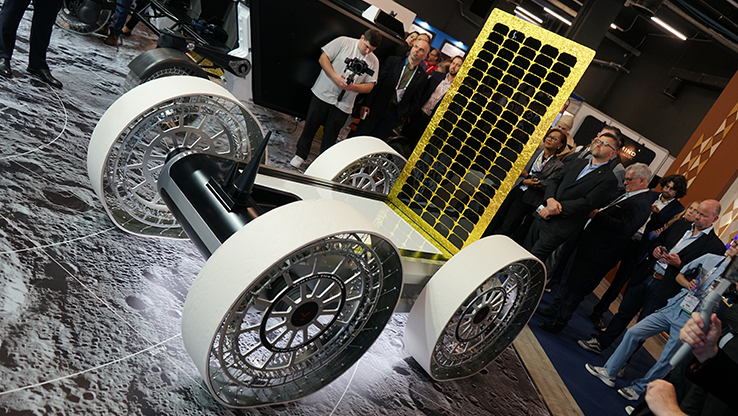
In a significant step for commercial lunar exploration, Astrolab has confirmed that four sophisticated NASA payloads will fly aboard its debut lunar rover, the FLEX Lunar Innovation Platform (FLIP), when it launches to the Moon’s South Pole later this year. The announcement, made jointly by the Hawthorne, California-based rover developer and the agency on May 18, solidifies the scientific agenda for a mission poised to lay critical groundwork for the Artemis campaign.
FLIP is scheduled to touch down on the lunar surface aboard Astrobotic’s Griffin-1 lander as part of NASA’s Commercial Lunar Payload Services (CLPS) initiative, with a launch window currently targeted for late 2026 . The mission represents a rapid, non-reimbursable collaboration between Astrolab and various NASA centers, utilizing Space Act Agreements that prioritize speed and scientific return over financial exchange, ensuring that the rover’s tight production schedule remains on track for integration by the end of the summer .
The selection of instruments highlights a strategic focus on resource utilization, navigation, and environmental mitigation—all essential components for sustaining a long-term human presence on the Moon. Leading the payload manifest is the Moon Exploration for Titanium with Active Lighting (METAL) , provided by NASA’s Ames Research Center in partnership with Interlune. This multicolor camera and radiometer is designed to perform a task that could define the economics of future lunar bases: estimating the concentration of helium-3 in the lunar regolith. Helium-3, a rare isotope scarce on Earth but abundant on the Moon, is theorized to be a potent fuel for future nuclear fusion reactors. *Researchers involved in the project emphasize the transformative potential of this survey, stating, “Understanding the distribution and concentration of helium-3 is the first step toward in-situ resource utilization. If we can locate viable reserves, we turn the Moon from a destination into a supply depot for Earth and deep space exploration”* .
In addition to prospecting, the rover will carry a permanent landmark to the lunar South Pole. NASA’s Goddard Space Flight Center has provided a Laser Retroreflector Array (LRA) , a dome-shaped array housing eight quartz corner-cube prisms. Unlike active electronics, this device requires no power or maintenance and will serve a dual purpose: while the rover is active, orbiting spacecraft will bounce lasers off the LRA to achieve precision geolocation of the vehicle. However, its most enduring legacy will occur long after FLIP’s batteries die. Scientists at Goddard note, “This retroreflector turns the rover into a permanent fiducial marker. Decades from now, long after dust has settled on the solar panels, this small array will still be there, acting as a reliable survey point for navigational satellites and future manned landers targeting the same region” .
Two additional payloads address the harsh realities of the lunar environment. The Lunar Dust level sensor and Effects on Surfaces (LDES) , hailing from the Johnson Space Center, will tackle the issue of regolith abrasion—the jagged, electrostatic dust that wreaks havoc on machinery. LDES will specifically quantify how dust buildup degrades critical systems, such as the loss of cooling efficiency in radiators and the reduction of power generation in solar arrays.
Researchers studying the lunar surface warn that dust is the ‘silent killer’ of lunar missions, stating, “We’ve learned from Apollo that dust gets everywhere. With LDES, we are moving from anecdotal evidence to hard data. By anchoring predictive models of thermal degradation, we can design future Moon bases that actually survive the night without losing life support to a dust short circuit” . Rounding out the foursome is a hardened LiDAR demonstration from the Marshall Space Flight Center. This system will generate high-resolution 3D surface maps to enable autonomous navigation and hazard avoidance, even in the permanently shadowed regions of the South Pole where sunlight never reaches .
Astrolab CEO Jaret Matthews expressed pride in the agency’s trust, emphasizing that FLIP’s design is uniquely capable of hosting such a diverse suite. Unlike traditional rovers that require complex deployment ramps, FLIP can egress directly from the top of the Griffin lander, reducing mechanical risks . As the mission primes the pump for Astrolab’s larger FLEX rover—a vehicle selected for NASA’s Lunar Terrain Vehicle (LTV) program—these payloads will ensure that even this preliminary scouting mission delivers high-value science. Matthews reiterated the urgency of the timeline, stating, “We have a closing window to get this hardware ready. FLIP is effectively complete; we are moving into thermal vacuum and vibration tests now. The goal is to have this rover on the launch pad by the end of summer, ready to show that commercial mobility is the key to unlocking the lunar economy” .