March 26, 2026
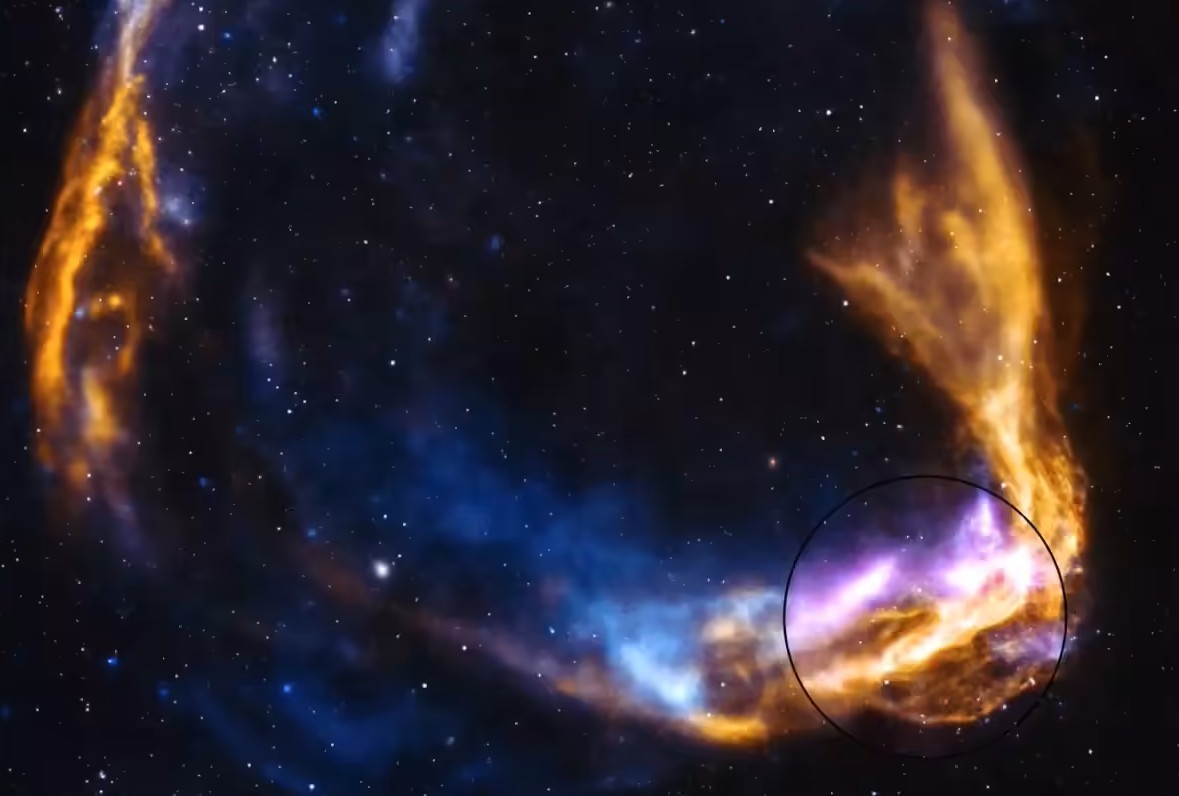
In a discovery that closes one of astronomy’s longest-standing cold cases, NASA has finally unraveled the mystery behind a 2,000-year-old cosmic explosion first recorded by ancient Chinese astronomers. For nearly two millennia, the origins of a brilliant “guest star” witnessed in 185 AD remained elusive, but a new study combining data from NASA’s Chandra X-ray Observatory and the Imaging X-ray Polarimetry Explorer (IXPE) has revealed the truth hidden within a massive cosmic bubble. The event, now known as supernova remnant RCW 86, has long baffled scientists due to a glaring inconsistency: historical records described a stellar explosion that occurred roughly 2,000 years ago, yet the debris field spans an astonishing 85 light-years across—a size typically associated with remnants nearly 10,000 years old . This paradox remained unresolved until researchers realized they were not looking at a typical supernova remnant, but rather the aftermath of an explosion that occurred inside a pre-existing, low-density cavity carved out by the star itself before it died.
The solution to this ancient puzzle lies in the final moments of the star’s life. Before it detonated, the progenitor star acted like a cosmic leaf blower, expelling massive amounts of material through powerful stellar winds that swept the surrounding interstellar medium clean, creating a hollowed-out bubble of nearly empty space . “The star essentially created its own vacuum,” explained one of the lead researchers involved in the Chandra study. “Because there was almost no gas to slow it down, the debris from the explosion shot outward at incredible speeds—over 10 million kilometers per hour—expanding far more rapidly than it would have in a denser environment” . This explains why RCW 86 grew to such immense proportions in a relatively short period, solving the 2,000-year-old size discrepancy that had puzzled astronomers since the remnant’s discovery.
However, the most dramatic part of the story unfolded when the speeding debris finally reached the edge of the cavity. Instead of dissipating, the material slammed into the denser gas wall at the bubble’s boundary, triggering a violent reverse shock wave—a cosmic “bounce back” effect . Just as ocean waves crash against a cliff and rebound, the shock wave ricocheted back toward the center of the explosion. This reverse shock performed a remarkable feat of recycling: it reheated the cold, ejected gas from the original blast to temperatures reaching several million degrees, causing it to glow brightly in X-ray light . It was precisely this high-energy X-ray emission, captured by Chandra, that allowed scientists to detect the hidden cavity and map the full extent of the rebound. “We are witnessing the aftermath of a stellar explosion that not only expanded into a void but then collided with its own walls, creating a second wave of heat and energy that we can see today,” a NASA astrophysicist noted during the press briefing, highlighting the unique physics of this event .
The implications of this discovery extend far beyond solving a historical mystery. RCW 86 is classified as a Type Ia supernova, a category of stellar explosion that serves as a “standard candle” for measuring cosmic distances . Because these explosions are thought to occur under specific conditions, they have a predictable intrinsic brightness, allowing astronomers to calculate how far away they are and, consequently, how fast the universe is expanding. However, this new research demonstrates that the environment surrounding a Type Ia supernova—whether it explodes into a dense interstellar medium or a pre-carved cavity—can significantly alter its observable properties. “By understanding how the surrounding density affects the shape and expansion of these explosions, we can calibrate our cosmic rulers more precisely,” a scientist from the Chandra X-ray Center explained. “This refinement is crucial as we continue to study dark energy, the mysterious force driving the accelerated expansion of the universe” .
The breakthrough was made possible by a combination of advanced X-ray telescopes working in concert. While Chandra provided the high-resolution imaging necessary to identify the super-heated gas and the reverse shock, IXPE added a new dimension by measuring the polarization of X-rays, helping to map the magnetic fields and shock dynamics at the southwestern rim of the remnant . This multi-telescope approach provided a complete picture of how the explosion evolved from the moment of the star’s death to the present day. For nearly 1,800 years, the “guest star” of 185 AD remained a footnote in ancient texts, a celestial event observed by Chinese astronomers who documented its eight-month-long visibility. Now, thanks to modern astrophysics and the keen eyes of NASA’s X-ray observatories, the hidden physics behind that ancient light has been fully revealed, turning a historical curiosity into a cornerstone for understanding the very structure and expansion of our universe .