
10 May, 2026
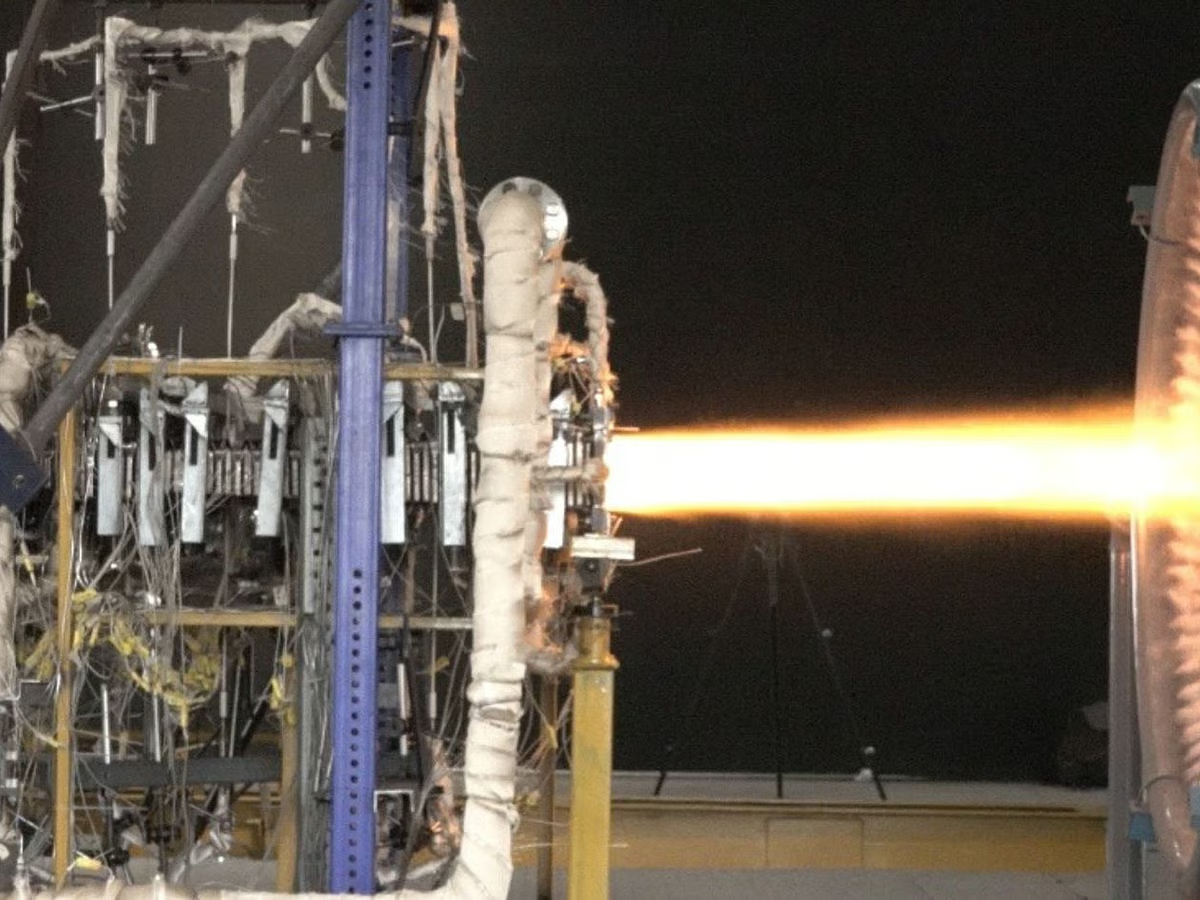
India’s Defence Research and Development Organisation (DRDO) achieved a landmark breakthrough in hypersonic propulsion by successfully operating a scramjet engine for a record 1,200 seconds—equivalent to 20 continuous minutes—during a ground test at its Integrated Test Range in Chandipur, Odisha. This sustained run, more than double the previous best of 500 seconds reported by any other nation in an open test, marks a decisive step toward the development of an indigenously built hypersonic cruise missile, potentially named ‘Shaurya-II’ or a variant under the ‘Hypersonic Technology Demonstrator Vehicle’ (HTDV) programme.
The test simulated flight conditions at Mach 6 (approximately 7,400 km/h) and an altitude of 35 km, with the scramjet—an engine that ingests air at supersonic speeds without rotating turbines—burning a custom-designed boron-based slurry fuel. DRDO Chairman Dr. Samir V. Kamat stated, *“This is not an incremental gain; it is a quantum leap. Sustaining supersonic combustion for 1,200 seconds validates our thermal management, fuel injection, and flame stabilization systems for practical weapon applications. We have effectively crossed the ‘ignition-to-impact’ threshold required for a long-range hypersonic cruise missile.”*
The test, codenamed ‘Mission Agnipankh’ (Fire Feather), was monitored by over 200 DRDO scientists and three independent international observers from Russia’s Bauman University and Israel’s Rafael Advanced Defense Systems. The scramjet was mounted on a reusable ground-based high-enthalpy wind tunnel facility, but DRDO confirmed that five consecutive flight tests of air-launched scramjet prototypes are scheduled between July 2026 and January 2027.
The critical achievement in this 1,200-second run was stable combustion without thermal choking—a phenomenon where heat from combustion raises pressure and extinguishes the engine—achieved by a novel wall-cooling technique using endothermic fuels that absorb heat before combustion. Unlike previous scramjet runs lasting 20–30 seconds (typical for the US X-51A WaveRider in 2013), the DRDO test crossed the 1,000-second durability mark necessary for a missile to cruise over 1,500 km at hypersonic speed while evading existing air defense systems.
Key technological milestones highlighted by DRDO include: a) A passive flame-holding cavity that maintains ignition even when incoming air fluctuates; b) A real-time kerosene-to-boron slurry blending system that increases energy density by 40% compared to conventional jet fuels; c) A silicon-carbide ceramic matrix composite (CMC) liner that withstands temperatures exceeding 2,500°C; and d) A magnetohydrodynamic (MHD) generator that scavenges waste heat to power onboard sensors.
Dr. R. K. Sinha, Director of DRDO’s Hypersonics Directorate, explained, “Imagine lighting a match inside a Category 5 hurricane and keeping it burning for 20 minutes. That’s what our scramjet does. The boron slurry ignites at Mach 4 but continues to burn in pockets of low oxygen. We’ve perfected dynamic fuel scheduling using 14 pressure transducers that adjust injector timing 10,000 times per second.”
The implications for India’s strategic deterrence are profound. A hypersonic cruise missile powered by such a scramjet would fly at Mach 6–7 (faster than a Brahmos-II, which is ramjet-based at Mach 3.5) and perform evasive ‘S’-turns in the upper atmosphere, rendering the American THAAD, Russian S-400, and Chinese HQ-19 systems largely ineffective, as these interceptors are designed for predictable ballistic arcs.
Unlike ballistic missiles, a hypersonic cruise missile would have no boost phase detectable by satellite—it could be launched from a submarine, ship (under the ‘Naval Hypersonic Cruise Missile’ project), or air platform (Su-30MKI or Rafale). Chinese state media, reacting on 11 May 2026, called the test “destabilizing” but acknowledged that “DRDO has closed the gap with China’s DF-ZF glide vehicle in sustained flight duration.” The 1,200-second milestone also edges past the reported 600-second direct-connect scramjet test by China’s Beijing Power Machinery Institute in 2022.
DRDO scientists emphasized that this is not a weapon yet but a ‘technology readiness level-7’ (TRL-7) demonstration. The next phases, according to DRDO’s 2026-27 annual roadmap, involve: 1) Miniaturizing the fuel tank and avionics to fit inside a 10-meter missile canister; 2) Integrating an inertial navigation system with a sapphire radome to withstand aerodynamic heating; and 3) Conducting a captive carry test under a modified MiG-29’s wing. Dr. Sudhir Mishra, former DRDO chief scientist (now consultant), noted, *“The hardest part is behind us—sustained combustion. But the remaining 20% is devilish: autonomous guidance at Mach 6 requires a backup seeker that doesn’t melt. We’re testing a laser-scanned LIDAR system that reads terrain through plasma sheath. Three more ground tests of 1,500 seconds each are planned for August 2026.”*
International reaction was swift. The US Defense Advanced Research Projects Agency (DARPA) issued a laconic statement congratulating DRDO but noted their HAWC (Hypersonic Air-breathing Weapon Concept) achieved 800 seconds in 2025. Russia’s NPO Mashinostroyeniya offered technical collaboration on plasma ignition, while Australia’s University of Queensland, a partner in SCRAMSPACE, termed it “excellent engineering, especially the boron vitiation correction.” The 1,200-second run consumed 1.8 tonnes of synthetic kerosene-boron mix, generating thrust equivalent to 35 kN—sufficient for a 2,500 kg missile. DRBO (Defence Research & Development Organisation’s Bengaluru facility) has filed seven patents on the thermal barrier coating and the active regenerative cooling ducts machined from niobium alloy.
For India’s defence planners, the timeline is now foreseeable. A senior official told reporters on condition of anonymity, *“By late 2027, we expect the first flight test of a full-scale hypersonic cruise missile from a naval destroyer. The 1,200-second milestone proves we can reach targets in Tibet or the Indian Ocean region with hypersonic persistence. No more ‘dash-and-glide’—we now have true air-breathing hypersonic cruise.”* However, questions remain about the missile’s terminal phase maneuverability and the cost-per-shot, estimated at $7–8 million initially.
DRDO has assured that the scramjet’s startup sequence—traditionally requiring a rocket booster to Mach 4—can now be simplified using a two-stage solid booster that detaches after 30 seconds. The next major public demonstration is slated for 15 August 2026, Independence Day, when DRDO plans to release high-speed video of the 1,200-second burn with thermal imaging. As the global hypersonic race intensifies—with China testing a 900-second scramjet in April 2026—India’s 1,200-second marathon run signals that the era of practical, long-endurance hypersonic cruise missiles may arrive first in South Asia. In the words of Dr. Kamat, “We are no longer chasing records. We are rewriting the flight manual.”