March 26, 2026
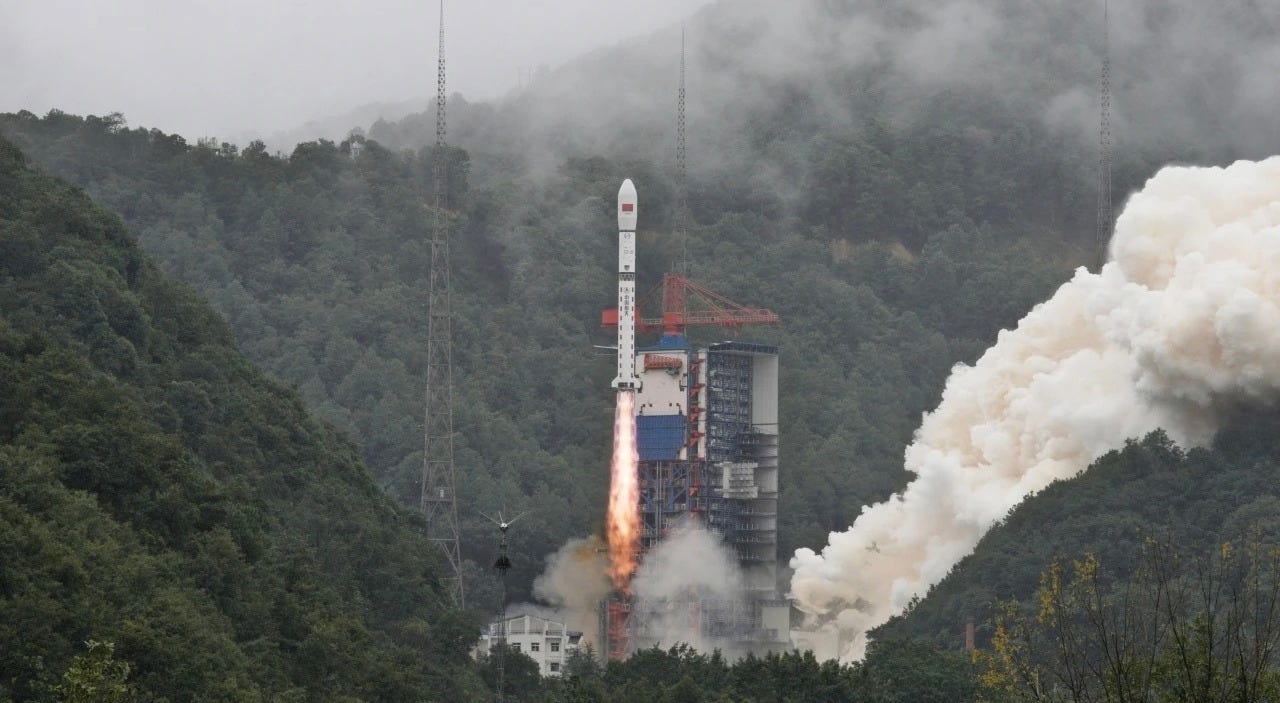
In the early hours today, China added another significant chapter to its rapidly expanding space exploration narrative. At precisely 6:51 a.m. Beijing Time, a Long March-2D carrier rocket lifted off from the Taiyuan Satellite Launch Center in north China‘s Shanxi Province, successfully executing a flawless launch under the pre-dawn sky . The mission was a complete success as the rocket delivered a pair of high-resolution remote sensing satellites, the Siwei Gaojing-2 05 and Siwei Gaojing-2 06, into their preset orbits . This event marked the 634th flight mission of the renowned Long March series rocket family, a testament to the maturity and reliability of China’s workhorse launch vehicle program . While this high-profile satellite deployment captured the immediate spotlight, it was merely one part of a much larger story of China’s deepening ambitions in cislunar space—a narrative that unfolded concurrently with groundbreaking announcements at the 2026 Zhongguancun Forum.
Beyond the immediate success of the launch, the broader scientific community was abuzz with revelations regarding China‘s substantial progress in mastering the complexities of Earth-Moon space. At the “Cislunar Space Development and Utilization Technology Forum,” a key parallel event of the 2026 Zhongguancun Forum held on March 25, Chinese scientists unveiled a series of historic achievements from a long-duration space mission . The spotlight fell on the Distant Retrograde Orbit (DRO) pioneering mission, a project independently deployed by the Chinese Academy of Sciences (CAS). After two years of in-orbit operations involving three test satellites, the mission has achieved a series of world-first accomplishments. The project successfully completed the international-first low-energy insertion into a Distant Retrograde Orbit (DRO) , a highly stable orbit that acts as a strategic gateway between Earth and the Moon. This complex maneuver validated crucial technologies for stable residence in DRO, low-energy orbital transfer, and a new principle of space-based measurement, orbit determination, and navigation .
The scale of this achievement is monumental, not just in terms of physics but also in engineering precision. The mission established a K-band inter-satellite link spanning an incredible 1.17 million kilometers, setting a new benchmark for deep space communication and measurement. Furthermore, it became the world’s first spacecraft to complete a comprehensive tour of all the Lagrange points in the Earth-Moon system in a single mission . This capability is akin to establishing strategic outposts at the gravitational balancing points that govern traffic in cislunar space. Speaking at the forum, CAS Vice President Ding Chibiao underscored the profound significance of this endeavor, stating, “Cislunar space, serving as the strategic hub connecting Earth to deep space, will become a new high ground in the new round of scientific and technological revolution and industrial transformation. It is a crucial direction for cultivating new quality productive forces, and it holds immense and far-reaching significance for seizing the technological high ground and achieving high-level technological self-reliance.” He further emphasized that the CAS has taken the initiative to propose and implement major national tasks like the DRO project, “opening a new era for China’s exploration of cislunar space, achieving a batch of original results with international influence, and forming a first-mover advantage in some areas, providing favorable conditions for China to secure future development opportunities.”
This vision of a sustainable presence in space is also being actively pursued by China’s burgeoning commercial space sector. In parallel to the government-led DRO mission and the satellite launch, a private Chinese aerospace startup, Sustain Space, announced a critical technological breakthrough. The company successfully demonstrated the in-orbit operation of a flexible robotic arm using its Yuxing-3 06 satellite, which had been launched on March 16. This mission is a major milestone for the country’s commercial space industry, focusing on the vital field of orbital refueling and on-orbit servicing. The test involved a flexible continuum robotic arm, developed in collaboration with Tsinghua University’s Shenzhen International Graduate School. Unlike traditional rigid robotic arms, this innovative manipulator is designed to move like an elephant’s trunk—capable of curling, twisting, and coiling to navigate complex and confined spaces . The satellite successfully completed a series of complex maneuvers, including autonomous programmed refueling simulation, ground-controlled refueling simulation, and vision-guided servo refueling simulation. This technology is a cornerstone for extending the operational lifespan of spacecraft, which is critical for long-term missions. Wang Xueqian, who led the research team at Tsinghua, eloquently framed the challenge, stating, “When a car breaks down, you can take it to a service center for repair, but what do you do when a spacecraft breaks down in space? Space robots can perform extravehicular operations, and even refuel and repair spacecraft as well as clear space debris.”
The successful launch of the Siwei Gaojing-2 satellites from Taiyuan demonstrates the continued operational capacity for Earth observation, supporting commercial and civil needs with high-resolution imagery. Concurrently, the revolutionary results from the DRO mission at the Zhongguancun Forum reveal the sophisticated, strategic advancements occurring at the frontiers of deep space exploration, establishing fundamental capabilities for future lunar bases and interplanetary travel. Complementing these government-led efforts, the commercial sector’s success with orbital refueling technology signifies a maturing ecosystem focused on sustainability and economic viability. As Hou Junshu, Vice Chairman of the Beijing Municipal People’s Congress Standing Committee, noted at the forum, Beijing is leveraging its position as the birthplace of China’s space industry, fostering a landscape of “rockets in the south and satellites in the north,” and is “accelerating the construction of a globally influential commercial aerospace innovation highland, creating a hundred-billion-level commercial aerospace industry cluster to provide solid support for cislunar space development and utilization.” With each launch and each technological breakthrough, China is not only reinforcing its status as a global space power but is also laying the foundational infrastructure for the next era of human activity beyond Earth.