The detonation of a nuclear weapon represents a cataclysm of such magnitude that it defies conventional comprehension. It is an event that unfolds in microsecond increments yet casts a shadow that can stretch across centuries. Unlike conventional explosives, which rely on a chemical reaction, a nuclear explosion releases energy through the splitting (fission) or combining (fusion) of atomic nuclei. This single, instantaneous event unleashes a chain of destruction that spreads outward in distinct, overlapping phases. From the blinding, subatomic inferno of the fireball to the insidious, generational poison of radioactive fallout, the destruction is not a single moment but a complex, cascading sequence of physical forces. Understanding these phases is crucial, not as a morbid exercise, but as a stark acknowledgment of why such weapons represent an existential threat to civilization itself. The spread of destruction from a nuclear explosion is a story of energy transforming matter, from the hardest steel to the delicate strands of human DNA, in a relentless expansion from the microscopic to the continental.
1. The Birth of the Fireball: Microseconds of Pure Energy
The genesis of a nuclear explosion is an event so rapid and energetic that it can only be described in terms of the physical laws that govern stars. In a fission weapon, a subcritical mass of material like uranium-235 or plutonium-239 is rapidly assembled into a supercritical mass, initiating an uncontrolled nuclear chain reaction. Within a millionth of a second, a chain reaction involving trillions of atoms releases an inconceivable amount of energy in the form of X-rays and gamma rays. This energy, initially concentrated in a volume no larger than a grapefruit, is at a temperature of tens of millions of degrees Celsius—several times hotter than the core of the sun. At these temperatures, matter ceases to exist as atoms; it becomes a plasma of subatomic particles stripped of their electrons.
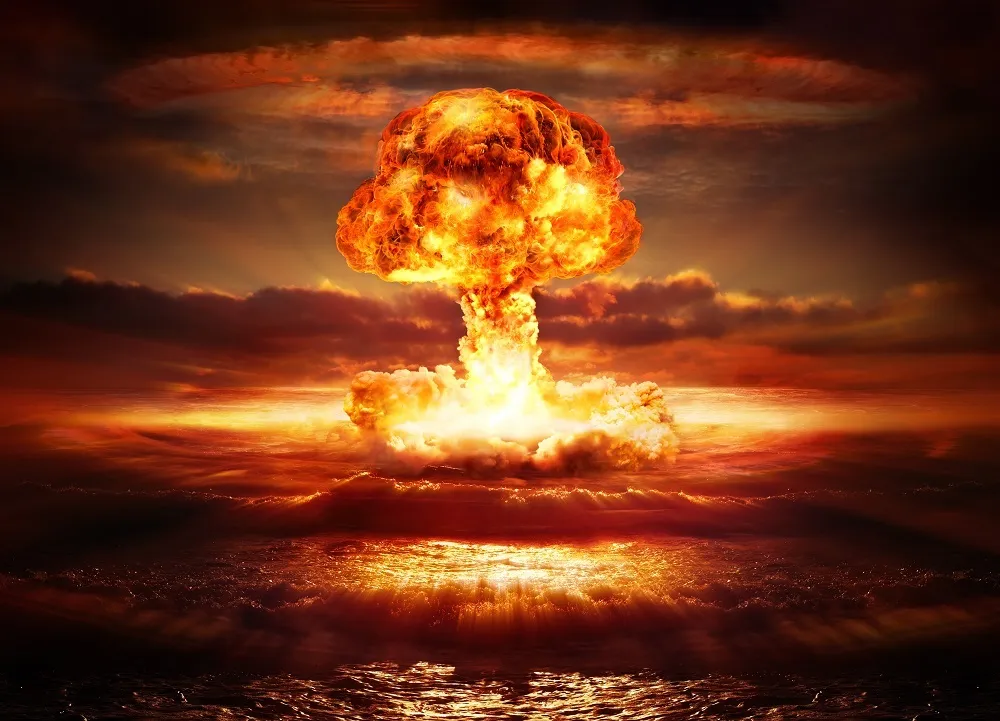
This superheated plasma immediately begins to expand, forming the characteristic fireball. In the first millisecond, the fireball is a brilliant, incandescent sphere that emits a blinding flash of light, visible for hundreds of miles. As it expands at supersonic speed, it creates a phenomenon known as the “hydrodynamic front.” The fireball acts like a colossal piston, compressing the surrounding air into a dense, opaque shell. This is the birth of the shockwave. The fireball continues to grow, swallowing everything in its immediate vicinity. For a one-megaton explosion, the fireball will reach its maximum size in about ten seconds, a sphere of superheated gas nearly a mile in diameter. Within this sphere, the temperature remains high enough to vaporize any material—steel, concrete, soil, water—into a homogenized, superheated plasma. This initial phase is the wellspring from which all subsequent destruction flows. It is the conversion of mass into pure energy, a point where the fundamental forces of the universe are briefly and terrifyingly unleashed upon the Earth. The very air itself becomes a weapon, transformed into a radiating, expanding wall of hellish energy that will soon level cities.
2. The Blast Wave: The Invisible Hammer
Following microseconds behind the initial flash of light, the blast wave emerges as the primary mechanical engine of destruction. Formed by the explosive expansion of the fireball, it is a wall of compressed air that travels outward initially at speeds far exceeding the speed of sound. This is not merely a powerful wind; it is a sudden, catastrophic increase in atmospheric pressure known as overpressure. Measured in pounds per square inch (psi), the effects of this overpressure are devastatingly precise. An overpressure of just 2 psi is enough to shatter residential windows and inflict widespread injuries from flying glass. At 5 psi, most residential buildings collapse, and the wind speed accompanying the shockwave exceeds 160 mph, turning debris into deadly projectiles. At 10 psi, reinforced concrete buildings are severely damaged or destroyed, and the chances of survival for anyone in the open are minimal.
The destruction spreads in a complex pattern. As the primary shockwave passes, it creates a powerful suction effect, or negative pressure, as air rushes back to fill the partial vacuum left in the fireball’s wake. This reversal can further weaken already damaged structures, causing roofs and walls to implode outward after having been blasted inward. The blast wave’s interaction with urban environments creates a labyrinth of hazards. Fragmented glass, splintered wood, twisted steel, and shattered masonry become high-velocity missiles, transforming the environment into a colossal fragmentation grenade. The physical destruction is also a primary driver of secondary disasters. The collapse of buildings traps countless victims under tons of rubble. The rupture of natural gas lines, coupled with the widespread electrical fires, creates a tinderbox ready for ignition. The blast wave is indiscriminate; it does not differentiate between a skyscraper, a hospital, or a home. Its destructive force is a pure function of distance from ground zero, leveling everything within a certain radius and creating a landscape of flattened, burning rubble that was, moments before, a functioning city. The shockwave, traveling invisibly at the speed of sound, is the mechanism by which the star-like energy of the fireball is translated into the terrestrial reality of total physical devastation.
3. Thermal Radiation: The Silent Incinerator
Simultaneous with the blast wave, yet traveling at the speed of light, is the thermal pulse—a wave of radiant heat that is often the most psychologically terrifying and physically gruesome aspect of a nuclear detonation. Unlike the shockwave, which arrives after a delay (up to several seconds for targets far from ground zero), the thermal radiation arrives in an instant. It is composed of a broad spectrum of electromagnetic radiation, from ultraviolet to infrared, and it carries approximately one-third of the weapon’s total energy. The effects are immediate and catastrophic.
The thermal pulse does not knock down a building; it sets it on fire. On a clear day, the radiant heat from a one-megaton explosion can cause third-degree burns—burns that destroy skin tissue and nerve endings—to exposed skin at distances exceeding five miles. Within a closer radius, the energy is so intense that it causes objects to spontaneously combust. Dark surfaces absorb heat more readily, meaning asphalt roads can melt, and dark-colored clothing can ignite on a person’s body. This phenomenon leads to the horrific “shadow” effect, where a person or object absorbs the thermal radiation, shielding the area behind them, leaving a permanent silhouette burned into a wall or the ground. The resulting conflagration is not merely a collection of individual fires but can coalesce into a massive firestorm.
A firestorm is a self-sustaining, hurricane-like inferno. The immense heat from thousands of simultaneous fires creates a powerful updraft, drawing in fresh oxygen from the periphery at speeds exceeding 100 mph. This influx of oxygen feeds the fire, making it burn hotter and more intensely, which in turn strengthens the updraft. The firestorm becomes a system unto itself, virtually impossible to extinguish and capable of consuming everything flammable within its footprint. Temperatures within a firestorm can reach over 1,000 degrees Celsius, hot enough to melt glass and metal. Unlike a conventional fire, which spreads from point to point, a firestorm engulfs an entire area simultaneously. The atmospheric conditions it creates are inimical to life; oxygen is depleted, carbon monoxide and other toxic gases are generated in lethal concentrations, and the sheer heat kills anyone trapped in shelters or basements. The thermal pulse, therefore, extends the destruction beyond the physical collapse of infrastructure to the systematic, crematory annihilation of the urban environment and its inhabitants.
4. Initial Nuclear Radiation: The Invisible Poison
In the first minute following the explosion, a lethal, invisible hazard emerges: initial nuclear radiation. This consists primarily of neutrons and gamma rays—high-energy, penetrating radiation emitted directly from the fireball. Unlike the blast and thermal effects, which are immediate and visible, this radiation is a silent, invisible killer. Its range is limited compared to the other effects, generally extending only a mile or two from ground zero for a one-megaton weapon, but within that radius, it is lethally effective. The radiation is so intense that it can deliver a fatal dose of over 10,000 rem (roentgen equivalent man) to an unprotected human in a matter of seconds. For context, a dose of 500 rem is generally considered fatal for 50% of those exposed without advanced medical treatment.
The biological mechanism of radiation poisoning is the destruction of cells, particularly those that divide rapidly. This leads to the collapse of the body’s critical systems in a predictable and agonizing sequence. In the first hours and days after exposure, victims experience acute symptoms: violent nausea, vomiting, diarrhea, and a profound weakness known as the “prodromal syndrome.” This is followed by a deceptive latent period where symptoms temporarily subside, only to return with a vengeance as the body’s bone marrow stops producing blood cells. Death, when it occurs, typically results from massive internal hemorrhage, systemic infection due to a total lack of immune response, or catastrophic organ failure.
The victims of initial radiation are not merely casualties of a blast or burn; they are individuals whose very biological machinery has been irreversibly destroyed. They face a slow, painful death even if they are physically unscathed by the explosion. For the survivors and first responders who venture into the ground-zero area in the hours afterward, the lingering but still intense radiation poses a severe hazard. This phase of destruction highlights a unique horror of nuclear weapons: the ability to kill not just by physical force, but by poisoning the fundamental processes of life, creating a landscape where the very environment is toxic to biology for a critical window of time after the detonation.
5. The Electromagnetic Pulse: The Systemic Saboteur
While not directly lethal to humans, the electromagnetic pulse (EMP) represents a distinct and devastating vector of destruction, particularly for modern, technology-dependent societies. The EMP is a powerful burst of electromagnetic energy created when gamma rays from the nuclear explosion interact with the Earth’s magnetic field and atmospheric molecules. This interaction strips electrons from air molecules, creating a massive, rapidly changing electromagnetic field that can induce destructive current and voltage surges in any conductive material—most critically, in electrical and electronic systems.
The effects of an EMP are felt far beyond the range of the blast, heat, and initial radiation. For a high-altitude nuclear detonation, an EMP can blanket an entire continent, instantly destroying unprotected electronics. The destruction is not physical in the sense of a blast; it is a systemic paralysis. A high-altitude EMP would induce currents powerful enough to burn out the delicate circuitry of computers, communications networks, power grids, and transportation systems. The result would be a sudden and catastrophic collapse of all technological infrastructure. Hospitals would lose power, water purification plants would shut down, fuel pumps would cease to function, and financial systems would evaporate.
This form of destruction spreads not through the air as a shockwave, but through every wire and antenna. It transforms the foundational infrastructure of a nation from a complex, interconnected system into inert scrap metal. The societal impact would be as profound as any physical destruction. In a post-EMP scenario, the ability to coordinate rescue efforts, provide medical care, transport food and water, and maintain public order would vanish instantly. The EMP is the “silent saboteur” of a nuclear attack, a weapon designed not to kill directly, but to dismantle the very fabric of a 21st-century society, plunging survivors back into a pre-industrial existence of isolation and scarcity, making recovery from the other effects exponentially more difficult.
6. Radioactive Fallout: The Long Shadow
Perhaps the most insidious and enduring effect of a nuclear explosion is radioactive fallout. While the initial radiation is intense but short-lived, fallout is the protracted poison that can contaminate vast territories for years, decades, or even centuries. Fallout is created when the nuclear fireball vaporizes enormous quantities of soil, water, and structural material, mixing it with the radioactive byproducts of the nuclear reaction. As this superheated, radioactive mass cools, it condenses into a fine, sand-like particulate matter—hundreds of thousands of tons of it. These particles are then carried aloft by the iconic mushroom cloud, which can rise tens of thousands of feet into the stratosphere.
The spread of fallout is dictated entirely by the wind. As the mushroom cloud drifts downwind, the heavier, larger particles begin to fall to earth within the first 24 hours, creating what is known as the “local fallout” zone. This zone is a highly contaminated, irregularly shaped plume that extends for hundreds of miles downwind from ground zero. In this area, radiation levels can be lethally high. A person entering a high-radiation zone in the first days after the explosion would receive a fatal dose in a matter of minutes. The threat is not limited to immediate exposure; radioactive particles can settle on skin, be inhaled into the lungs, or contaminate food and water supplies. The long-lived isotopes, such as strontium-90 and cesium-137, have half-lives of about 30 years, meaning they will remain a persistent environmental hazard for generations. Strontium-90 is chemically similar to calcium and is absorbed by the body into bone tissue, where it can cause bone cancer and leukemia. Cesium-137 mimics potassium and spreads throughout the body’s soft tissues, posing a long-term cancer risk.
The spread of fallout transforms the concept of “ground zero” from a specific location to a vast, downwind region. It makes uninhabitable large swaths of productive land, turning farmland into poisoned desert and rendering cities into ghost towns. This phase of destruction ensures that the consequences of a nuclear explosion are not confined to the moment of detonation but become a permanent, radiating scar on the landscape and a persistent, multi-generational threat to all life within its reach.
7. Environmental and Global Consequences: A Legacy of Ruin
The final, and perhaps most far-reaching, spread of destruction from a nuclear explosion extends beyond the immediate blast zone to encompass the global ecosystem. A single detonation causes severe local environmental damage, but a large-scale nuclear war would trigger planetary-scale effects that threaten the very stability of the Earth’s life-support systems. The immediate environment is scoured by the blast, burned by the thermal pulse, and poisoned by fallout. Forests are leveled and ignited, creating massive wildfires. The intense heat of the firestorm injects soot, smoke, and dust into the upper atmosphere—the stratosphere—where it cannot be washed out by rain.
This leads to the phenomenon known as “nuclear winter.” The stratospheric soot, composed of black, light-absorbing carbon from burning cities and forests, forms a persistent global layer that blocks a significant fraction of incoming sunlight. Climate models predict that even a limited regional nuclear war could cause a decade-long drop in global average temperatures, comparable to or exceeding the coldest periods of the last Ice Age. This sudden cooling would devastate global agriculture, leading to widespread crop failures, famine, and mass starvation across the globe, even in countries far removed from the conflict. The ozone layer, which protects life from harmful ultraviolet radiation, would be severely depleted by nitrogen oxides produced in the fireballs, leading to increased rates of skin cancer and genetic damage in all living organisms.
The destruction, therefore, spreads not only outward in space but also forward in time, destabilizing the global climate and eroding the ecological foundations of civilization. The combined effects of blast, fire, radiation, and climatic disruption would trigger a cascade of societal collapse—a breakdown of global supply chains, public health systems, and governance. In this final analysis, the spread of destruction from a nuclear explosion reveals the weapon’s ultimate nature: it is not merely a tool of war, but a fundamental threat to the continued existence of complex human society and the delicate planetary equilibrium upon which it depends. The story of how destruction spreads is, in the end, a story of how a single, momentary act can unravel the world.