
April 5, 2026
As NASA’s Artemis II mission successfully executed its trans-lunar injection burn and began its historic crewed voyage toward the Moon, an air of calm determination pervaded China’s space community and government circles. While the United States celebrated its first crewed lunar flyby in over five decades, official reactions from Beijing and statements from leading Chinese scientists emphasized a narrative of steady, independent progress rather than competitive anxiety. The overwhelming sentiment from the China National Space Administration (CNSA) and affiliated researchers is that China is not engaged in a space race with the United States, but rather is following a methodical, long-term plan for lunar exploration that will not be rushed by the achievements of others . In contrast to the extensive media coverage in the West framing Artemis II as a pivotal move in a new geopolitical contest, Chinese state media and officials largely framed the event as a “good progress for humanity” while reiterating that China’s goal of landing taikonauts on the Moon by 2030 remains firmly on track, unaffected by NASA’s current schedule .
Behind the scenes, strategists in Beijing are well aware of the geopolitical implications of the Artemis program, particularly the Artemis Accords, which they view as an attempt by Washington to set rules for lunar resource extraction that exclude China . However, the public-facing reaction on April 5 was notably devoid of panic. Analysts noted that China holds several strategic advantages that allow it to ignore the pressure of a “deadline.” Chief among these is the ability to execute decades-long planning without disruption from political elections, a factor that frequently complicates NASA’s funding and timelines . Furthermore, while Artemis II is a test flight, China has already achieved feats the U.S. has yet to replicate, specifically landing on the far side of the Moon and returning samples—a capability demonstrated by the Chang’e missions . This technical foundation provides a buffer of confidence against the visual spectacle of the Space Launch System (SLS) rocket carrying the Orion capsule.
In interviews conducted on the morning of April 5, Chinese space scientists downplayed the notion of a “race,” instead highlighting the structural differences between the two nations’ approaches. Dr. Qian Yuqi, a lunar researcher at the University of Hong Kong involved in China’s sample analysis program, provided a representative perspective. “China does not see this as a competition. We operate without that burden,” Dr. Qian stated, contrasting the intense political pressure on NASA with the freedom enjoyed by the CNSA . “Whether the U.S. lands in 2028 or later, our plan is fixed to our own scientific and industrial logic, not their launch calendar.” This sentiment was echoed by other experts who pointed out that China’s lunar ambitions are integrated with national development goals and the “Space Silk Road,” aiming to build infrastructure and partner with Global South nations through the International Lunar Research Station (ILRS), rather than simply winning a symbolic flag-planting contest .
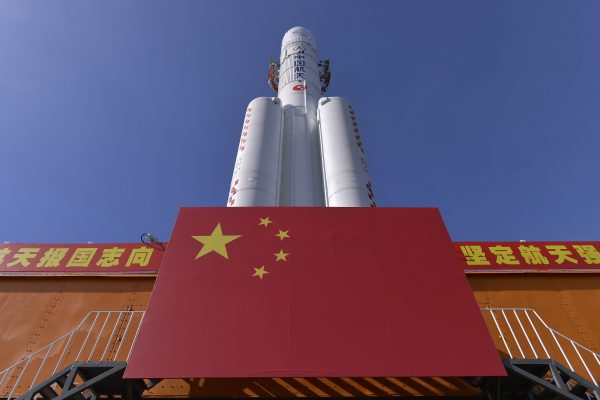
Looking specifically at the hardware, Chinese commentators noted that while the Artemis II Orion capsule is flying, China’s next-generation spacecraft for taikonauts, the Mengzhou (“Dream Vessel”), has already completed its first test flights . Furthermore, the CNSA is actively developing the Long March 10 rocket and the Lanyue lunar lander. A key divergence in strategy was highlighted on April 5 regarding the landing sites. While NASA’s Artemis III (planned for 2028) aims for the challenging lunar South Pole to locate water ice, China is taking a more conservative first step. China plans to land on the relatively flat equatorial regions—specifically, a site named Rimae Bode—where the terrain is safer and the scientific return regarding the Moon’s volcanic history is high . “Landing at Rimae Bode would be like opening a high-definition history book of the Moon’s life,” explained Dr. Jun Huang, a planetary scientist at the China University of Geosciences, highlighting the scientific rationale behind a mission that avoids the high-stakes gamble of a polar landing for the first human touchdown .
Despite the dismissive tone regarding the “race,” there is a quiet urgency in China’s industrial base. On April 5, analysts pointed out that while the SLS is expendable and costs billions per launch, China is aggressively pursuing reusable rocket technology and mass satellite manufacturing to lower costs . However, the prevailing narrative remains one of resilience. As the four Artemis II astronauts—Reid Wiseman, Victor Glover, Christina Koch, and Jeremy Hansen—flew farther from Earth than any humans have before, China’s reaction was not one of awe or fear but of reaffirmation. The official stance is that the cosmos is vast enough for both nations, though Beijing clearly intends to offer the world a different “operating system” for space governance than the one proposed by the Artemis Accords . For now, China is watching, learning from NASA’s data on the Orion heat shield and life support systems, but ultimately adhering to the wisdom that in space exploration, steady consistency often wins the long game.