April 6, 2026
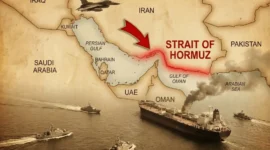
The United States government has formally requested commercial satellite firms to indefinitely withhold high-resolution imagery of the conflict in Iran and the broader Middle East. The directive, confirmed by California-based Planet Labs on April 4, represents a dramatic shift from the relatively open access to space-borne surveillance that has characterized recent decades. This request comes against the backdrop of a widening war that began on February 28, 2026, when the US and Israel launched coordinated military strikes against Iran, prompting Tehran to retaliate with daily missile barrages targeting Israel and US military installations in Gulf states including Saudi Arabia, Kuwait, and Bahrain . The suppression of these images is a direct response to the unique vulnerabilities exposed by this conflict, specifically the realization that relatively inexpensive commercial satellite data—once the exclusive domain of superpowers—is now a double-edged sword that can be wielded by non-state actors and adversarial nations to deadly effect. Planet Labs announced that the restriction is “indefinite” and will remain in effect until the cessation of hostilities, expanding upon a 14-day delay the company had implemented only weeks earlier .
The core logic behind Washington’s demand is rooted in operational security and the prevention of “targeting intelligence” flowing to the enemy. Military experts and analysts argue that the US is attempting to shut down a critical intelligence loophole. “The US is restricting the release of commercial satellite images to cut off Iran’s access to key strike intelligence,” explained Wei Dongxu, a military commentator for China Media Group, highlighting the tactical realities of the current theater . In modern warfare, satellite technology is utilized for target identification, weapon guidance, missile tracking, and battle damage assessment . Before the restriction, it was feasible for Iran to acquire recent images of US airbases in Qatar or the United Arab Emirates, identify the precise location of Patriot missile batteries or parked F-35 aircraft, and use that data to program drone or missile attacks. *“It cannot be ruled out that previous strikes against E-3 AWACS and KC-135 tanker aircraft were related to the acquisition of relevant satellite images,”* Wei added, suggesting that Tehran may have been using commercial imagery to conduct post-strike damage assessments to refine their targeting algorithms for subsequent volleys . By blacking out the region, the US aims to degrade the “Observe, Orient, Decide, Act” (OODA) loop of the Iranian military, forcing them to rely on slower, less reliable sources of intelligence.
The mechanism of this censorship is as notable as the policy itself. Planet Labs, which operates a large fleet of Earth-imaging satellites and sells frequently updated photos to governments and media, informed its clients via email that it is shifting to a “managed access model.” Under this new regime, the company will retain all images dating back to March 9, only releasing visuals on a “case-by-case basis” for what the government deems “urgent, mission-critical requirements or in the public interest” . This effectively hands the US government veto power over the visual narrative of the war. The move has been met with alarm by transparency advocates and human rights organizations. “The Trump administration’s demand to withhold satellite images will make it much more difficult to monitor US-Israeli bombing there, which seems to be the point,” said Kenneth Roth, former executive director of Human Rights Watch, suggesting that the suppression serves not only to hide US troop movements but also to obscure the potential collateral damage and civilian casualties resulting from the bombing campaigns . Independent journalists and academic researchers, who have long relied on these “eyes in the sky” to verify events in regions where ground access is restricted or too dangerous, now find themselves flying blind. The restriction threatens to turn the conflict into a “black box” where official military claims cannot be easily verified by the public.
However, analysts caution that while this move hinders Iranian intelligence, it does not render them helpless. “Although Iran currently lacks the ability to independently launch advanced reconnaissance satellites and relies on commercial imagery, once this channel is cut off, there will be a shortfall in their intelligence system,” Wei noted, but he quickly added that Tehran retains significant Human Intelligence (HUMINT) capabilities . “For large airbases, acquiring information on force deployment and facilities through personnel infiltration can also achieve target localization.” This suggests that while the satellite blackout slows down the Iranian response cycle, it does not eliminate the threat entirely. The landscape of commercial providers is also fractured; while Planet Labs is complying, Vantor (formerly Maxar Technologies) , another major US provider, stated that it has not been directly contacted by the US government regarding this specific request, though it has independently reserved the right to implement “enhanced access controls” during geopolitical conflicts . This discrepancy raises questions about the uniformity of the information blackout and whether adversaries might simply pivot to other, perhaps non-US based, commercial sources.
The implications of this decision extend far beyond the immediate battlefield. It establishes a precedent for wartime censorship in the age of commercial space flight. Since the early 2000s, the availability of high-resolution satellite imagery has acted as a democratizing force in geopolitics, allowing small nations and even journalists to verify ceasefires, track troop buildups, and document war crimes. By closing this window, the US is acknowledging that the very technology that provides strategic transparency has become an “asymmetric threat.” Planet Labs acknowledged the extraordinary nature of the situation in their correspondence, stating, “These are extraordinary circumstances, and we are doing all we can to balance the needs of all our stakeholders” . Yet, critics argue that by acquiescing to an indefinite blackout without a clear sunset clause, these firms are ceding their role as neutral observers. As the war continues to rage, with threats of strikes on Iranian civilian infrastructure like power plants and bridges being debated, the lack of independent visual confirmation means the world is navigating the April 6, 2026 conflict with a blindfold on, reliant entirely on the narratives provided by the warring parties themselves.