April 9, 2026
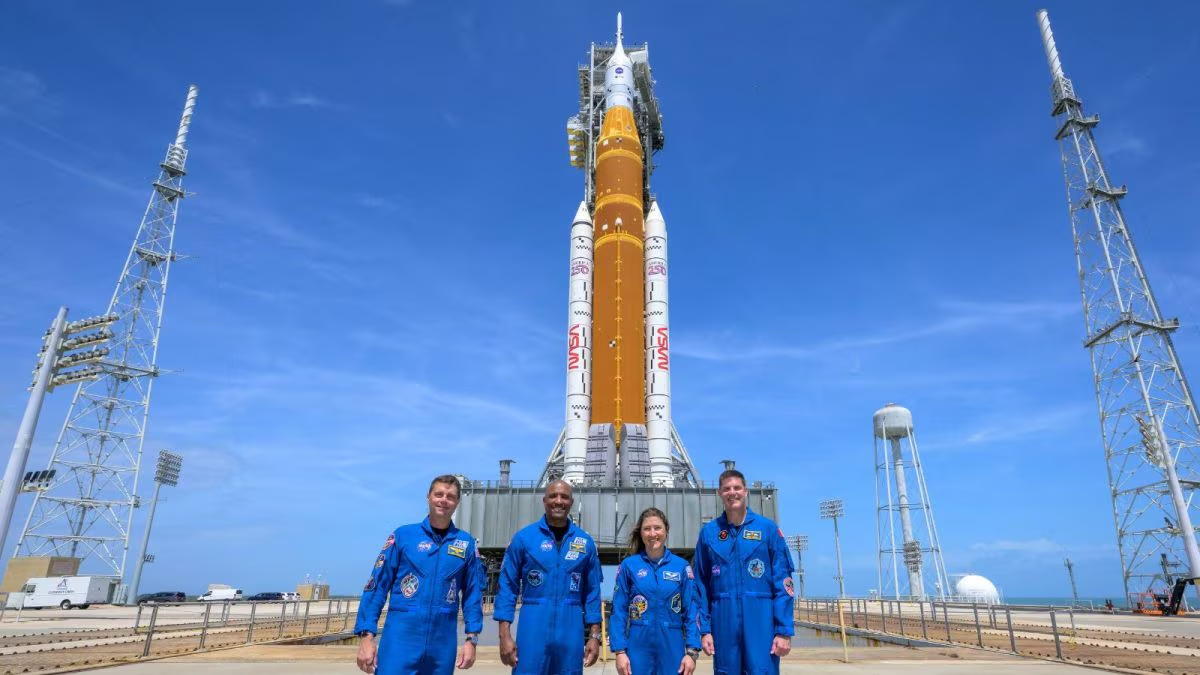
NASA’s Artemis II mission is in its final and most critical phase, with the four astronauts—Commander Reid Wiseman, Pilot Victor Glover, Mission Specialists Christina Koch and Jeremy Hansen—preparing for their historic return to Earth. After a flawless launch on April 1 and a record-breaking lunar flyby, the crew is now conducting final in-flight tests, stowing equipment, and preparing the Orion spacecraft for re-entry. According to the latest updates from NASA, the crew began their day approximately 322,316 kilometers from Earth, waking up to the sounds of Queen and David Bowie’s “Under Pressure” as they methodically work through their final checklist before Friday’s splashdown . The day’s activities are focused heavily on the physiological transition back to Earth’s gravity, specifically the testing of an orthostatic intolerance garment. This specialized device is designed to apply lower-body compression, helping the astronauts maintain blood pressure and circulation to stave off dizziness and fainting after nine days in microgravity . The schedule for April 9 includes a Mission Status Briefing at 3:30 p.m. ET followed by a Crew News Conference at 5:59 p.m. ET, where the astronauts are expected to share their personal reflections on the journey. Additionally, a Live Downlink Event is scheduled for 7:54 p.m. ET, offering the world one last look at the crew before they sever communications in preparation for the intense heat of re-entry .
The mission has already surpassed all technical expectations, with the Space Launch System (SLS) rocket and Orion spacecraft performing beyond the engineers’ most optimistic projections. After two scrubbed launch attempts in February and March due to technical issues, the rocket finally roared to life on April 1, generating 8.8 million pounds of thrust and delivering the crew into a precise trajectory toward the Moon. The performance was so accurate that two of the three planned course corrections were scrapped as unnecessary . The critical translunar injection burn, which committed the spacecraft to its lunar path, was described by NASA’s Artemis program head Dr. Lori Glaze as “flawless” . On April 6, the crew achieved their primary milestone when Orion reached a distance of 406,771 kilometers (approximately 252,760 miles) from Earth, officially breaking the record for the farthest humans have traveled from our home planet—a record previously set by the ill-fated Apollo 13 mission in 1970 . Shortly after breaking the record, the crew experienced a 40-minute communications blackout as they passed behind the Moon, a period of solitude that no human has endured in over five decades .
The lunar flyby itself provided not only engineering data but deeply human moments that have resonated across the globe. During their closest approach, the crew became the first humans to witness specific regions of the Moon’s far side with the naked eye. Pilot Victor Glover described the view of a solar eclipse from the far side as “unreal,” while Commander Wiseman struggled for adjectives, calling the sights “absolutely spectacular” and insisting he needed “to invent some new ones to describe what we’re looking at” . However, the most poignant moment came when the crew requested to name two previously unnamed craters. Mission Specialist Jeremy Hansen, his voice thick with emotion, asked Mission Control to designate one crater “Integrity” after their spacecraft, and another “Carroll” in honor of Commander Wiseman’s late wife, who died of cancer in 2020 . Dr. Simeon Barber, a space scientist at the Open University, reflected on the mission’s broader impact, stating: “The artistic value of the images returned from Artemis and its crew is significant… This is all about putting humans in the loop – these pesky humans that press buttons and breathe carbon dioxide and want air conditioning and want to use the toilet.”
As the crew turns their attention homeward, the final hurdle remains the most dangerous: re-entry. The Orion capsule is expected to slam into Earth’s atmosphere on Friday, April 10, at approximately 25,000 mph (40,000 km/h) , generating temperatures that will test the spacecraft’s heat shield to its absolute limits. This is the same issue that caused an unexpected loss of charred material during the uncrewed Artemis I mission, leading to a year-long delay as engineers redesigned the re-entry trajectory. Splashdown is currently scheduled for 8:06 p.m. ET on Friday in the Pacific Ocean off the coast of San Diego, where the USS John P. Murtha and U.S. Department of Defense personnel await to recover the capsule and assist the crew . NASA Administrator Jared Isaacman has emphasized that while this flight is a test, the agency must shift its mindset. “Launching a rocket as important and as complex as SLS every three years is not a path to success,” he said prior to launch, urging a move toward treating these rockets less “like a work of art” and more like a sustainable mode of transportation . As the world waits for Friday’s finale, the success of Artemis II has already shifted the probability of a 2028 lunar landing in the right direction, proving that Orion can safely carry humans to the Moon and back.