April 18, 2026
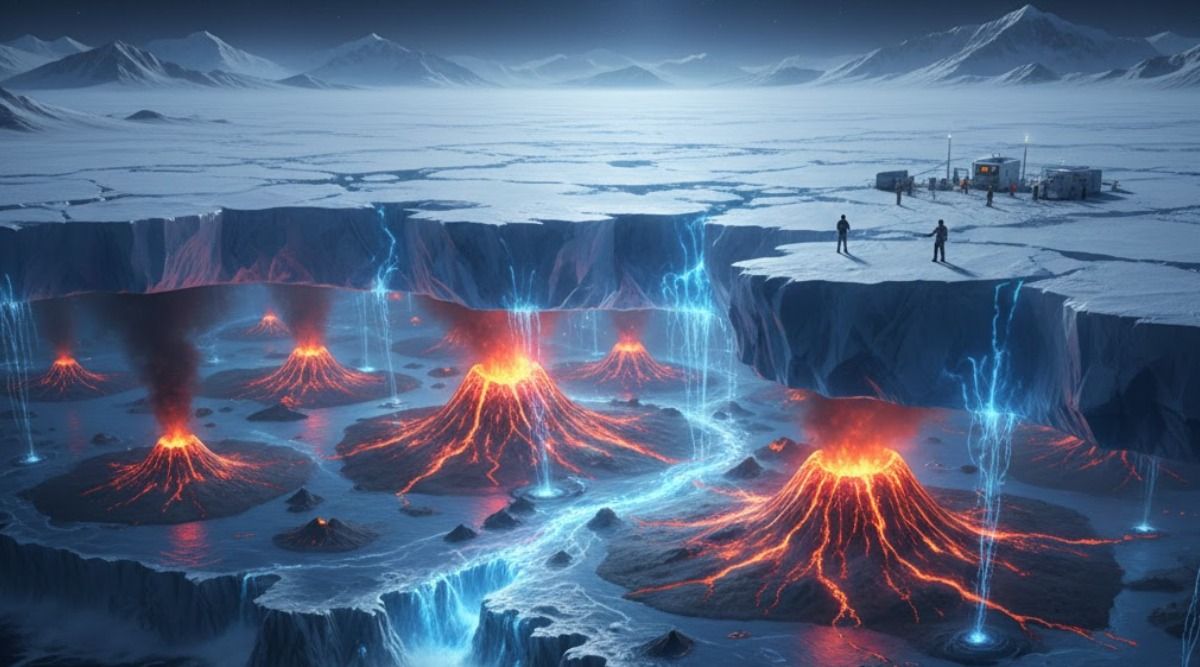
Deep beneath the massive, kilometers-thick ice sheet that blankets Antarctica, a fiery secret has been hiding for millennia, one that scientists are only now fully comprehending. In a landmark study published in early 2026, an international research team led by the China Polar Research Institute (PRIC) has unveiled the first comprehensive catalog of the continent’s subglacial volcanoes. This pioneering research has confirmed and meticulously documented 207 hidden volcanoes lurking beneath the ice, a discovery that dramatically reshapes our understanding of the Antarctic ice sheet’s behavior and its potential impact on global sea levels. For decades, the Antarctic ice sheet, which averages about 2,160 meters (over 7,000 feet) in thickness, was thought to insulate the land below from the warming world above.
However, this new research reveals a complex and dynamic interplay from below, suggesting the Earth’s internal heat is a critical, and previously underestimated, factor in the ice’s stability. The research, published in the journal Earth-Science Reviews, was led by scientists from the PRIC in collaboration with Zhejiang University, Fudan University, and the UK’s University of Exeter. The team did not discover new volcanoes in the traditional sense but rather performed a monumental task of data consolidation, integrating decades of radar surveys, satellite imagery, and existing volcanic records to create a unified reference catalog named “ANT-SGV-25”. This painstaking work marks the first time scientists have been able to establish a continent-wide, systematic understanding of the distribution and physical characteristics of these hidden giants, filling a massive gap in polar geological research.
The findings paint a stark picture of an unevenly heated continent. The 207 volcanoes are not scattered uniformly; instead, they are overwhelmingly concentrated in a specific region—the West Antarctic Rift System. This geological feature, a zone of crustal stretching and thinning, is a hotbed of volcanic activity, housing the vast majority of the identified structures. The research team identified three major volcanic clusters that dominate the region: Marie Byrd Land, containing 37.55% of the volcanoes; the Bellingshausen region, with 26.48%; and McMurdo, which accounts for 16.21%. In stark contrast, the immense and ancient landscape of East Antarctica contains only three confirmed subglacial volcanoes, highlighting a dramatic geological divide between the two halves of the continent. Cui Xiangbin, the project’s lead researcher from the PRIC, emphasized the profound implications of this discovery. “Recent research increasingly shows that subglacial volcanoes hidden beneath the massive ice sheet can alter subglacial topography, promote basal ice melting, regulate subglacial hydrological activity, and ultimately affect ice flow dynamics and the stability of the ice sheet,” he explained.
By creating the ANT-SGV-25 catalog, the team has for the first time quantified the sheer scale and power of these hidden forces. The volcanoes range dramatically in size, with heights from a modest 100 meters to a staggering 4,181 meters (over 13,700 feet) —making some of them taller than Mount Fuji. Their volumes are equally impressive, ranging from 1 to a colossal 2,800 cubic kilometers, with basal widths spanning up to 58 kilometers. The research team developed a multi-dimensional parameter system to create an individualized “morphological fingerprint” for each volcano, using computer vision technology to precisely extract details on their shape, slope, and size. This level of detail is not just an academic exercise; it is crucial for understanding how each volcano interacts with the ice above it.
The timing of this discovery is critical, as it intersects with another pressing global issue: climate change. The presence of this geothermal heat beneath the world’s largest ice sheet creates a dangerous feedback loop. As the volcanoes release heat, they melt the base of the ice sheet from below. This meltwater acts as a lubricant, reducing friction between the ice sheet and the bedrock, which can accelerate the flow of glaciers toward the ocean. The faster this “ice discharge” occurs, the more rapidly global sea levels rise. This process is already being observed in places like Iceland, where increased volcanic activity has been linked to glacier retreat since the 1970s.
Scientists are now warning that a similar, potentially more catastrophic, scenario could be unfolding in Antarctica. The concern is amplified by the fact that many of these volcanoes are not isolated relics; some of the large volcanoes identified, with basal diameters exceeding 20-30 km, are known to be active and pose a considerable threat. As climate change accelerates the melting of the overlying ice, the reduction in surface pressure could trigger these dormant magma systems to reawaken. Research on volcanic histories in the Chilean Andes has demonstrated that the immense weight of ice sheets during ice ages effectively suppresses volcanic activity. When the ice melts, the sudden release of pressure allows the crust to expand and gases within the magma to build up, leading to more frequent and explosive eruptions. This would create a terrifying self-reinforcing cycle: global warming melts ice, the loss of pressure triggers volcanic eruptions, those eruptions release more greenhouse gases (like CO2) which in turn drive further warming, leading to more ice melt, and so on.
Furthermore, subglacial volcanic eruptions, even if they don’t break through the ice, could generate massive floods of meltwater, destabilizing the ice sheet from within. The new catalog provides the foundational data needed to model these complex interactions. By inputting the precise location, size, and heat output of these 207 volcanoes into ice sheet models, scientists can now make far more accurate predictions about future sea-level rise. This is a stark departure from previous models, which only accounted for atmospheric and oceanic warming. The research serves as a powerful reminder that the planet’s fate is governed by interconnected systems. The study was supported by China’s National Key Research and Development Program and the National Natural Science Foundation. As the world grapples with the need to cut greenhouse gas emissions, the discovery of these 207 hidden giants under the ice adds a new and urgent layer of complexity to the challenge of forecasting our planet’s future.