April 23, 2026
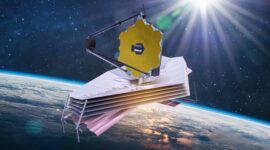
In a landmark revelation for planetary science, new data released this week suggests that the mysterious outer rings of Uranus are hiding a secret: a population of undiscovered moons weaving through the ice giant’s complex orbital system. Astronomers, utilizing a powerful synthesis of data from the James Webb Space Telescope (JWST), the Hubble Space Telescope, and the W. M. Keck Observatory, have finally decoded the composition of the planet’s two rarest rings—the mu ($\mu$) and nu ($\nu$) rings. These findings, published on April 16, 2026, in the Journal of Geophysical Research: Planets, provide the first complete reflectance spectrum of these structures, proving that while they exist in the same neighborhood, they have vastly different and “chaotic” origins.
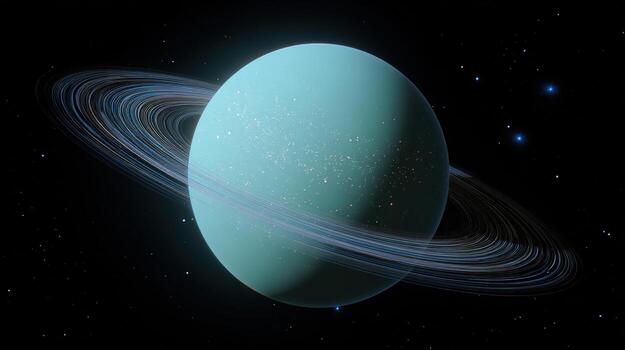
The mu-ring, the outermost of the pair, has long baffled scientists with its distinct blue color. In our solar system, blue rings are an anomaly; the only other known example is Saturn’s E-ring, which is replenished by water-ice geysers from the moon Enceladus. The new 2026 analysis confirms that the mu-ring is also composed of microscopic water-ice grains. Researchers have successfully traced these icy particles back to a tiny, 12-kilometer-wide moon named Mab. It appears that constant micrometeorite impacts on Mab’s surface are “chipping” away at the moon, flinging fresh ice into orbit to maintain the ring’s vibrant blue hue. “The mu-ring closely matches the spectral signature of water ice,” noted Imke de Pater, a professor at the University of California, Berkeley, and lead author of the study, “suggesting that it’s made up of tiny icy grains that were flung from Uranus’ small moon, Mab.”
In stark contrast, the nu-ring, which sits slightly closer to the planet, exhibits a reddish tint, characteristic of much larger, “dirtier” particles. The spectrum reveals that this ring is composed of rocky debris mixed with roughly 10% to 15% carbon-rich organic compounds. Unlike the mu-ring, the nu-ring has no visible “parent moon” to supply this material. This discrepancy is what points to the existence of hidden “moonlets”—objects too small for even our most advanced telescopes to see clearly, but large enough to grind against one another and create a constant stream of rocky dust. Scientists believe these unseen bodies are orbiting in the gaps between known moons like Ophelia and Bianca, essentially serving as a “dust factory” for the nu-ring.
The discovery of the new moon S/2025 U 1 earlier this year—a tiny object only 6 miles (10 km) in diameter—served as the “smoking gun” for this theory. Spotted by the James Webb Space Telescope, S/2025 U 1 is so faint and dark that it escaped the eyes of Voyager 2 during its 1986 flyby. Its presence confirms that the region between Uranus’ inner and outer rings is far more crowded than previously thought. “No other planet has as many small inner moons as Uranus,” said Matthew Tiscareno of the SETI Institute. “Their complex inter-relationships with the rings hint at a chaotic history that blurs the boundary between a ring system and a system of moons.”
This “chaotic” history refers to a cycle of collision and rebirth. Astronomers now hypothesize that the moons of Uranus are not permanent fixtures but are instead in a state of perpetual flux—colliding, shattering into rings, and then potentially coalescing back into new moonlets over millions of years. The fact that the mu-ring is pure ice while the nu-ring is rocky remains a major puzzle. “One interesting question is why the parent bodies sourcing these rings are so different in composition,” de Pater added. This suggests that the original material that formed these moons was not uniform, or perhaps that some moons were “captured” from different parts of the solar system billions of years ago.
Furthermore, scientists have detected fluctuations in brightness within the mu-ring, suggesting that the amount of material being shed by the moon Mab is not constant. “We see hints that the mu-ring’s brightness changes over time, and what could be causing those changes is still a mystery,” stated Matt Hedman, a professor at the University of Idaho and co-author of the research. These “flickers” could indicate recent, large impacts on Mab or shifts in Uranus’s intense magnetic field that influence how the ice particles spread.
The implications of these findings extend far beyond Uranus. By studying how these tiny moons and rings interact, researchers are gaining a “natural laboratory” look at how debris disks behave around distant stars. Because Uranus is tilted on its side, its ring-moon system provides a unique geometric perspective that isn’t available with Jupiter or Saturn. The discovery of these hidden moons reinforces the scientific community’s call for a dedicated Uranus Orbiter and Probe mission. While JWST has provided unprecedented infrared views, only a spacecraft in orbit can truly count the “ghost moons” responsible for the nu-ring’s red dust.