
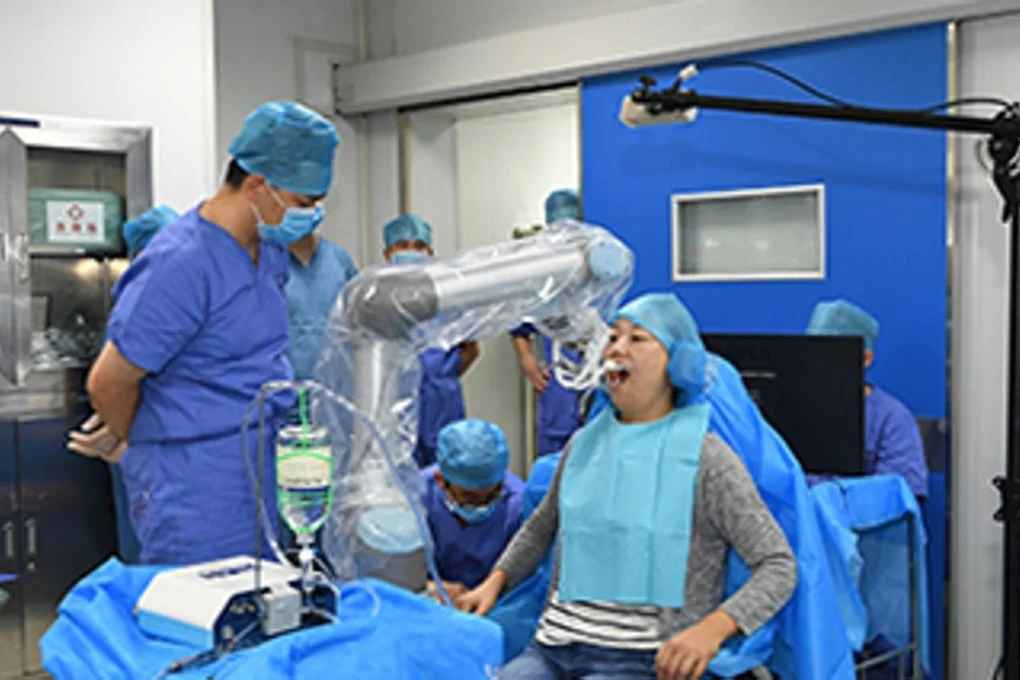
China’s dental industry is witnessing a paradigmatic shift, moving away from traditional manual procedures toward a fully integrated digital ecosystem. Recent developments reveal a landscape where artificial intelligence (AI) , robotics, and advanced 3D printing are no longer futuristic concepts but daily clinical realities. The most significant breakthroughs center on intelligent biomaterials and autonomous robotic surgery, marking China’s emergence as a global leader in digital implant dentistry. Researchers at Chongqing Medical University have unveiled a groundbreaking solution to a persistent clinical challenge: the failure of dental implants in patients with chronic conditions like diabetes. Led by Professor Chen Tao, the team has successfully leveraged AI to “intelligently design” a smart coating for implants that functions like a “chameleon,” adapting its chemical behavior based on the local biological environment . Professor Chen Tao explained the revolutionary mechanism: “For diabetic or periodontitis patients, the difficulty in implantation lies in the destruction of the oral ‘soil’ environment… This smart coating acts like a piece of intelligent ‘bulletproof armor.’” This material actively fights bacteria in acidic, infected environments and promotes bone growth in healthy tissue, dramatically improving the success rate of osseointegration .
Simultaneously, the clinical application of robotic navigation has transitioned from experimental to national policy-driven implementation. In a major policy push, a national project for the promotion and application of oral implant surgical navigation equipment was launched in Changsha on April 18, 2026 . Supported by three key central government ministries, this initiative represents the only national-level high-end medical equipment promotion project in the stomatology field in Central China. The goal is to scale the use of domestically produced autonomous robots, breaking the long-standing reliance on imported precision equipment for complex procedures . Adding to this momentum, Shanghai-based Yangshan Medical Technology received significant funding to commercialize the country’s first “non-occlusal” (unobstructed) surgical robot . This design allows the robotic arm to operate without blocking the doctor’s line of sight, a major leap in usability. Industry analysts note that this technology, combined with the recent strategic investment by digital dentistry leader Aidite, is creating a closed-loop ecosystem of “material + equipment + service” for digital implantology .
The manufacturing side of these implants has also seen a digital renaissance. The “Talis Digital Manufacturing Solution,” unveiled in April at the Western International Dental Exhibition, utilizes aerospace-grade 3D liquid printing technology . This innovation moves away from traditional subtractive manufacturing (milling) to additive manufacturing, producing crowns and abutments with a marginal fit of less than 20 microns. This hyper-precision not only improves aesthetics but drastically reduces the risk of secondary caries by preventing bacterial leakage . Furthermore, companies like Denfac (Wuxi) have launched digital solutions for personalized abutments, ensuring full-process traceability and compliance with the evolving medical insurance database standards, signaling a move toward mass personalization in implant restorations .
In the realm of full-mouth rehabilitation, Taiwanese researchers have introduced the “FullMorph” system at Linkou Chang Gung Memorial Hospital . This innovation integrates multi-module surgical guides with digital coordinate transfer printing. Unlike traditional freehand techniques for full-arch restorations, FullMorph utilizes CT occlusion alignment technology to create standardized, reproducible bite records. This modular approach simplifies complex surgeries, significantly shortening the learning curve for young dentists while increasing precision for veterans . Innovator Dr. Ke Baiyu stated, “We are moving towards a modular and step-by-step design for complex restorations, allowing complex operations to be broken down and standardized.” This is complemented by the rapid growth of companies like UnionTech, which has achieved near-30% coverage of domestic dental labs with high-speed DLP 3D printers, compressing the traditional 10-step restoration process into just 3 to 4 digital steps . As the industry converges on intelligent, traceable, and minimally invasive solutions, April 2026 will likely be remembered as the moment Chinese digital dentistry scaled from niche innovation to the standard of care.