
April 28, 2026
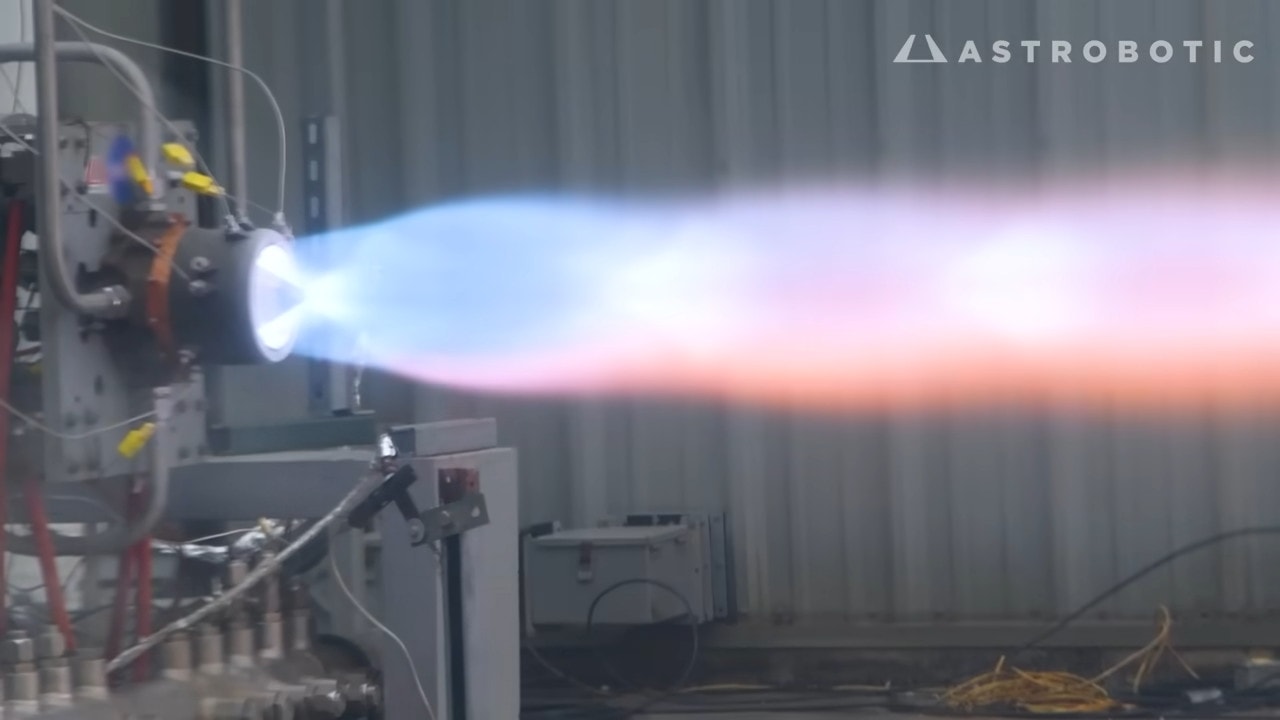
The American space robotics firm Astrobotic announced a major breakthrough in propulsion technology, successfully completing a record-breaking series of hot-fire tests for its next-generation Rotating Detonation Rocket Engine (RDRE). The tests, conducted at NASA’s Marshall Space Flight Center (MSFC) in Huntsville, Alabama, have set new benchmarks for stability and endurance, pushing this experimental technology significantly closer to actual spaceflight use . The prototype, named Chakram, demonstrated unprecedented durability by operating continuously for 300 seconds during a single burn—a duration that Astrobotic confirms is the longest sustained firing of a rotating detonation engine in aerospace history . This milestone represents a shift from theoretical exploration to practical engineering, proving that the violent physics of continuous detonation can be harnessed for long-duration missions rather than just brief, proof-of-concept bursts .
The fundamental mechanics of this engine mark a radical departure from traditional rocket designs. Conventional rocket motors rely on deflagration, a subsonic combustion process where fuel and oxidizer burn in a controlled, steady manner to produce thrust. In contrast, the RDRE utilizes supersonic detonation waves—essentially controlled explosions traveling faster than the speed of sound—that race around a circular, ring-shaped combustion chamber at thousands of miles per hour . This process generates significantly higher pressure per unit of propellant. According to the test data, this translates to a potential 10% to 15% increase in specific impulse (engine efficiency) compared to conventional systems, while simultaneously allowing the engine to be smaller, lighter, and mechanically simpler . For deep space missions, where mass and volume are at a premium, this efficiency leap is transformative, offering the possibility of higher payloads with less fuel.
Throughout the campaign, two Chakram prototypes were subjected to eight separate ignitions, amassing a total cumulative firing time of over 470 seconds. Remarkably, post-test inspections revealed no visible damage or degradation to the engine hardware, a common failure point in earlier RDRE attempts where sustained heat and vibration often destroyed the components . Each engine generated in excess of 4,000 pounds of thrust (approximately 17.8 kN), placing the Chakram among the most powerful RDREs ever demonstrated . Speaking about the results, Bryant Avalos, Astrobotic’s Principal Investigator for Chakram, expressed surprise at the flawless performance. “Chakram more than exceeded our expectations,” he said. *”With any cutting-edge technology like an RDRE, moving from design into testing, you’re always worried about unknown factors that could be critical to performance. But the engine performed even better than expected. The 300-second burn was the cherry on top”* . Travis Vazansky, the RDRE Program Manager, echoed this sentiment, emphasizing the team’s efficiency: “Seeing the engine perform flawlessly on its first attempt is a testament to their ingenuity, power, and low-cost” .
Achieving this duration is not merely a matter of endurance; it is proof that the engineers have solved the thermal management puzzle. For an RDRE to be viable, it must reach a state of “thermal steady state,” where the extreme internal heat generated by the detonation wave is perfectly balanced by the engine’s cooling systems, preventing meltdown. The Chakram achieved this equilibrium and maintained it, indicating that the 3D-printed “tunable porosity metal additive manufacturing” (PermiAM) used in the injector design is effectively managing the heat flux and combustion stability . “This test campaign was a tremendous success, and we met every objective we set out to achieve,” stated Monica Traupmann, Co-Investigator on the program. “The data from these tests gives us a powerful foundation for the next phase of RDRE development. I’m excited about where we can take this technology next” .
Looking toward the future, Astrobotic has clear ambitions to integrate this technology into their fleet of spacecraft. The company intends to deploy the Chakram engine or its derivatives on future Griffin-class lunar landers, reusable rockets like the Xodiac and Xogdor, and an orbital transfer vehicle designed for cislunar operations—the region of space between Earth and the Moon . This successful campaign, supported by NASA Small Business Innovation Research (SBIR) contracts and a Space Act Agreement, suggests that the era of “exploding engines” is no longer a laboratory curiosity but a viable future for getting humanity to the Moon, Mars, and beyond .