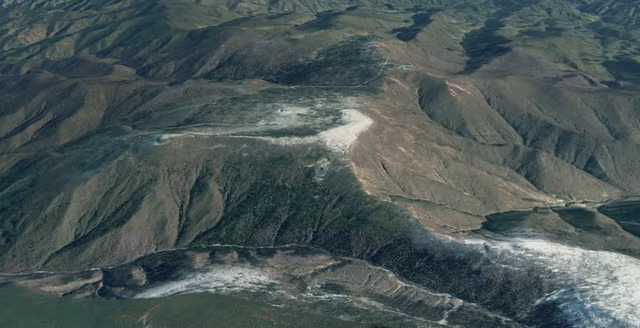
New geological evidence has conclusively determined that the iconic mountain housing North Korea’s only nuclear test facility partially collapsed due to the sheer force of the nation’s sixth and most powerful detonation, a 250-kiloton hydrogen bomb test conducted on September 3, 2017. According to peer-reviewed studies published by Chinese seismologists and geophysicists, the massive explosion, which was 16 times more powerful than the bomb that devastated Hiroshima , fundamentally destabilized the underground infrastructure at the Punggye-ri site, leading to a delayed structural sinking of Mount Mantap. This revelation provides scientific closure to years of speculation regarding the “tired mountain syndrome” and confirms that the site, officially closed and partially demolished by the Kim Jong Un regime in 2018, is now geologically unusable for any future testing.
The chain of events leading to the mountain’s demise began at 12:30 pm local time on September 3, 2017. When North Korea detonated what it claimed was a thermonuclear weapon, global seismic monitoring stations registered a 6.3-magnitude earthquake—a tremor powerful enough to be felt clearly across the border in China. However, it was what happened exactly eight-and-a-half minutes later that sealed the mountain’s fate .
A second, smaller but geologically significant magnitude-4.0 quake was detected. Initial analyses by monitoring groups suspected this was merely an aftershock, but rigorous studies led by the University of Science and Technology of China (USTC) have since clarified that this secondary event was actually the sound of a mountain caving in on itself. “The occurrence of the collapse should deem the underground infrastructure beneath mountain Mantap not be used for any future nuclear tests,” stated the research team led by Lianxing Wen of New York’s Stony Brook University and Tian Dongdong of USTC, in a summary of their findings published in Geophysical Research Letters .
The 250-kiloton blast did not just create a crater; it created a massive underground cavity. Without the support of the vaporized rock, the immense weight of the mountain above—hundreds of millions of tons of granite and sedimentary rock—succumbed to gravity. Scientists argue that the magnitude-4.0 event recorded minutes after the test was the “rapid destruction of an explosion-generated cracked rock chimney,” essentially a sinkhole forming at the heart of the nuclear facility. This collapse was not an isolated incident.
Advanced retrospective analysis of seismic data by Columbia University’s Lamont-Doherty Earth Observatory revealed a slow-motion disaster unfolding over the following eight months. Between the detonation and April 2018, seismologists detected at least 13 smaller aftershocks, ranging between magnitudes 2.1 and 3.4, clustered in a neat 700-meter-long row located about 5 kilometers northwest of the original blast site. These tremors, invisible to standard monitoring techniques at the time, indicated that a previously unmapped geological fault had been reactivated by the blast, causing the mountain to continuously settle and fracture. “These are probably triggered due to the explosion,” explained Won-Young Kim, a seismologist at Columbia University, emphasizing that such seismic activity was not random but a direct consequence of the man-made blast .
For experts watching the Korean peninsula, the collapse of Mount Mantap offers a compelling geological explanation for Pyongyang’s sudden diplomatic pivot in 2018. Just months after the test, Kim Jong Un announced a moratorium on nuclear testing and invited international journalists to watch the ceremonial demolition of the Punggye-ri site’s tunnels. While officially a peace gesture ahead of summits with then-US President Donald Trump and South Korean President Moon Jae-in, the release of these studies suggests the decision was as much a geological necessity as a political one.
With the main testing tunnel collapsed and the mountain unstable, further testing posed an unacceptable risk of a radioactive leak. “It is necessary to continue monitoring possible leaks of radioactive materials caused by the collapse incident,” the Chinese research team warned, highlighting the environmental danger of an uncontrolled fissure opening in the mountain . The fear is not a nuclear detonation, but a silent venting of fission byproducts trapped in the rubble—specifically noble gases like xenon and krypton, which are nearly impossible to contain once the geological seal is broken.
Despite the mountain’s collapse, the strategic landscape of 2026 remains tense. While the physical test site under Mount Mantap is dead, North Korea has since pivoted to the production of nuclear-capable tactical weapons. In the years following the mountain’s sinking, and as recently as January 2026, Pyongyang has successfully test-launched systems like the KN-25 short-range ballistic missiles, which have a range of 250 miles and are designed to overwhelm regional defenses . The sinking of Mount Mantap, therefore, represents the closure of the era of testing, but not the era of production. As North Korea continues to flout sanctions to build its arsenal, the hollowed-out mountain stands as a silent monument to the awesome, self-destructive power of the regime’s own weapons program—a peak that was shattered not by an earthquake, but by the force of a hydrogen bomb.