21 May 2026
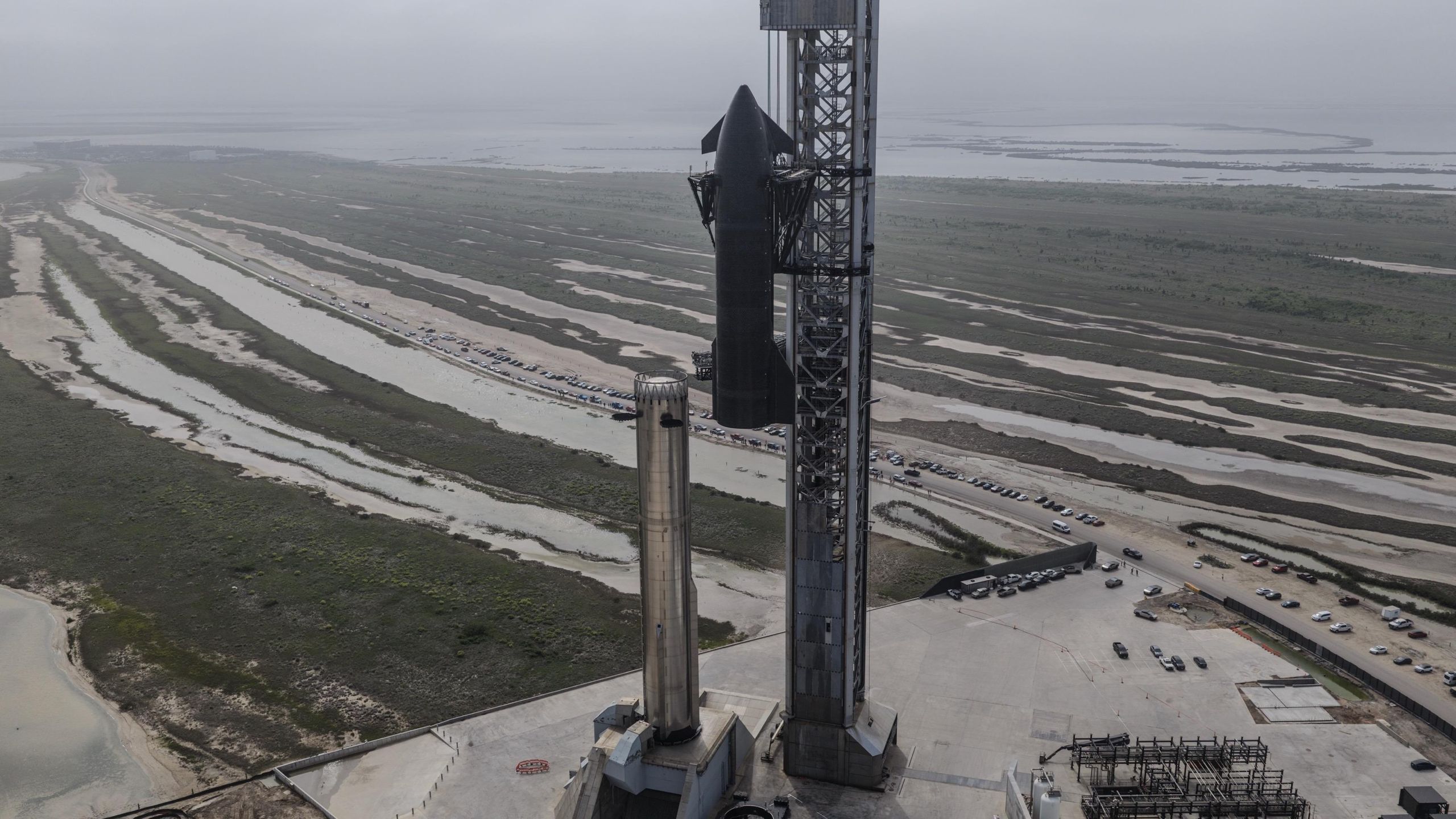
SpaceX achieved a major milestone at its Starbase facility in Boca Chica, Texas, as engineers successfully stacked the fully assembled Starship V3 rocket for the first time and completed an extensive fueling test, setting the stage for the vehicle’s long-awaited debut launch. The towering stainless-steel vehicle, standing nearly 150 meters tall when combined with its Super Heavy booster, represents the most powerful launch system ever conceived, surpassing even the Saturn V and the previous Starship versions.
In a meticulously choreographed operation beginning at dawn local time, the upper stage Starship spacecraft was lifted by massive mechanical arms and precisely positioned atop the Super Heavy booster, which had been secured to the orbital launch mount hours earlier. With the full stack illuminated by the rising Texas sun, ground teams then initiated a full-duration wet dress rehearsal, pumping over 10 million pounds of liquid methane and liquid oxygen into both stages while running through countdown procedures up to the point of engine ignition.
According to SpaceX’s launch telemetry, the propellant loading proceeded without anomalies, and the ground support equipment successfully maintained cryogenic temperatures for the required duration. The test concluded with a partial defueling and a thorough inspection, after which SpaceX CEO Elon Musk confirmed via internal communications that no structural or leak issues were detected, clearing the path for a potential launch attempt in late June or early July 2026.
The significance of this test cannot be overstated, as earlier versions of Starship had encountered persistent fueling and pressurization challenges. Unlike its predecessors, the Starship V3 incorporates redesigned propellant tanks, upgraded insulation, and a more robust quick-disconnect system that addresses the leaks and ullage problems that plagued previous integrated flight tests. SpaceX engineers have also introduced a new autogenous pressurization system that draws gaseous methane and oxygen directly from the engines’ pre-burners, reducing the need for heavy helium bottles.
Dr. Elena Vasquez, a propulsion systems analyst at the University of Texas’s Aerospace Engineering Department, commented: “The fact that they managed a full cryogenic load and hold without visible venting anomalies or structural buckling is a game-changer. The V3’s tank architecture appears to have solved the ‘slosh and bubble’ issues that caused flight terminations in the past. This is the cleanest integrated fueling test we’ve seen from SpaceX since the first Falcon Heavy static fire.” Meanwhile, Dr. Rajan Mehta, a former NASA launch director now advising on commercial spaceflight safety, added: “What impresses me is the rapid iteration. From Starship V1 to V3 in just over two years, with each step learning from explosive disassembly. The stack’s stability during the test proves their modeling has matured significantly.”
The fueling test also served to validate the new ground infrastructure at Starbase, including the reinforced launch pad with a water deluge system capable of discharging 30,000 gallons per second to dampen acoustic shockwaves. SpaceX has also completed the relocation of fuel farms further from the pad and installed blast-resistant barriers for critical equipment. During the test, sensors recorded peak vibrations within acceptable limits, and nearby residents reported no unusual noise or damage — a stark contrast to earlier tests that shattered windows in Port Isabel. The Federal Aviation Administration (FAA) has been monitoring progress closely, and following the 21 May success, the agency indicated it would expedite the remaining environmental and safety reviews. A launch license for orbital flight is now expected as early as mid-June, contingent on final data analysis.
Researchers from several institutions are particularly excited about the payload capabilities of Starship V3. With an estimated lift capacity exceeding 200 metric tons to low Earth orbit in fully reusable mode, the rocket could revolutionize deep-space missions, lunar base construction, and Mars transit. Dr. Amira Al-Farsi, a space resources specialist at the Colorado School of Mines, stated: “We’ve been designing in-space mining equipment around mass constraints for decades. Starship V3’s throw weight means we can send prefabricated habitats, bulldozers, and even nuclear reactors to the Moon in a single launch.
The fueling test success gives credibility to every lunar and Martian architecture we’ve drawn up.” Meanwhile, Dr. Kenji Tanaka, a cryogenic fluid management researcher at JAXA, noted: “The zero-boil-off technology hinted at in V3’s tank insulation is something we’ve only seen in labs. If SpaceX can keep propellant loss below 0.1% per day during interplanetary cruise, it changes everything for human Mars missions. This fueling test is the first proof point.”
However, significant challenges remain. The debut launch will attempt a full orbital insertion and controlled reentry of both stages, with the Super Heavy booster aiming for a precision landing back at Starbase and the Starship upper stage targeting a splashdown in the Pacific near Hawaii. Previous attempts at booster recovery ended in explosions or ocean crashes. SpaceX has implemented new grid fin actuators, a reinforced heat shield with hexagonal tiles, and a redesigned engine relight sequence to increase success odds. Musk has publicly stated that the 2026 test campaign aims for “at least a 50% chance of full success,” with the fueling test already exceeding expectations for ground performance.
As the team at Starbase packs up the ground support equipment and prepares for a series of static fire engine tests over the coming week, the space industry watches with bated breath. If the Starship V3 lifts off successfully in the coming months, it will not only mark the dawn of fully reusable super-heavy-lift rocketry but also provide the first tangible step toward Musk’s vision of a self-sustaining city on Mars by the 2040s. For now, the fully stacked rocket stands silent on the launch mount, its tanks empty but its promise full, waiting for the final approvals and the countdown clock to begin.