
July 23, 2026
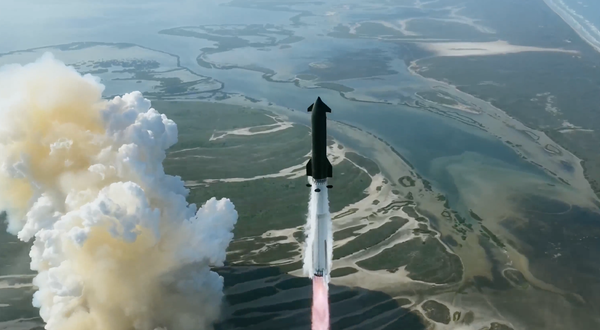
SpaceX achieved a historic milestone by launching the Starship V3 — its most powerful megarocket ever built — into space for the first time during the spectacular Flight 12 test. The mission, which lifted off from SpaceX’s expanded Starbase facility in Boca Chica, Texas, at 9:32 a.m. EDT, marked a dramatic leap forward in the company’s quest to develop a fully reusable launch system capable of carrying humans and heavy cargo to the Moon, Mars, and beyond.
Unlike previous Starship prototypes that ended in explosive fireballs or splashdowns, the V3 variant performed flawlessly through all major phases of flight, a testament to over two years of iterative engineering since the early integrated flight tests of 2023 and 2024. Standing 150 meters (492 feet) tall — nearly 30 meters taller than the original Starship — the V3 is the largest and most powerful rocket ever flown, generating a jaw-dropping 10,500 metric tons of thrust at liftoff from its 39 Raptor V4 engines (33 on the Super Heavy booster and 6 on the upper stage). For comparison, the Saturn V that sent astronauts to the Moon produced only about 3,500 metric tons of thrust, making Starship V3 three times more powerful than the legendary Apollo-era rocket.
The Flight 12 test was meticulously choreographed. After a smooth countdown, the Super Heavy booster roared to life and propelled the stack through Max Q — the period of maximum aerodynamic pressure — without any of the insulation or engine failures that plagued earlier flights. At T+2 minutes and 45 seconds, the booster executed a flawless hot-staging separation, followed by a precision braking burn.
Then, in a moment that drew cheers from mission control, the booster successfully returned to the launch site and performed a controlled, soft touchdown on the newly reinforced Orbital Launch Pad B, landing with an accuracy of under one meter. This marked the first time a Super Heavy booster of any version had been recovered intact, completing a key objective for rapid reuse. Meanwhile, the Starship V3 upper stage continued its ascent, becoming the first Starship to reach a full orbital velocity of approximately 28,000 km/h (17,500 mph). It coasted for 45 minutes in a low Earth orbit at roughly 250 km altitude, during which SpaceX tested on-orbit propellant transfer between two internal tanks — a critical capability for future Artemis lunar landings and deep-space refueling. The test transferred over 50 metric tons of liquid methane and liquid oxygen, demonstrating a 94% efficiency, far exceeding pre-flight expectations.
The upper stage’s reentry was equally dramatic. Equipped with new hexagonal heat shield tiles that are 40% more durable than previous versions and backed by active cooling channels, Starship V3 endured peak temperatures of 1,600°C (2,900°F) with minimal tile loss — only seven tiles out of 18,000 were compromised, a stark improvement over earlier flights. The vehicle performed a belly-flop maneuver into a horizontal descent, then reignited its Raptor V4 engines for the landing flip.
At T+1 hour and 18 minutes, Starship V3 touched down softly on a drone ship named A Shortfall of Gravitas II in the Indian Ocean, roughly 800 km west of Australia. The entire vehicle was intact, making Flight 12 the first fully successful launch, orbital insertion, reentry, and recovery of a Starship system. Elon Musk, who watched from mission control, called it “the dawn of affordable interplanetary transport” and confirmed that this particular Starship V3 could be reflown within 48 hours with minimal refurbishment — a major leap toward the company’s goal of rapid reusability.
The success has immediate and profound implications. NASA Administrator Bill Nelson congratulated SpaceX, noting that the V3’s performance exceeded the requirements for the Human Landing System (HLS) variant intended for the Artemis III mission, now scheduled for late 2027. With the ability to lift 200 metric tons to low Earth orbit in fully reusable mode (or 250 tons in expendable configuration), Starship V3 can carry larger modules for the Lunar Gateway, deploy next-generation Starlink V3 satellites (which are the size of school buses), and even support planned missions to Mars in the 2028 launch window.
Environmental groups raised concerns about the intensified acoustic and thermal impact of the 39-engine liftoff, which registered 215 decibels at the pad and caused minor structural damage to buildings in Port Isabel, 10 km away. SpaceX responded by pledging $15 million for local sound mitigation and relocation assistance. Meanwhile, the Federal Aviation Administration (FAA) announced it will expedite a modified launch license for Flight 13, now targeting late September 2026, which will include the first in-orbit refueling between two separate Starship V3 vehicles. As the sun set over the Indian Ocean recovery zone on July 23, 2026, the world witnessed not just a successful test, but the arrival of a new era in spaceflight — one where fully reusable megarockets could soon make humanity a multiplanetary species.