29 May 2026
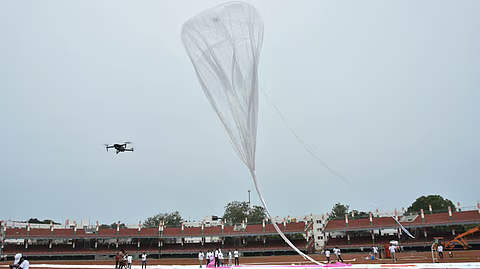
India marked a historic leap in its stratospheric research capabilities with the successful launch of its first indigenously developed super pressure balloon from the Indian Space Research Organisation (ISRO) launch site in Vijayawada, Andhra Pradesh. The event, witnessed by scientists, space enthusiasts, and senior officials from the Department of Space, unfolded under clear skies at 8:45 AM IST, as the massive polyethylene envelope—standing over 60 meters tall and capable of carrying a payload of up to 500 kilograms—rose steadily into the upper atmosphere.
Unlike conventional zero-pressure balloons that expand and vent gas with temperature changes, leading to altitude loss at night, the super pressure balloon is designed to maintain a constant internal pressure and float at a fixed altitude for weeks or even months, revolutionizing India’s ability to conduct long-duration near-space experiments. The mission, named SPB-01 (Super Pressure Balloon Mission-01), is a joint effort of ISRO’s Balloon Facility, the Tata Institute of Fundamental Research (TIFR), and the National Atmospheric Research Laboratory (NARL).
The launch vehicle, which took nearly three hours to fully inflate and ascend, carried a suite of scientific instruments including a wide-field gamma-ray detector, a cosmic dust collector, and an atmospheric ozone analyzer. Within two hours of launch, the balloon had reached its cruising altitude of 33 kilometers, well above commercial air traffic and most weather systems, entering the stratospheric wind current that would carry it eastward across the Bay of Bengal and beyond.
The primary objectives of SPB-01 include monitoring high-energy cosmic radiation, studying aerosol concentrations in the stratosphere, and testing in-situ communication relays for future lunar missions. ISRO Chairman Dr. K. Sivan, present at the control room in Vijayawada, described the moment as “a paradigm shift for India’s atmospheric and astronomical observation capabilities. Unlike satellites that have fixed orbits or sounding rockets that offer mere minutes of data, the super pressure balloon gives us a persistent, steerable platform at a fraction of the cost. This is our doorway to routine access to the near-space environment.”
The balloon’s unique design is its key innovation: made from a multilayered co-extruded polyethylene film reinforced with a net of synthetic cords, it can withstand an internal pressure differential of over 150 Pascals without rupturing. The envelope is sealed at both ends, and a diaphragm-based pressure regulation system automatically compensates for gas contraction during the cold stratospheric nights, ensuring that the balloon neither bursts from overheating in daylight nor descends due to cooling.
Project Director Dr. Arundhati Roy, from TIFR’s Balloon Facility, explained: “Conventional zero-pressure balloons can only stay aloft for 24 to 48 hours before losing helium or succumbing to diurnal cycles. Our super pressure balloon, however, is designed for missions up to 60 days. This longevity allows us to track transient cosmic events, like gamma-ray bursts, for their entire duration, and to sample stratospheric layers repeatedly over multiple latitudinal bands.” She added that the Vijayawada location was chosen for its stable low-wind conditions in the lower troposphere and its proximity to the equator, which enhances the balloon’s ability to circumnavigate the globe within the subtropical jet stream.
Weather officials had delayed the launch twice earlier in the week due to concerns about upper-atmospheric turbulence, but on May 29, conditions proved optimal. Real-time telemetry from the balloon’s onboard GPS and Iridium satellite relay began streaming data to the ground station within minutes of liftoff. One of the most exciting experiments aboard is the Indian Cosmic X-Ray Polarimeter (ICXP), developed by the Raman Research Institute, which aims to measure polarized X-rays from pulsars and black hole binaries.
Lead scientist Dr. Priyanka Mehta commented, “We have been restricted to ground-based and satellite observations for decades. Now, with a super pressure balloon floating above 99.5% of the atmosphere, our detectors face virtually no absorption or scattering. For the first time, we can make continuous polarization measurements over several days. This could finally resolve the geometry of magnetic fields around neutron stars.” The balloon also carries a biological exposure module containing spores of Deinococcus radiodurans—a radiation-resistant bacterium—to study survival in simulated Martian surface conditions, a precursor experiment for future astrobiology missions.
Public and political reaction was swift and celebratory. Andhra Pradesh Chief Minister Jagan Mohan Reddy, who attended the launch, called it “a proud moment for Vijayawada and for India’s scientific community. This facility will transform our region into a hub for aerospace research and inspire countless young students.” The launch cost, estimated at ₹45 crore (approximately $5.4 million), is less than 5% of the cost of a mini-satellite, making super pressure balloons an attractive alternative for academic and start-up led space research. The balloon is expected to complete a full circumnavigation of the Earth in 12–14 days, passing over Southeast Asia, Central America, the Atlantic, and Africa before returning to Indian airspace, where a parachute-based recovery system will bring the payload back to the ground near Bhubaneswar.
However, challenges remain. The balloon’s path crosses several international flight corridors, requiring real-time coordination with air traffic control in over 15 countries. ISRO has signed temporary agreements with the International Civil Aviation Organization (ICAO) to reroute flights during the balloon’s transit. Additionally, the potential for micrometeoroid punctures remains a risk, though redundancy layers and self-sealing patches have been incorporated. Dr. S. Raghavan, a senior atmospheric scientist at NARL, noted: “The real test begins after the first week. Stratospheric winds are capricious, and even a super pressure balloon can develop leaks. But the engineering is robust. We are also using this mission to validate long-duration power systems—lithium-ion batteries recharged by thin-film solar cells on the balloon’s equator—which will be crucial for future zero-pressure airships.”
As the balloon drifted past the coastline of Myanmar on its second day aloft, sending back crisp images of the Bay of Bengal’s cyclonic formation, India’s space agency confirmed that a second super pressure balloon, SPB-02, is already in fabrication and scheduled for a December 2026 launch carrying a terahertz imager for atmospheric water vapor mapping. The success of 29 May 2026 thus not only signifies a technological breakthrough but also positions India as a leading player in the emerging field of stratospheric persistent platforms—bridging the gap between drones and satellites. For the team in Vijayawada, the sight of that translucent, pumpkin-shaped giant ascending into the blue marked the beginning of a new chapter: one where the edge of space is no longer a frontier reached only by rockets, but a backyard that can be visited, studied, and eventually inhabited by Indian science.