June 16, 2026
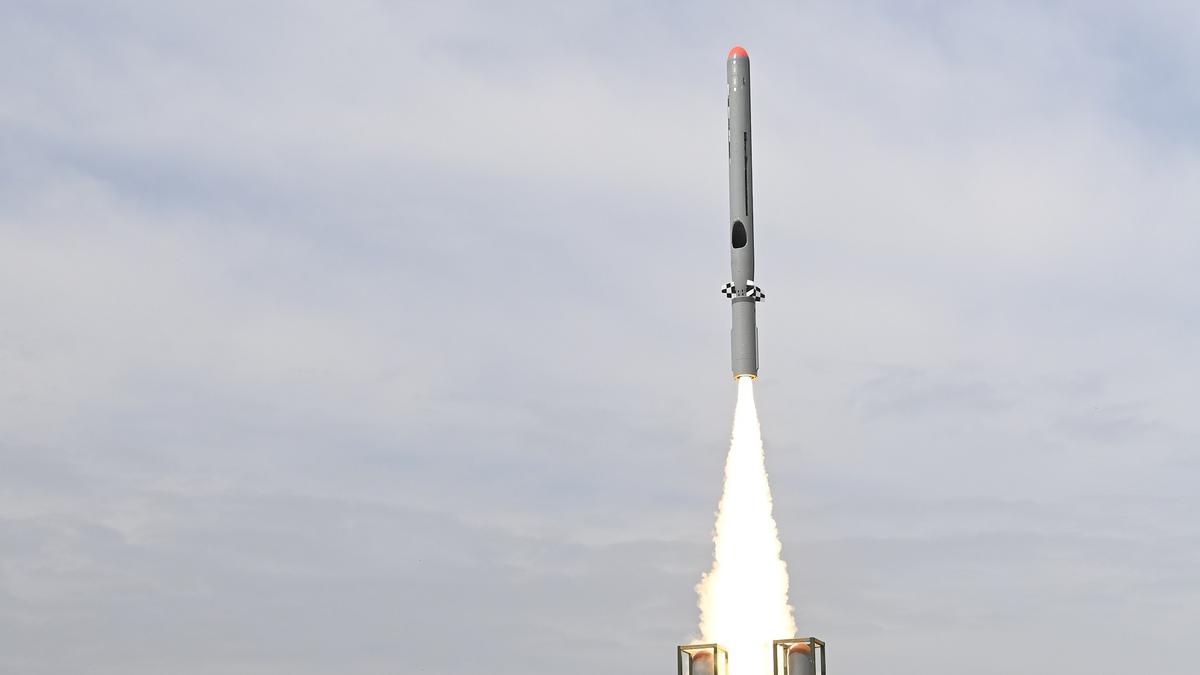
India took a monumental leap in its defense capabilities as the Defence Research and Development Organisation (DRDO) successfully conducted the flight-test of the indigenous Long Range Land Attack Cruise Missile (LRLACM) . The test, conducted from the Dr. A.P.J. Abdul Kalam Island off the coast of Odisha, has been hailed as a major step towards achieving self-reliance in critical military technology, drawing immediate comparisons to the American Tomahawk missile due to its range and precision . During the trial, the missile met all mission objectives, validating critical technologies related to propulsion, navigation, and control systems .
Data captured by various tracking instruments, including radars and electro-optical systems deployed by the Integrated Test Range (ITR) at Chandipur, confirmed that the missile’s performance was flawless throughout the flight envelope . The launch was witnessed by senior DRDO officials alongside user representatives from the Indian Navy and the Indian Air Force, indicating the tri-service relevance of this new weapon system . Defence Minister Rajnath Singh congratulated the DRDO scientists and industry partners, calling the feat a proud moment for the nation and a significant boost to the ‘Aatmanirbhar Bharat’ (Self-Reliant India) initiative in defense .
The LRLACM is a subsonic, terrain-hugging cruise missile designed specifically for precision strikes against high-value land targets deep within hostile territory . Approximately six meters long and weighing about a tonne, the missile is powered by the indigenous Manik Small Turbofan Engine, which provides the sustained thrust required for long-range missions . The missile’s aerodynamic design and flight profile are engineered for survivability; by flying at low altitudes, utilizing terrain-following capabilities, and employing waypoint navigation, the LRLACM can evade enemy radar detection and penetrate modern air defense networks .
Officials state that the missile has an estimated operational range of 1,000 to 1,500 kilometers, placing it in the same league as the US Tomahawk, Russia’s Kalibr, and China’s CJ-10 . This range allows the Indian military to strike strategic targets such as command centers, communication hubs, airfields, and logistic depots while keeping launch platforms—whether ground-based mobile launchers or naval ships—outside the reach of enemy counter-battery fire . The missile’s all-weather capability and pinpoint accuracy provide India with a credible conventional deterrent and a potent option for surgical strikes with reduced risk of collateral damage .
One of the most significant aspects of this project is the indigenous development of all subsystems, a point heavily emphasized by the DRDO . The Aeronautical Development Establishment (ADE) in Bengaluru served as the nodal laboratory for the project, coordinating efforts across various DRDO labs and Indian private and public-sector industries . This collaborative approach underscores the maturity of India’s defense industrial base, reducing reliance on foreign imports . The LRLACM traces its lineage to the earlier Nirbhay cruise missile program, which faced several developmental setbacks over the years .
However, through persistent redesign and rigorous testing, DRDO engineers mastered the complex technologies required for long-range cruise missiles, including navigation, guidance, and the Manik engine. The current LRLACM represents the successful culmination of those efforts, evolving from the earlier Indigenous Technology Cruise Missile (ITCM) program to deliver a weapon ready for serial production and induction . The success of the June 15 test follows the missile’s maiden flight-test conducted in November 2024, showing steady progress towards final operational clearance .
Strategically, the LRLACM is designed to complement, not replace, the BrahMos supersonic cruise missile . While the BrahMos relies on sheer speed to overwhelm defenses, the LRLACM uses stealth and range to penetrate defended airspace. For the Indian Navy, this missile is a game-changer. Once integrated with the Universal Vertical Launch Modules being installed on frontline warships, naval platforms operating in the Arabian Sea or the Bay of Bengal will be able to threaten strategic enemy targets hundreds of kilometers inland without entering contested waters .
Similarly, the Indian Air Force is not far behind; development of an air-launched variant of the LRLACM is reportedly underway, with initial integration work focused on the Su-30MKI fighter jet . The Indian Army also has a significant stake in this project. The Defence Acquisition Council (DAC) has already given initial nods for massive procurements; the Army is expected to acquire systems worth approximately Rs 4,000 crore, while the IAF’s proposed acquisition is estimated at Rs 10,000 crore . The Navy is expected to follow with a requirement of around 200 missiles valued at roughly Rs 5,000 crore after developmental trials conclude . With the successful demonstration of its accuracy and range, the LRLACM is poised to become the cornerstone of India’s long-range conventional strike arsenal, significantly altering the strategic calculus in the region .