June 17, 2026
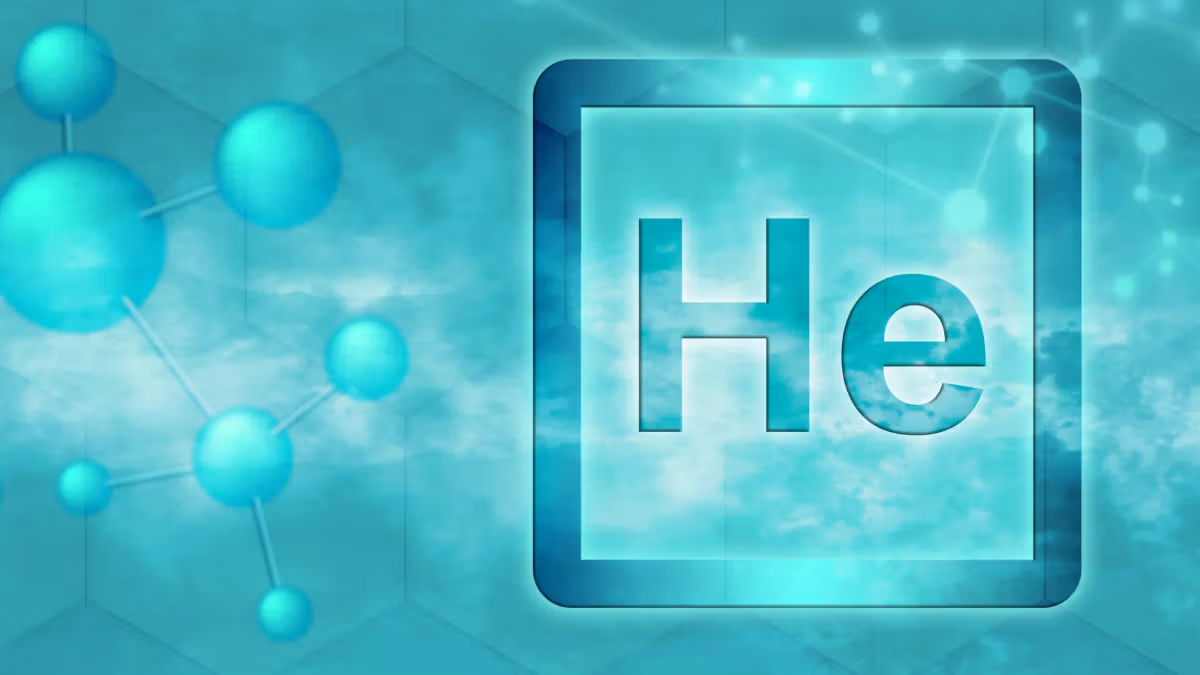
The world finds itself on the precipice of a new kind of space race, fueled not by flags or national pride, but by a rare, invisible gas worth over $2,000 per litre. This substance, helium-3, is a light, non-radioactive isotope of helium that is practically nonexistent on Earth but is theorized to be trapped in vast quantities within the Moon’s dusty surface. This seemingly simple difference in atomic structure—having one less neutron than the common helium-4—endows it with properties that could prove essential for the future of advanced technology and energy, making it the catalyst for a modern-day gold rush aimed at the lunar regolith.
The immense interest in helium-3 is driven by two primary, high-stakes technological frontiers: quantum computing and nuclear fusion. In the realm of quantum computing, helium-3 is an indispensable workhorse. It is a key component in dilution refrigerators, which utilize a mixture of helium-3 and helium-4 to achieve temperatures in the millikelvin range, fractions of a degree above absolute zero. This extreme cold is critical for stabilizing the fragile qubits that are the building blocks of quantum computers, allowing them to function without errors. As quantum computing scales up, potentially requiring thousands of litres of helium-3, the existing terrestrial supply—derived mainly as a byproduct from the decay of tritium in nuclear weapons stockpiles—will be drastically insufficient. Dima Zmeev, a senior lecturer who uses helium-3 in physics experiments, highlights the value of its cooling properties, explaining that its “phase change” is the basis for dilution refrigeration.
Beyond computing, the gas’s more speculative and potentially transformative application lies in nuclear fusion. Helium-3 is considered by many to be an almost ideal fuel for fusion reactors. When fused with deuterium, it produces a reaction that releases immense energy but generates far fewer dangerous neutrons than conventional deuterium-tritium fusion, resulting in significantly less long-lived radioactive waste. Theoretically, just tens of tons of helium-3 could power an entire nation for a year. While a commercial helium-3 fusion reactor remains a future prospect, its potential for near-clean energy adds a powerful geopolitical and economic incentive to the lunar quest. A research paper on the Helion fusion concept notes that while using D-He3 fuel allows for efficient energy conversion, the physics are demanding, “implying much tighter requirements on plasma lifetime, anomalous losses, and direct-conversion efficiency.”
The celestial source of this coveted resource is the Moon itself. Over billions of years, the solar wind has implanted helium-3 particles into the top layer of the lunar soil, known as regolith. This is why the Moon, with its lack of a magnetic field and atmosphere, has become a massive repository. The current supply of helium-3 on Earth, sourced from the controlled decay of tritium, yields perhaps tens of thousands of litres annually, but even this production is linked to geopolitical and safety constraints. With demand set to skyrocket, the moon’s regolith is being viewed as the ultimate untapped reserve. “Scientists believe that quantum computers would need thousands of litres of Helium-3 to operate, which exceeds existing production capabilities,” highlighting the fundamental supply chain problem that lunar mining is intended to solve.
Leading the charge to harvest this resource are private companies, with Seattle-based Interlune at the forefront. Co-founded by former Blue Origin president Rob Meyerson and Apollo 17 astronaut Harrison “Jack” Schmitt, the company is developing autonomous excavators designed to be deployed on the lunar surface. “We’ve spent the last four years developing, prototyping and testing technologies… We have a team of 30 people, and growing,” says Meyerson, outlining the company’s tangible progress. Their vision involves robotic rovers that scoop up regolith, crush it, and heat it to release the trapped gases, including helium-3. Interlune aims to test its technology on the Moon as early as autumn 2027 and has already signed a $300 million deal to supply 10,000 litres of helium-3 annually to a quantum computing company starting in 2028. Another firm, Astrotech Corporation, is also developing similar technology, planning to extract helium-3 by heating regolith on future SpaceX Starship missions.
However, the path from lunar dust to commercial product is fraught with monumental engineering and economic challenges. The fundamental problem is scarcity in the source material. Estimates from Apollo-era samples suggest helium-3 concentrations on the Moon are only a few parts per billion (ppb) to perhaps a couple of dozen ppb. This means that to obtain a single kilogram of helium-3, companies would need to excavate and process hundreds of thousands of tonnes of lunar regolith. Paul Burke of Johns Hopkins Applied Physics Laboratory describes this as a “mountain-moving” prospect and notes that these estimates may be skewed, as “Apollo regolith samples might have lost some of their helium-3 on their return to Earth,” potentially creating a false picture of its true abundance. The lunar environment itself is notoriously hostile, with abrasive, electrostatically charged dust that can foul machinery, making remote operation extremely difficult.
In the face of these obstacles, some researchers and companies are looking for more pragmatic alternatives that are much closer to home. For instance, Portugal-based Pulsar Helium is investigating helium-3 deposits in Minnesota, where concentrations of around 12 ppb have been identified. Peter Barry, a geochemist and scientific advisor to the company, argues a more conventional approach could be viable, stating, “Minnesota is a lot easier to get to than the moon.” Simultaneously, some scientists are researching new cooling technologies for quantum computers that could reduce, or potentially eliminate, the need for helium-3. As of this day, June 17, 2026, the race to mine the Moon for helium-3 is a story of incredible ambition, representing a high-risk, high-reward venture where cutting-edge technology, economic calculus, and geopolitics converge. The potential prize is a stake in the future of computing and energy, but the tangible reality of a lunar helium-3 industry hinges on overcoming staggering technical hurdles that, for now, keep the $2,000/litre gas tantalizingly just out of reach.