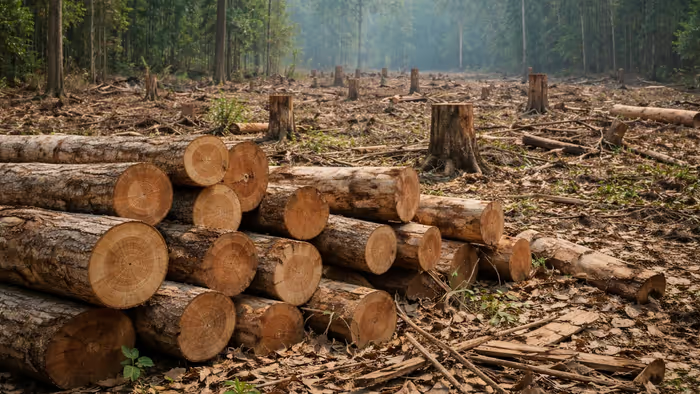
An in-depth analysis of official records from the Union Ministry of Environment, Forest and Climate Change has revealed a stark environmental reality: over 2.8 million trees on forest land were approved for felling or already cut down within a three-year period. Conducted by the environmental publication Down To Earth (DTE), the investigation meticulously compiled data from the minutes and records of the ministry’s Forest Advisory Committee and various Regional Empowered Committees. The findings highlight a relentless drive toward commercial and industrial expansion at the direct cost of India’s natural carbon sinks and biodiversity hotspots.
The core revelation of the analysis is that industrial, infrastructure, and rehabilitation projects accounted for nearly 90 percent of the total trees approved for removal. This pattern underlines a structural preference for large-scale development over ecological preservation. Rather than being driven by small-scale or localized needs, the massive loss of green cover is structurally tied to the state’s strategic economic ambitions. Commenting on the long-term ecological trauma of such widespread clearance, Dr. Arshiya Bose, an environmental researcher specializing in forest ecosystems, noted: “When millions of mature trees are removed across diverse eco-classes, we aren’t just losing timber; we are effectively shattering intricate symbiotic networks, altering microclimates, and permanently disrupting regional water tables.”
Among the various sectors driving this widespread deforestation, mining operations emerged as the leading culprit, closely followed by major hydropower initiatives and large-scale rehabilitation projects. The extraction of mineral resources consistently demands the total clearing of surface vegetation, converting dense canopy forests into barren, hollowed-out landscapes. Similarly, massive hydroelectric dams necessitate the flooding of vast reservoirs, submerging entire river valleys and drowning millions of endemic plant species. These multi-sectoral demands have systematically outpaced local conservation efforts, leading to a highly fragmented landscape where remaining forest patches are increasingly isolated from one another.
The geographic distribution of these clearings shows that the ecological brunt is heavily concentrated in resource-rich and ecologically sensitive states. Regions possessing substantial mineral wealth or significant river systems bear a disproportionate share of the environmental devastation. This localized destruction accelerates soil erosion, triggers unpredictable flash floods, and drastically escalates human-wildlife conflict as native fauna are stripped of their natural habitats. Reflecting on the systemic drivers behind these trends, Dr. Sharpal Singh, a climate scientist analyzing land-use patterns, stated: “The persistent divergence of pristine forest land for commercial exploitation creates a compounding environmental debt. The immediate economic yields of mining and energy infrastructure are routinely prioritized over the invisible, multi-billion-dollar ecosystem services provided by standing forests.”
Furthermore, the DTE investigation brought to light severe concerns regarding the transparency, long-term monitoring, and rigorous verification of compensatory afforestation initiatives. While the Forest (Conservation) Act mandates that equivalent non-forest land must be planted with trees to offset the loss, researchers argue that a newly planted sapling cannot immediately replace a centennial tree. The lag time required for a monoculture plantation to match the ecological functions, carbon sequestration capacity, and biodiversity of a mature, multi-layered forest can span several decades, if not centuries. As Dr. Nitin Desai, a restoration ecologist, observed: “Replacing ancient, old-growth biomes with highly uniform, commercial tree plantations is an ecological illusion. These artificial monocultures fundamentally lack the complex structural integrity, soil microbiota, and resilience against pest outbreaks that define a healthy, natural forest system.”
The ongoing policy shifts and legislative amendments to environmental frameworks have further loosened restrictions on clearing woodland. By streamlining the bureaucratic pipeline for “in-principle” approvals, the administrative mechanism has significantly expedited final-stage clearances for commercial user agencies. Consequently, thousands of hectares across multiple ecological zones—ranging from tropical semi-evergreen zones to sub-alpine scrubs—are being systematically cleared under the banner of public interest and national progress. This accelerated pace of degradation poses a direct challenge to the country’s international commitments, such as the Bonn Challenge, which aims to restore millions of hectares of degraded and deforested land by the end of the decade.
The sheer scale of the clearances highlights an urgent need for a fundamental recalibration of how environmental costs are assessed during project planning. The current economic frameworks rely heavily on the Net Present Value (NPV) of forests, which critics argue grossly undervalues the true worth of complex ecosystems, clean air production, and genetic repositories. Without a comprehensive, independent audit of both the trees felled and the survival rate of compensatory afforestation sites, the true deficit in green cover remains obscured behind administrative paperwork. Emphasizing the necessity of a paradigm shift, Dr. Vishaal Mehta, a conservation scientist, concluded: “We cannot continue to treat our primary forests as mere real estate waiting to be converted. If our developmental trajectories do not explicitly account for the irreplaceable loss of biodiversity, we are locking ourselves into a future defined by severe ecological instability.”
In summary, the DTE analysis functions as a critical wake-up call regarding the rapid depletion of India’s forest resources. The approval to fell over 2.8 million trees in just three years underscores a profound systemic conflict between rapid economic expansion and long-term environmental sustainability. As heavy machinery continues to clear away pristine canopies for mines, dams, and roads, the scientific community remains deeply concerned that the resulting ecological fragmentation will permanently weaken regional climate resilience. Addressing this crisis will require more than just financial compensation or superficial tree-planting drives; it demands a strict, legally binding commitment to preserving remaining primary forests and adopting a development model that respects ecological boundaries.