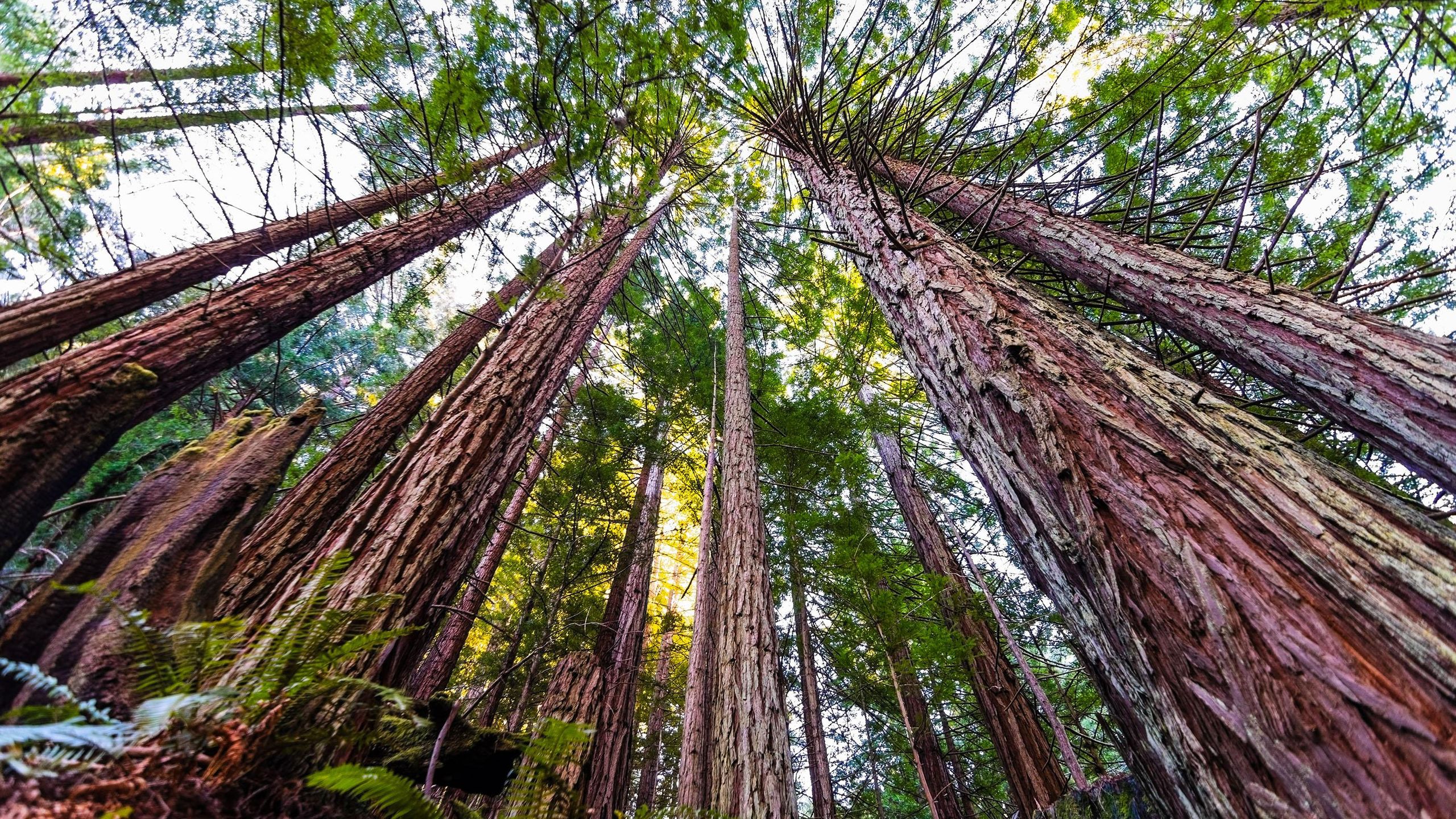
The seemingly simple act of a tree growing is still a subject of profound scientific inquiry, but the mystery of how these giants reach over 300 feet is finally being demystified by the elegant, hidden physics at play. While conventional wisdom often points to capillary action, the reality is that this process, governed by Jurin’s law, would stagnate at about 130 meters, far short of the dizzying heights achieved by the world’s tallest trees .
The true secret lies in a sophisticated interplay of water’s unique properties and the tree’s internal architecture. For decades, the classic explanation has been the cohesion-tension theory, which posits that the evaporation, or transpiration, of water from the leaves creates a negative pressure or tension that pulls water up from the roots . This process relies heavily on two critical properties of water: cohesion, where water molecules stick to each other, and adhesion, where they stick to the walls of the tree’s vascular system, the xylem . This creates an unbroken column of water that is essentially pulled upwards from the top, much like a chain being drawn through a tube.
However, this theory presents a significant physical challenge: water under such extreme tension is in a metastable state and prone to cavitation, where air bubbles or embolisms form and break the water column, threatening to sever the lifeline to the canopy . This is where the true “physics trick” emerges. The secret to a tree’s success is not just about pulling water up in a perfect, unbroken stream, but also about its ability to manage and repair these inevitable breaks. The tree’s xylem is not just a passive pipe; it is a sophisticated system of microscopic vessels and nanoscale pores, known as pit membranes, that allow for the movement of water between adjacent conduits . It is at this nanometric scale that the disjoining pressure comes into play.
This force, which acts on the thin films of liquid in these tiny pores, acts as a sort of “exhaust valve,” enabling the refilling of embolized vessels even when the surrounding liquid is under immense tension . The water can effectively bypass the blockage and move laterally, using these microscopic bypasses to continue its journey upward. The very stability domain of these liquid thin-films is what ultimately limits the maximum height a tree can achieve, suggesting that a colossal tree like the 300-foot giant redwood exists on the very edge of what is physically possible .
To achieve these monstrous heights, trees also adjust their internal engineering. It is a critical adaptation that taller trees develop larger xylem vessel diameters to reduce hydraulic resistance . Since the flow rate through a vessel is proportional to the fourth power of its radius, even a slight increase in diameter leads to a massive increase in water conductivity, making the long journey to the canopy more efficient . This is complemented by the structural physics of the tree itself.
Based on Greenhill’s theory of structural mechanics, the height a tree can reach is also proportional to the two-thirds power of its diameter, a scaling law that explains how the trunk must thicken to support the massive weight and resist buckling under its own load . This is a delicate balancing act, as increasing vessel size for better water flow can also make a tree more vulnerable to drought-induced embolisms, a trade-off that trees in humid environments appear more willing to make . Ultimately, the 300-foot tree stands as a testament to overcoming a tripartite physical challenge: it must simultaneously pull water up against gravity, patch the system when it breaks, and construct a trunk that can support its own immense weight, a feat that positions it at the boundary of the laws of physics and life itself .