June 25, 2026
Recent developments in Chinese space technology, confirmed through state-funded procurement tenders, industrial deliveries, and infrastructure planning, strongly indicate that the nation is actively developing a new family of powerful, reusable rockets with a diameter of approximately 7 meters. This initiative, which surfaced in June 2026, points to a strategic move to fill a critical capability gap between its existing and planned launch vehicles, creating a more versatile and competitive space launch architecture. The evidence, including a tender for specialized welding equipment and the delivery of massive stainless-steel rings, suggests the project is advancing from the design phase into hardware production. This development would provide China with a launch vehicle analogous to Blue Origin’s operational New Glenn rocket, offering a substantial increase in payload capacity and mission flexibility to support its ambitious space goals, including the deployment of mega-constellations and large-scale space infrastructure projects.
The most compelling evidence for this new rocket program comes from several recent industrial and logistical actions. A publicly available tender on the electronic procurement platform of the China Aerospace Science and Technology Corporation (CASC), the country’s main space contractor, sought a specialized “7-meter-class tank-dome welding system” . This specific tooling requirement is a strong indicator that CASC is preparing to manufacture the large, propellant-carrying tanks for a rocket of this diameter. Corroborating this, the Shanghai-listed forging firm Wuxi Parker New Materials announced in early June 2026 that its subsidiary had passed acceptance and shipped a “7.5-meter-class ultra-large-diameter high-strength ring for aerospace use” .
Crucially, the acceptance panel for this component included representatives from CASC’s China Academy of Launch Vehicle Technology (CALT), confirming its direct relevance to a future, unnamed “important model” . These industrial moves are complemented by statements from officials at the Hainan commercial space launch site. Yang Tianliang, the site’s chairman, confirmed plans to construct new launch facilities capable of supporting 7-meter and even 10-meter-class rockets, as the current pads are designed for smaller vehicles. This planned infrastructure expansion shows a long-term commitment to fielding these larger rockets and is a logical step given the logistical constraints of transporting such wide stages, which would be too large for rail or road transport and would therefore necessitate coastal manufacturing and sea transport to the Wenchang launch site on Hainan Island.
The strategic rationale for this 7-meter-class rocket is to provide an intermediate, highly capable option within China’s developing launch vehicle roadmap. According to a development recommendation circulated by CALT in May 2023, the country aims to develop a family of rockets with 5-meter, 7-meter, and 10-meter diameters. The 5-meter class is already represented by the Long March 10 series for crewed lunar missions, while the 10.6-meter class corresponds to the super-heavy Long March 9, expected to debut in the 2030s. The 7-meter class, which had not previously received a public designation, would fill the gap between these two, offering a vehicle capable of delivering roughly 25,000 to 50,000 kilograms to low Earth orbit (LEO), depending on engine configuration.
This positions it as a high-frequency workhorse for deploying large satellite constellations, a role increasingly important as China pushes forward with projects like the Qianfan (Spacesail) constellation. The technical design is also evolving, with a notable shift from traditional aluminum alloys to high-strength martensitic stainless steel for the rocket’s structure, a choice likely driven by the material’s superior performance in reusability and lower manufacturing costs, aligning with the “small steps, rapid iteration” development philosophy CALT recently described for its large-diameter stainless structures.
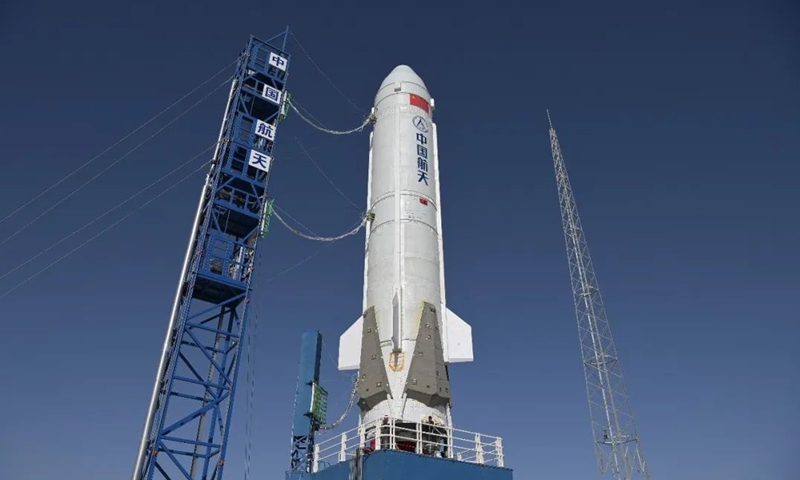
The development of this 7-meter rocket is a significant part of China’s broader, fast-paced push into reusable launch technology. This ambition is already being demonstrated by the recent successful maiden flight of the Long March 12B rocket on June 1, 2026, a 4.37-meter-diameter reusable rocket with a LEO payload capacity of 20 tons, developed by a commercial subsidiary of CASC. That rocket, developed in just 21 months, serves as a technological demonstrator, incorporating features like “dual brains” for autonomous flight control and a recovery test planned for a future mission.
The experience and technologies developed with the Long March 12B are likely to inform the larger 7-meter project. While the specific engine configuration for the new 7-meter rocket remains unknown, the 2023 recommendation suggests options including clusters of the 80-ton-thrust YF-209 methalox or larger 200-ton-thrust engines, indicating a move toward methane propulsion to further enhance performance and reusability. The suite of planned rockets—3.8-meter, 5-meter, 7-meter, and 10.6-meter—demonstrates China’s intent to create a comprehensive and redundant portfolio of launch vehicles, with the 7-meter class serving as a pivotal new capability in its quest to become a dominant power in space.