June 27, 2026
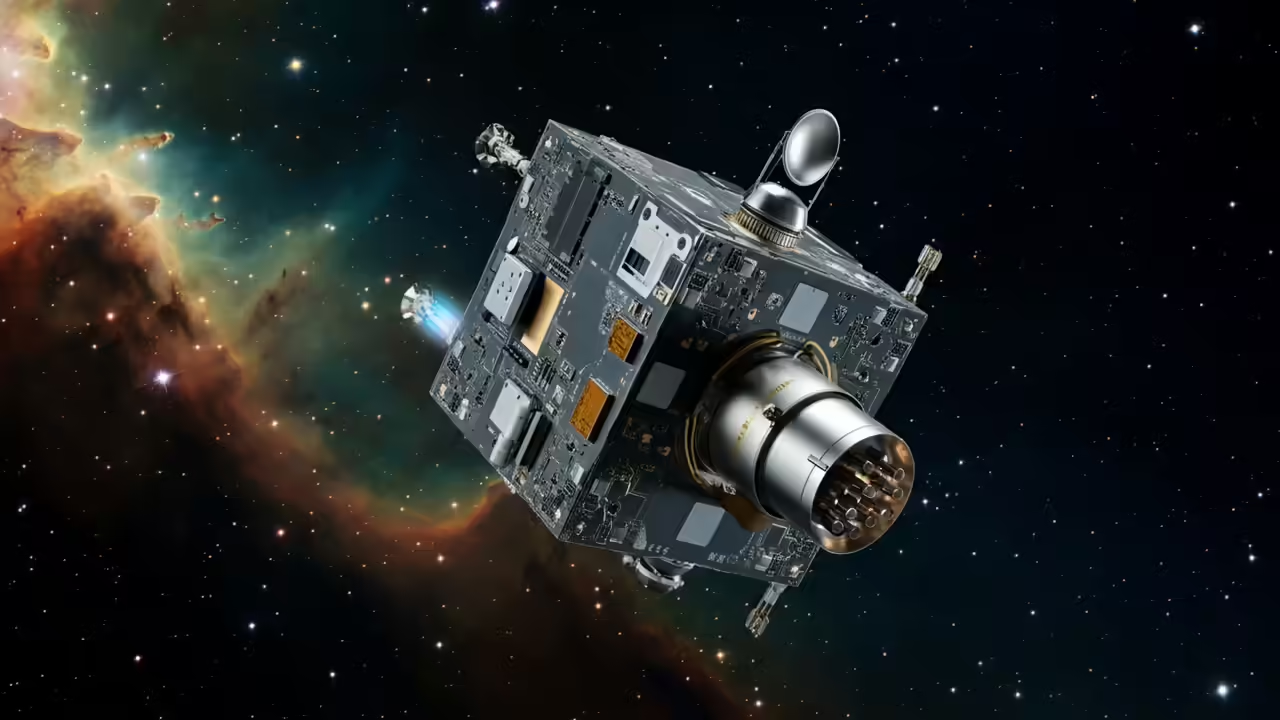
The prospect of tiny, low-cost satellites exploring the far reaches of our solar system has moved from science fiction to tangible reality, thanks to a groundbreaking new propulsion system developed by engineers at the Massachusetts Institute of Technology (MIT). This innovation promises to revolutionize space exploration by equipping small spacecraft, known as CubeSats, with the ability to travel to destinations as distant as Mars and the asteroid belt.
The core of this breakthrough lies in a novel dual-mode propulsion architecture that cleverly integrates two traditionally distinct technologies—chemical and electric thrusters—into a single, highly efficient system that operates on one shared fuel source. This ingenious design effectively resolves the long-standing trade-off in spacecraft design between high thrust for rapid maneuvers and exceptional fuel efficiency for long-haul travel, opening the door for a new era of flexible and affordable deep-space missions.
The research, published in the Journal of Propulsion and Power, demonstrates a propulsion system that offers the “best of both worlds” for small satellites, as described by Amelia Bruno, a former postdoctoral researcher in MIT’s Department of Aeronautics and Astronautics and lead author of the study. This compact, two-in-one system allows a single satellite to perform both powerful, rapid bursts of thrust for quick trajectory changes and highly efficient, low-thrust acceleration for long-duration interplanetary cruising.
The key to this remarkable versatility is a specialized propellant known as ASCENT (Advanced SpaceCraft Energetic Non-Toxic propellant) , originally developed by the U.S. Air Force as a safer, greener alternative to the highly toxic hydrazine traditionally used in chemical rockets. The MIT team discovered that ASCENT, which is an ionic liquid mixture, is also perfectly suited to power miniature electric thrusters called electrospray thrusters, which are roughly the size of a thumbnail or a coin. “ASCENT happens to be an ionic liquid mixture,” Bruno explained. “And we said, hey, that’s the stuff we typically use. Theoretically, this should work. Let’s go figure out how”.
Electrospray thrusters are a marvel of miniaturization. They function by using an electric field to charge and accelerate particles of a liquid propellant, expelling them as a fine spray to generate thrust. While the force produced by each thruster is small, its extreme efficiency allows a spacecraft to gradually build up tremendous velocity over months or years, consuming very little fuel in the process—an ideal characteristic for long interplanetary voyages.
In their experiments, the MIT team tested electrospray thrusters fueled with ASCENT, mounting them on a CubeSat-like structure placed on a magnetic levitation platform inside a vacuum chamber to simulate the conditions of space. The results were exceptionally promising: the thrusters performed on par with conventional electrospray propellants, achieving a thrust-to-power ratio of 40–65 micronewtons per watt, a specific impulse of 600 seconds, and an overall efficiency of 15%. Moreover, the system demonstrated remarkable durability, operating continuously for up to 167 hours with no measurable degradation. This validation confirmed that a single tank of ASCENT can effectively fuel both a high-thrust chemical engine and highly efficient electric thrusters, significantly reducing the weight and complexity of the spacecraft and freeing up precious volume for scientific instruments.
The implications of this technology are profound. Professor Paulo Lozano, the Miguel Alemán Velasco Professor of Aeronautics and Astronautics at MIT and a co-author of the study, envisions a new paradigm for space exploration. “We could send CubeSats to Mars, or the asteroid belt, where they could make the journey slowly, using electrospray thrusters,” he said. “You could then use your chemical thrusters to quickly move to look at interesting features. You could have a lot more flexibility to do a lot more things”. This capability could allow scientists to deploy swarms of low-cost CubeSats to conduct scientific investigations across the solar system, rather than relying on a single, large, and expensive spacecraft. The technology’s benefits are also expected to extend to Earth-observation missions, where satellites could use chemical thrusters to quickly reposition to monitor a developing storm and then use electric thrusters for precise station-keeping, all from the same fuel supply.
The critical next step for this technology is an in-space demonstration, which is scheduled to take place as early as November 2026 through NASA’s Green Propulsion Dual Mode mission. This mission will feature a briefcase-sized CubeSat equipped with one chemical thruster and four electrospray thrusters, all connected to a shared fuel tank filled with ASCENT. If successful, it will be the first time a satellite has operated with a shared propellant tank, proving the concept’s viability in the harsh environment of space and potentially setting the stage for a new generation of explorers. The MIT breakthrough thus marks not just an incremental improvement, but a potential paradigm shift, promising to transform CubeSats from simple Earth-orbiting instruments into capable pioneers of the solar system, democratizing access to the cosmos and accelerating humanity’s journey to the stars.