What was once a solution for the harsh, unforgiving terrain of Mars is rolling onto city streets and bike paths, promising to redefine our relationship with one of the most fundamental parts of our vehicles: the tyre. The air-filled rubber tyre, a mainstay of transportation for over a century, is facing its most significant challenge yet from a technology developed by NASA. This innovation, known as the superelastic tyre, was originally designed for planetary rovers to withstand the rigors of the Moon and Mars. Now, through the work of The SMART Tire Company, this space-age technology is being adapted for everyday bicycles, potentially making punctures, blowouts, and the humble spare tube relics of the past.
The journey from a NASA laboratory to a bicycle wheel began with a critical problem. When the Curiosity rover landed on Mars, its rigid aluminium wheels began showing significant signs of damage after just 16 months due to the planet’s sharp, rocky surface. This necessitated a radical rethinking of wheel design for future missions. Researchers at NASA’s Glenn Research Center moved away from traditional structures and created a tyre that could adapt to its environment rather than break under pressure. The core of this revolutionary tyre is a remarkable nickel-titanium alloy called Nitinol.
This is not an ordinary metal; it is a shape memory alloy (SMA) that possesses a unique “superelastic” property. Unlike most metals that permanently bend or deform under stress, Nitinol can be bent, twisted, or crushed and will instantly snap back to its original shape when the force is removed. At a molecular level, the material rearranges its internal structure when deformed and then reverts perfectly, allowing it to handle up to thirty times the strain of ordinary metals without lasting damage. This combination of strength and flexibility makes it as elastic as rubber but as strong as titanium.
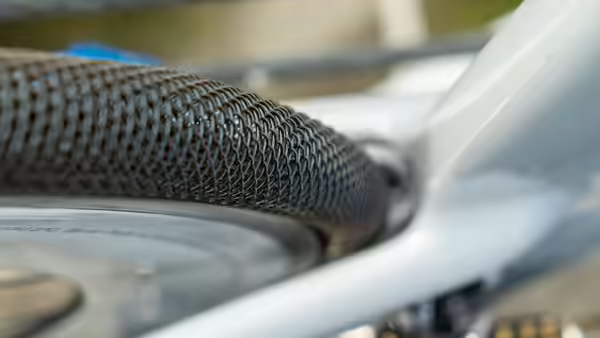
This superelastic material is the key to the tyre’s puncture-proof nature, as it requires no air to hold its shape. The design itself is ingenious, often featuring two layers of SMA elements. A single long wire is coiled to form the tyre’s primary structure and strength, while a second layer of smaller, interlocked springs acts like chain mail, providing flexibility and creating a cushioning effect similar to a pneumatic tyre. The result is a wheel that acts like a giant, indestructible shock absorber, providing a smooth ride without the risk of flats or the need to maintain air pressure. For the consumer version, known as the METL tyre, this high-tech metal mesh core will be covered with a special poly-rubber material to provide the necessary traction and grip for a wide range of weather conditions and terrains. This coating offers the practicality needed for everyday use, from smooth city roads to muddy mountain trails, while the Nitinol structure ensures the tyre’s long-term integrity.
Beyond its revolutionary, puncture-proof nature, the METL tyre promises a lifespan that could match the bicycle itself. While the outer rubber tread may eventually wear down and need replacing, the inner Nitinol alloy core is immune to rust, corrosion, and the structural fatigue that plagues traditional tyres, making it incredibly durable and low-maintenance. This has profound implications for sustainability, as it could drastically reduce the millions of rubber tyres that end up in landfills each year.
With a projected availability starting in the third quarter of 2026, the technology is already available for licensing, indicating a broad commercial push. The SMART Tire Company, founded by Brian Yennie and Earl Cole, has secured licenses for NASA’s patents and is spearheading the consumer rollout. While the initial launch is focused on the cycling market, particularly for commuter, road, gravel, and mountain bikes, the potential applications for this technology are vast. It could eventually revolutionize tyres for heavy-duty trucks, military vehicles, commercial aircraft, and even personal cars, representing a significant leap forward in transportation technology and a prime example of how solving the extreme challenges of space exploration can lead to world-changing innovations here on Earth.