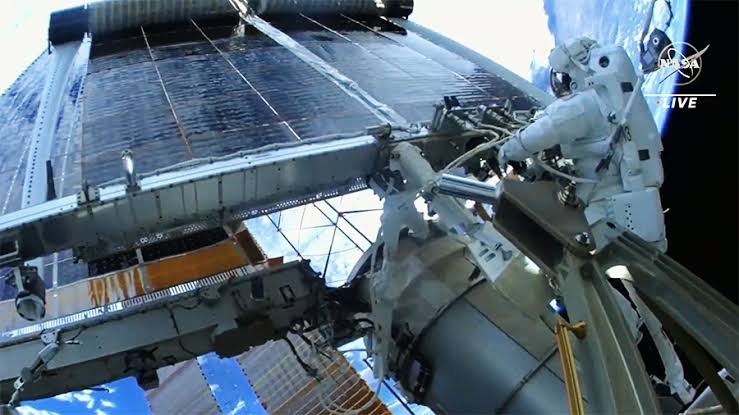
In a landmark mission that combined cutting-edge orbital engineering with a historic milestone in human spaceflight, NASA astronaut Anil Menon and Canadian Space Agency (CSA) astronaut Joshua Kutryk successfully completed a grueling 7-hour and 11-minute spacewalk outside the International Space Station (ISS). Stepping out of the station’s Quest airlock, the two spacewalkers embarked on a mission to install and deploy the seventh International Space Station Roll-Out Solar Array (iROSA) on the station’s port-side truss structure. This meticulously executed excursion not only provided a vital technological upgrade to the orbiting laboratory but also officially marked the 100th U.S. spacewalk conducted exclusively from the space station without a docked space shuttle. Operating approximately 260 miles above Earth, the crew navigated alternating cycles of orbital darkness and intense sunlight, meticulously executing each phase of a complex installation timeline to reinforce humanity’s premier orbital outpost.
The centerpiece of the extravehicular activity (EVA) was the deployment of the compact yet immensely powerful iROSA technology, which addresses the declining performance of the station’s original solar panels after decades of relentless exposure to the harsh space environment. Unlike traditional, rigid solar panels that require massive pre-assembled rigid structures, iROSA units are delivered tightly rolled up inside SpaceX Dragon cargo vehicles and are unfurled once safely mounted in orbit. During the operation, Anil Menon utilized the Canadarm2 robotic arm to maneuver the heavy, compact roll-out array to its designated worksite on the 2A electrical power channel, while Joshua Kutryk traversed the station’s complex exterior truss structure to meet him at the assembly point. Working in tandem under demanding microgravity conditions, the astronauts carefully unfastened the array from its temporary stowage platform, secured it rigidly to its structural mounting brackets, and successfully integrated its heavy-duty cables into the station’s primary electrical grid before triggering its automated deployment mechanism.
The physical installation of this seventh array represents a monumental leap forward in the station’s overall power generation and operational longevity. Once the final eighth array is fully integrated, the comprehensive iROSA upgrade program will increase the ISS’s available power by up to 30%, boosting the station’s total electricity-generating capacity from 160 kilowatts to approximately 215 kilowatts. This substantial power surge is critical for sustaining cutting-edge scientific experiments, heavy-duty life-support infrastructure, and day-to-day station operations as humanity enters the latter half of the decade. Furthermore, mission planners have emphasized that the augmented energy capacity is essential for supporting the ISS through its planned service life and powering its eventual safe and controlled deorbit. By ensuring a stable and robust power baseline, these roll-out arrays safeguard the legacy of international cooperation and scientific discovery housed within the orbiting laboratory.
Beyond its technical achievements, the landmark spacewalk carried profound personal and historical significance for the spaceflight community. The mission represented Anil Menon’s fourth career spacewalk, showcasing his seasoned expertise in extravehicular operations, while Joshua Kutryk completed his very first spacewalk, marking a proud moment for Canadian participation in human space exploration. Statistically, this excursion added to a rich lineage of orbital maintenance, standing as the 285th overall spacewalk dedicated to the construction, maintenance, and modernization of the space station since its inception. Following their triumphant return to the Quest airlock, the astronauts also utilized the tail-end of their EVA window to complete critical preparatory maintenance tasks, setting the stage for the final phase of the power augmentation initiative.
With the seventh roll-out array securely installed and generating power, NASA and its international partners are already setting their sights on the horizon. The final chapter of this multi-year power upgrade campaign is scheduled for November 5, when astronauts will embark on another crucial spacewalk to install the eighth and final iROSA on the station’s 3B electrical power channel. This upcoming milestone will officially bring the massive solar-array augmentation project to a close, culminating years of careful planning, cargo deliveries, and high-stakes spacewalks that began back in 2021. As the International Space Station approaches the final phase of its historic operational lifecycle, these engineering triumphs serve as a powerful testament to the resilience, adaptability, and enduring vision of international space exploration.