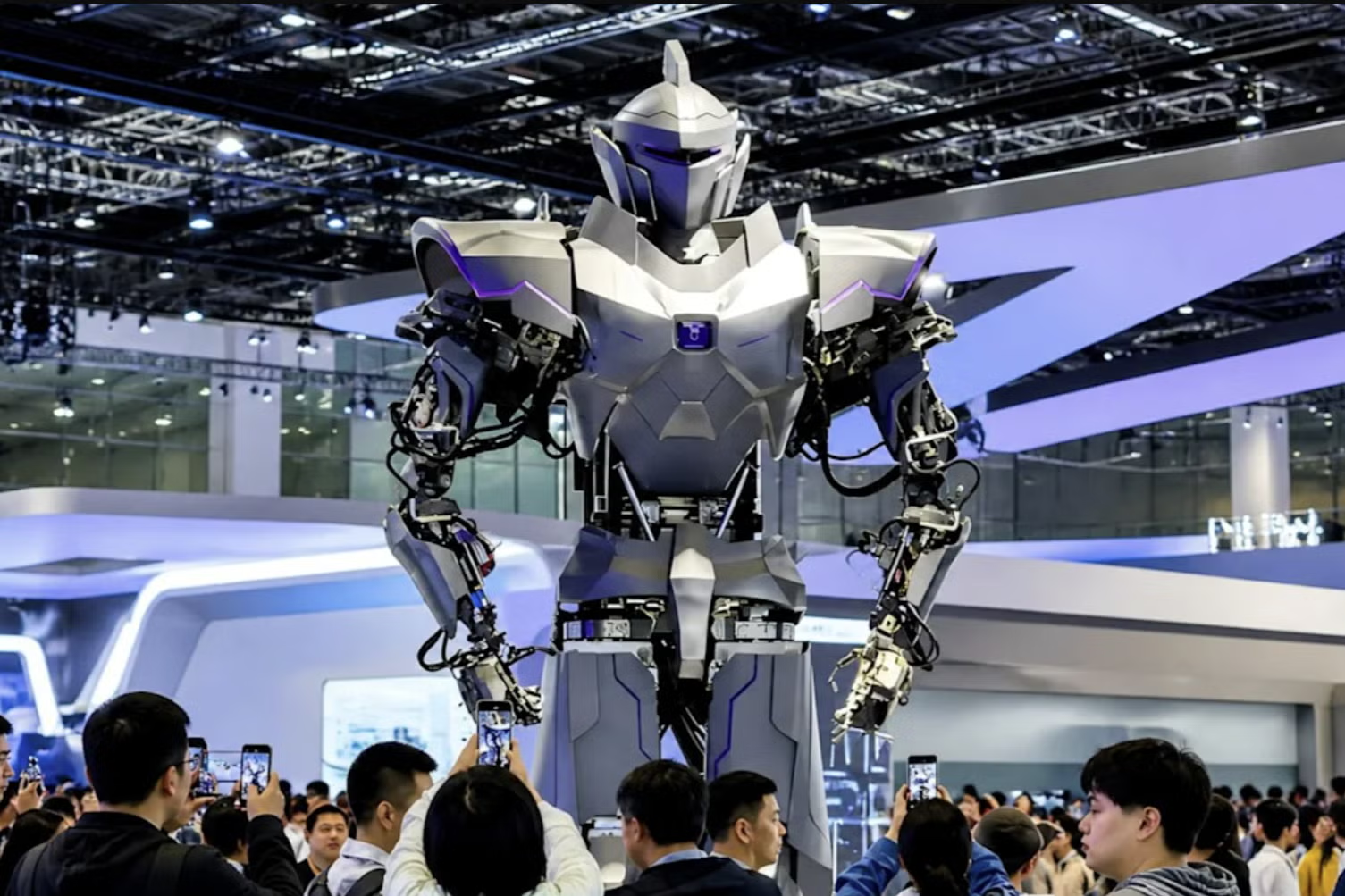
The robotic landscape witnessed a monumental leap forward with the unveiling of Neo1, a gigantic 4-meter-tall (13-foot), 1.2-ton “super humanoid” robot developed by the Chinese startup NeodraDynamics. Designed to revolutionize heavy industrial labor, Neo1 boasts a dual-arm payload capacity of 500 kilograms (1,102 lbs), with a single arm capable of lifting up to 300 kilograms. While traditional human-sized humanoid robots generally top out at lifting light loads of 10 to 30 kilograms, Neo1 crosses into the domain of industrial cranes while retaining a bipedal, anthropomorphic form factor. To understand how this massive engineering marvel works, one must look closely at its hybrid power core, joint engineering, structural materials, dexterous manipulators, and extreme-environment tolerance.
At the heart of Neo1’s extreme lifting capability lies a proprietary hydraulic-electric hybrid drive system. Most modern commercial humanoids rely exclusively on electric servo motors, which offer clean precision but lack the raw torque density required to lift half a ton without overheating or requiring oversized gearboxes. Conversely, traditional hydraulics are immensely powerful but notoriously heavy, prone to fluid leaks, and difficult to control with high precision. NeodraDynamics bridged this gap by developing digital hydraulic actuators that act as synthetic muscles across 39 of the robot’s 41 active degrees of freedom (DOF). By pairing compact digital hydraulic cylinders for heavy torque output with high-speed electric drive motors—specifically for rotation-heavy joints like the forearms—the robot distributes power on demand. This hybrid approach delivers immense power density while maintaining tight energy management to prolong runtime.
The mechanical architecture of Neo1 is built to translate raw hydraulic force into ultra-precise motion. The robot features a total of 41 full-body degrees of freedom, with each of its main arms possessing 7 degrees of freedom designed to mirror the range of motion of human upper limbs. Despite handling half-ton loads, the arm actuators achieve an end-point repeatability precision of 0.05 mm, allowing the giant machine to position heavy industrial components with microscopic accuracy. The mechanical skeleton is constructed from high-strength alloy frameworks and reinforced composites, built to withstand high torsional strain without flexing under maximum load. This structural rigidity ensures that when the robot lifts a 500 kg payload across its 3.9-meter working radius, its balance center and limb trajectories remain completely stable.
Beyond mere strength, Neo1 separates itself from basic industrial machinery through its two high-power dexterous hands, each equipped with 15 degrees of freedom. Humanoid hands designed for heavy lifting usually sacrifice fine manipulation, but Neo1’s fingers achieve a fingertip repeatability of 0.005 mm. The hands integrate tactile sensor arrays and pressure feedback directly into the digit tips, enabling the robot to exert hundreds of kilograms of gripping force on thick steel beams or scale down its pressure instantly to assemble delicate parts or handle sensitive tools. This dual capability—combining heavy crane strength with human-like dexterity—allows the robot to operate standard human tools and industrial equipment designed for manual labor.
Controlling a 1.2-ton machine carrying a 500 kg dynamic load requires advanced real-time compute and dynamic stabilization algorithms. Neo1 relies on an embedded artificial intelligence control architecture paired with dynamic load-balancing software. Because moving heavy payloads rapidly shifts the machine’s center of gravity, the software continuously calculates full-body inverse kinematics and dynamic force distribution across the torso, legs, and hydraulic circuits thousands of times per second. Sensor fusion inputs—including multi-axis force/torque sensors at every joint, optical cameras, and inertial measurement units (IMUs)—feed into the central processor to instantly compensate for shifting weights, preventing tipping or structural stress during dual-arm manipulation.
Finally, Neo1 is explicitly engineered to replace human workers in “4D” environments—Dull, Dirty, Dangerous, and Difficult. Its hydraulic-electric internal components are sealed within an extreme-environment chassis capable of operating in temperature ranges from 50 degree to 300 degree, resisting intense nuclear radiation, and enduring pressures down to 12,000 meters in deep-sea operations. Designed for heavy manufacturing, emergency disaster clearance, chemical spill response, nuclear waste handling, and subsea cable repair, Neo1 represents a fundamental shift in robotics: scaling up the humanoid form factor to tackle the world’s most hazardous heavy-duty industrial tasks.