
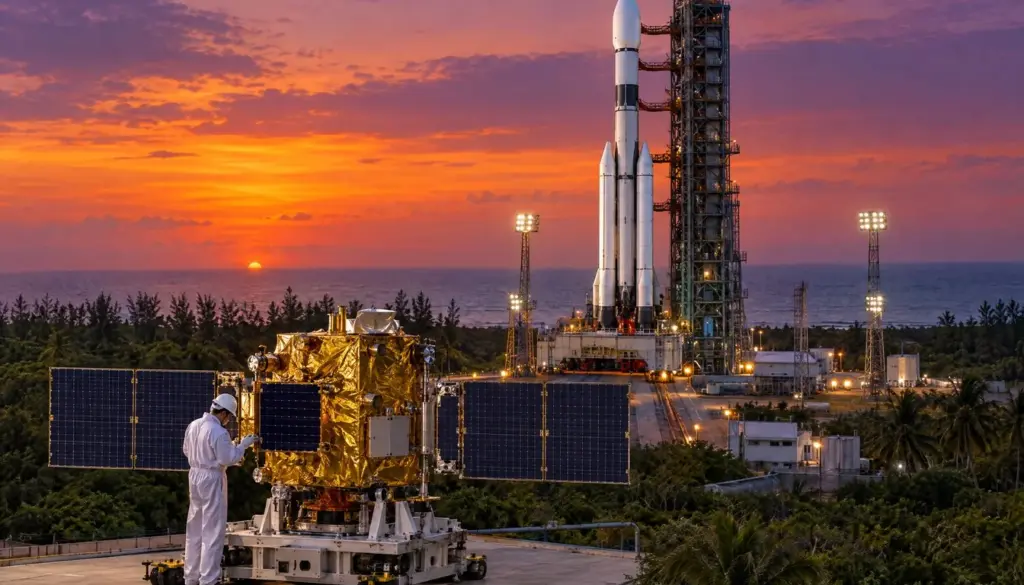
With just 3 days to go before the high-stakes launch, the Indian Space Research Organisation (ISRO) is making final preparations to lift off its advanced NVS-03 navigation satellite aboard the GSLV-F18 rocket from the Satish Dhawan Space Centre in Sriharikota. Scheduled for October 30, 2026, at 11:51 PM IST, this mission marks a critical milestone in India’s quest to solidify, revive, and modernize its regional satellite navigation network, NavIC (Navigation with Indian Constellation). As global positioning architecture becomes increasingly vital for national security, economic infrastructure, and daily consumer tech, the successful deployment of NVS-03 is set to address past constellation attrition, introduce cutting-edge technological payloads, and reinforce India’s technological self-reliance.
To understand why this upcoming event is so pivotal, one must look at what NavIC is and the challenges it has faced. NavIC is India’s indigenous regional alternative to major global systems like the United States’ GPS, Russia’s GLONASS, or Europe’s Galileo. Designed to provide precise positioning, navigation, and timing (PNT) services across the Indian mainland and an extended area of approximately 1,500 kilometers beyond its borders, NavIC plays a dual role. It underpins critical civilian sectors such as commercial transport, merchant shipping, mobile mapping, telecom network synchronization, and disaster management, while simultaneously serving strategic and military operations for the Indian armed forces. However, maintaining an active satellite constellation is a relentless task. Over recent years, some older-generation satellites in the network have begun approaching the end of their operational lifespans, leading to concerns about potential coverage gaps, signal degradation, and a temporary slump in constellation redundancy. The arrival of the NVS series—and specifically the launch on October 30—is designed to decisively bridge these gaps and upgrade the overall architecture to NavIC 2.0 standards.
Weighing roughly 2,232 kilograms, NVS-03 is a heavy, sophisticated spacecraft engineered for a planned mission life of 12 years. What makes this satellite a game-changer for India’s navigation ecosystem is its inclusion of next-generation payloads, most notably the indigenous Rubidium atomic clock. Precise timekeeping is the absolute heartbeat of any satellite navigation system; even a nanosecond of timing error can translate to meters of positional inaccuracy on the ground. By mastering and deploying homegrown atomic clocks, ISRO reduces its historical reliance on foreign components, securing vital strategic autonomy. Furthermore, NVS-03 broadcasts signals across multiple frequency bands, including the L1, L5, and S-bands. The incorporation of the civilian L1 band is particularly momentous. While previous iterations of NavIC operated primarily on specialized bands that required dedicated chipsets, the addition of the L1 band—the same frequency utilized globally by civilian GPS—drastically eases integration into everyday consumer electronics, smartphones, and commercial mass-market devices. This compatibility is expected to drive widespread civilian adoption across India, transitioning NavIC from a niche regional tool into a ubiquitous utility.
So, what will happen on October 30? At precisely 11:51 PM IST, the GSLV Mk II launch vehicle will roar to life, cutting through the night sky over Sriharikota to inject NVS-03 into its designated geosynchronous orbit. Following separation, mission control will not immediately declare full operational status; instead, a meticulous checkout phase will begin. ISRO scientists will monitor telemetry, command the deployment of the spacecraft’s solar panels, verify power generation subsystems, and rigorously test the complex navigation and ranging payloads. Once these orbital checkouts are successfully completed, NVS-03 will synchronize with the existing operational satellites in the NavIC constellation. This integration will instantly restore full NavIC capabilities, enhance signal resilience against interference, and provide unyielding, all-weather positioning accuracy.
Ultimately, can NVS-03 revive India’s GPS alternative? The answer is a resounding yes. By injecting fresh vigor, state-of-the-art timing hardware, and mass-market L1-band accessibility into the network, the October 30 launch moves NavIC past its historical setbacks. It ensures that India retains uninterrupted command over its geospatial data, secures its critical infrastructure from foreign dependency vulnerabilities, and paves the way for an indigenous navigation ecosystem capable of powering everything from next-gen autonomous vehicles to secure defense networks. As the countdown ticks down to zero, all eyes are on ISRO as it prepares to write a triumphant new chapter in India’s space history.


