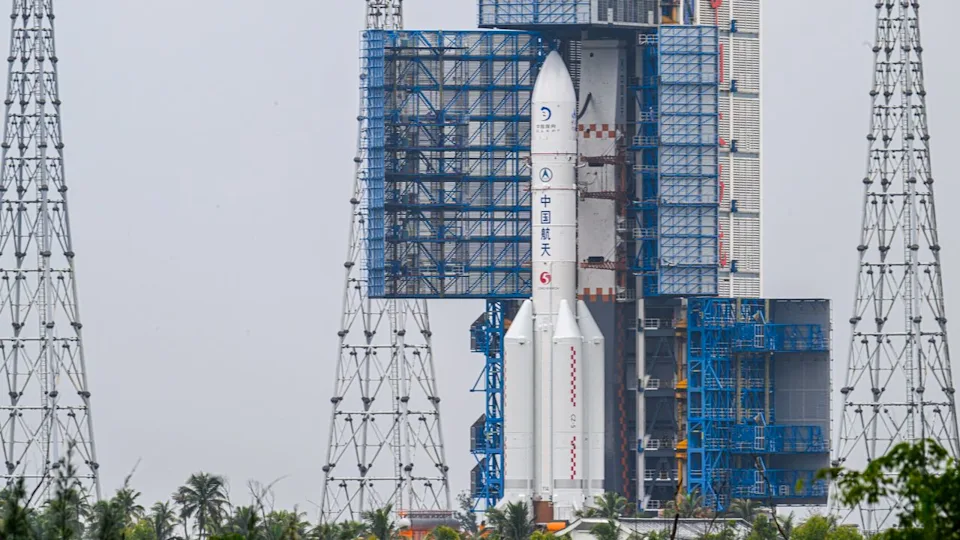
In a significant setback for China’s ambitious lunar exploration agenda, the much-anticipated launch of the Chang’e-7 mission has been indefinitely postponed due to adverse weather conditions. The China Manned Space Agency (CMSA) announced the delay on Sunday, August 23, 2026, stating that the mission could not proceed within its scheduled launch window for the year . The robotic lunar probe, which had been slated for liftoff from the Wenchang Space Launch Site on Hainan Island, was designed to embark on a historic quest to search for water ice at the moon’s south pole, a region considered prime real estate in the new era of space exploration .
The primary culprit for the delay is reported to be Tropical Depression Narra, which has been lingering in the Gulf of Tonkin, bringing inclement weather and high winds to the spaceport on Hainan Island . While Chinese officials initially pushed the launch back by a day in hopes of clearer skies, a comprehensive assessment ultimately led to the conclusion that the mission could not be launched safely during the current window . In a brief statement, the CMSA explained that the decision was made based on the principles of “prudence, reliability, and absolute mission success,” emphasizing the high stakes of the complex endeavor . This cautious approach comes less than two weeks after a rare failure involving a Long March 7A rocket, which launched from the same site and experienced an anomaly during flight . While the official explanation focuses on the weather, the postponement has generated considerable speculation about whether technical issues or the recent launch failure might have also played a role in the decision, though sources indicate the engine shared by the two rockets is an unlikely cause .
The Chang’e-7 mission represents a monumental step in China’s lunar program, which is named after a mythical Chinese goddess of the moon . It is poised to be the first mission in history to directly probe for and analyze water ice on the lunar surface . The spacecraft is an extraordinarily capable and ambitious suite of scientific instruments, comprising an orbiter, a lander, a rover, and a unique “hopper” probe designed to jump into permanently shadowed craters . The mission’s target is the lunar south pole, an area believed to contain vast stores of frozen water in craters that have not seen sunlight for billions of years . These “cold traps” are of immense strategic and scientific value; water can be converted into breathable air, drinking water, and even rocket fuel, making it a crucial resource for sustaining a permanent human presence on the moon and enabling deeper space exploration . As Yuqi Qian, a lunar geologist at the University of Hong Kong, noted, the Chang’e-7 mission signals China’s shift “from exploration to resource exploitation” .
The delay of Chang’e-7, which may now not launch until 2027, adds a dramatic twist to the intensifying space race between China and the United States . Both nations view the lunar south pole as a critical strategic foothold and are racing to build bases there . If the Chang’e-7 mission is pushed to 2027, it opens a window of opportunity for the U.S. to reach the lunar south pole first. American companies like Astrobotic Technologies, with its Griffin lander, and Jeff Bezos’s Blue Origin, which plans to send its Blue Moon Mark 1 lander carrying NASA probes, are on track to launch as early as late 2026 or 2027 . This competition underscores the high value placed on the south pole’s resources, making the eventual success and scientific return of Chang’e-7 a pivotal moment in the future of international lunar exploration and the quest to establish a permanent human presence beyond Earth . While the exact new launch date remains unclear, with some reports suggesting a potential opportunity in February or March of 2027, the delay has certainly heightened the stakes in the race for the moon’s most coveted territory .